
By Matthew Coller
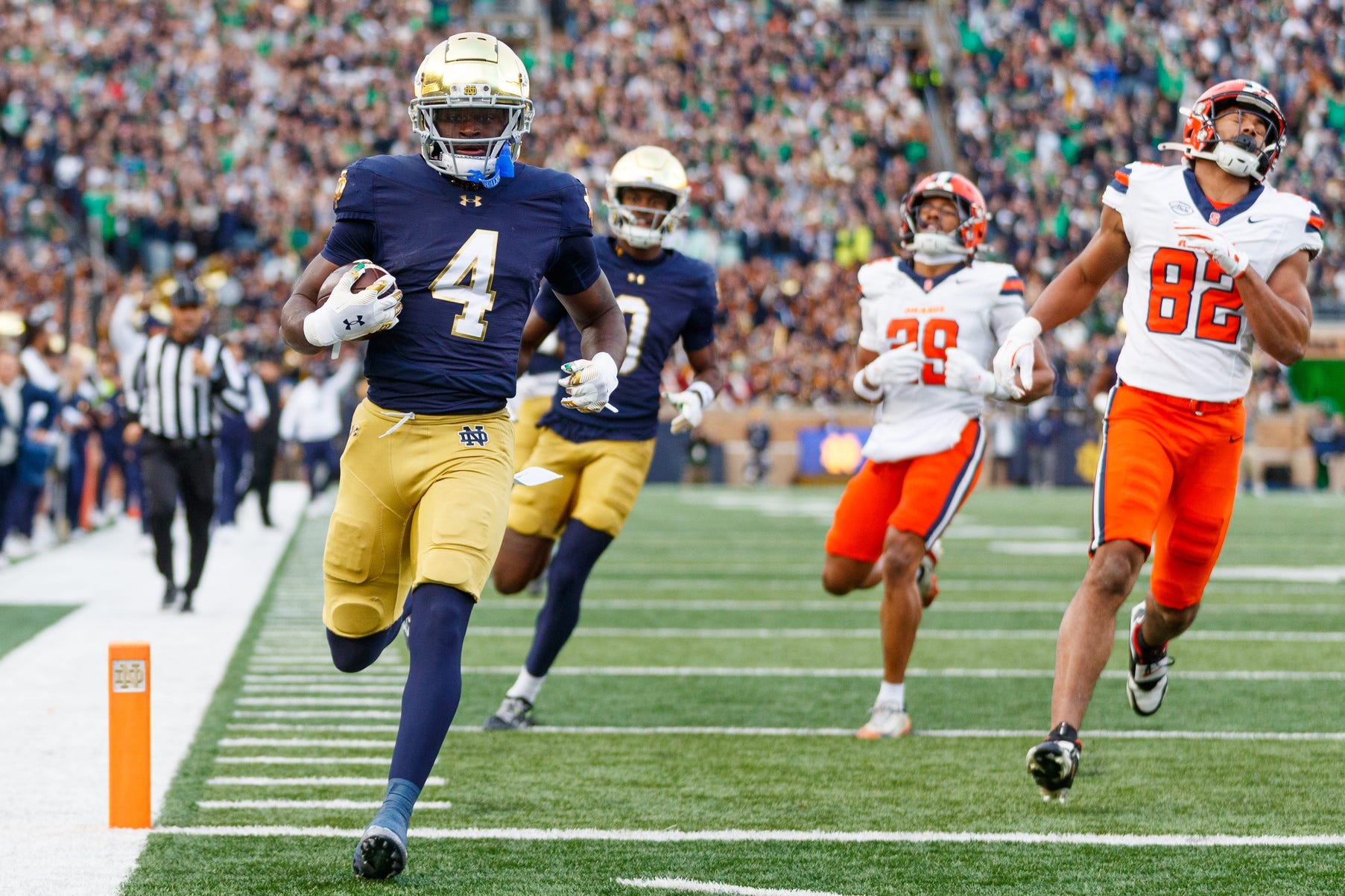
On Monday, NFL Network draft analyst Daniel Jeremiah tossed out the idea of the Minnesota Vikings trading up in the draft to select Notre Dame star running back Jeremiyah Love.
If they are not interested in something like that, it’s certainly not showing in free agency.
The Vikings were reportedly interested in Jaguars free agent running back Travis Etienne but he signed a four-year contract for $52 million with the New Orleans Saints.
That is at least some indication that they were willing to make a significant investment.
If not, the options are running thin. A bunch of players went off the board right away, including Kenneth Walker, Rico Dowdle, Tyler Allgeier, JK Dobbins and Kenneth Gainwell. Day 2 of free agency, the Detroit Lions landed Isiah Pacheco.
On The Athletic’s list of top 150 free agents, the only RBs remaining are Tampa Bay’s Rachaad White, Green Bay RB Emanuel Wilson, Arizona’s Michael Carter the veteran Kareem Hunt.
The other options include (maybe?) Joe Mixon, coming off a mystery injury in Houston last year. Nick Chubb, Brian Robinson Jr., Raheem Mostert, Najee Harris, Khalil Herbert are also among the available names.
Baltimore’s Keaton Mitchell, whose option was not exercised by the Ravens, might be intriguing as well as an explosive part-time player. Tampa Bay also did not exercise the option for Sean Tucker, who has 151 carries for 651 yards over the last three years.
If the Vikings just needed someone to fill out the RB room, then some of those players make sense. White and Robinson Jr. have been effective in the past.
There may be some circumstance where they bring back Aaron Jones at a better contract number.
But aren’t the Vikings looking for a gamechanger?
Last year they acquired Jordan Mason from the San Francisco 49ers and he was a solid runner, gaining 758 yards on159 attempts (4.6 YPC) and he ranked 12th best in terms of yards after contract. By PFF, he had the 12th best run grade and was 6th in Rushing Yards Over Expected per carry.
Those numbers are very strong but Mason also showed some limitations. He was not a threat in the passing game, and struggled mightily when he was asked to contribute as a pass protector. He scored the eight lowest PFF pass blocking grade out of 71 RBs and allowed the fifth most QB pressures despite only having 65 snaps as a blocker.
So it would appear the Vikings have a few options to fill out the room. They can 1) sign one of the role-playing veterans to use as a third-down back type and lean heavier on Mason 2) sign a player that might have more upside if given more opportunity 3) draft a RB in the middle rounds 4) make a wild move for Love.
Let’s start with the last one because it’s the most interesting.
For the longest time, the idea of drafting a running back in the first round was enough to make anyone who took Statistics 101 turn green. There was a run of unsuccessful first-round pick RBs that included Leonard Fournette and Trent Richardson that were used as cautionary tales for anyone daring to swing at a highly-touted back.
That combined with the fact that running backs have the earliest steep decline of any position on the field — around age 28 — and second contracts rarely pay dividends even for the successful draft picks. Not to mention that plenty of second-rounders like Dalvin Cook and Jonathan Taylor became superstars, making it appear favorable to grab “premium” positions in the first round and RBs later.
Lately the trend isn’t looking as definitive. Not only did Bijan Robinson and Jahmyr Gibbs turn into instant superstars but the second contracts for first-rounders Saquon Barkley. Christian McCaffrey and Josh Jacobs worked out nicely (even if they were for other teams).
Are the tides changing?
Possibly. There has been a trend in recent years of teams moving toward playing defenses with two safeties deep, which opens the door for running backs to have advantageous box counts and forces passing games underneath more often. The 2025 season had the second highest yards per carry in NFL history (per PFR) and passing yards per game was at its lowest mark since 2006.
Interestingly, teams have become wildly more efficient at running the ball. Last year there were 21 teams on the positive side of EPA running the ball, whereas 10 years ago (2016) there were only five. Coaches have gotten better at understanding when to run.
That doesn’t exactly prove that the new model for success in the NFL is running the ball is the new model for success. The New England Patriots and Los Angeles Rams ranked No. 1 and 2 in Passing Expected Points Added and the Seattle Seahawks were 9th. Four of the top six teams in Rushing EPA missed the playoffs.
Receiving is also an element of making a top pick worth it though. Bijan Robinson caught 79 passes for 820 yards, Gibbs had 77 receptions and McCaffrey grabbed 102 passes out of the backfield.
Jeremiyah Love only caught 27 passes at Notre Dame but averaged 10.4 yards per catch and looked very comfortable running routes and catching passes during his NFL Combine workout. He has the potential with his coordination to be an all-around player, even if it might not quite be at the level of McCaffrey.
In a draft that isn’t supposed to be deep with premium-position talent, there is even more of a solid case for a player who has averaged 6.9 yards per attempt in each of the last two seasons. Per Grinding The Mocks, Love’s average expected draft position is 6th overall.
So as much as the Vikings might have a case for adding a monster talent to an offense that already has Justin Jefferson and Jordan Addison, the odds that a player mocked in the top six picks ends up at No. 18 are not high. It’s not impossible, but not likely.
Daniel Jeremiah’s idea of the Vikings trading up for Love doesn’t exactly fit with an offseason plan that has seen the franchise hesitate to spend in free agency. They have talked about “guardrails” and not selling out for 2026. It stands to reason that they would want to stockpile draft capital rather than going all in for one player, even if he is special.
This is where we have to stop and point out that the Vikings have indeed struggled to run consistently, causing Kevin O’Connell to have a reputation for avoiding the run game. But we have to at least consider that a major contributor to the lack of trust in the ground attack is the actual success that they’ve had when doing it and the RBs that have been in the backfield. Dalvin Cook faded down the stretch in 2022. Alexander Mattison struggled in an RB1 role. Aaron Jones was good in 2024 until Christian Darrisaw went out for the season and there was improvement in 2025 but Jones was hurt for a big portion of the season.
They have only drafted two RBs since KOC got to Minnesota in Ty Chandler (5th round) and DeWayne McBride (7th round).
Presumably there would be a different level of focus on the ground if the investment was as heavy as trading up for a first-round star. That might be evidenced by the hiring of Frank Smith, former offensive coordinator of the Miami Dolphins. They were a highly efficient rushing attack during his time under Mike McDaniel.
Love with a rebuilt Vikings OL, Smith’s acumen and opponents fearing Justin Jefferson seems like a combination set up for success.
The cost to move up, however, would be pretty steep.
If we use the traditional Jimmy Johnson draft value chart, moving up from No. 18 into the top 10 in a trade with Kansas City, for example, would cost the Vikings the equal of their second-round pick and another fourth-rounder.
With an extra third-round compensation pick due to Sam Darnold leaving in free agency last year, that type of deal might be worth it. But moving up into the top five would require them likely having to dip into 2027’s draft capital, which would be an excessive price to pay.
Getting Love to the No. 9 pick means him getting past a team with a track record of taking RBs high in Tennessee and the RB-needy Washington Commanders. If that happens, there might be a decent argument for it, even with other needs on the field like cornerback, defensive tackle, center, and receiver.
It is still a tough sell when we look down the road at the Vikings’ future roster. With a lot of veterans on the club, many of them with expensive contracts, a reset of the 53 may be on the way in 2027 similar to what we saw from 2022 to 2023. Not exactly the ideal time to ship a second-round pick out.
One thing making it more intriguing as a concept is the lack of high-end talent throughout the rest of the draft at running back. Per Mock Draft Database, the next highest running back behind Love ranks 49th on the consensus big board. After that, 73rd, 88th, 95th and 97th are the only other top-100 prospects in the backfield.
That doesn’t leave a lot of options and there are plenty of other teams who might be interested in drafting players in the backfield. The best options within that group are Notre Dame’s all-around back Jadarian Price and speedster Mike Washington Jr.
Otherwise, they went to the trade market last year to get Mason. Maybe there’s an option there. Or they are just going to have to cobble together a committee of a low-price veteran, a draft pick or several UDFA competitors in training camp any maybe even try to bring back Ty Chandler.
If the Vikings can’t pull off something stunning to move up and take Love, then they may need Mason to rise to the challenge and Zavier Scott to take on a third-down back type of role as well.
The backfield’s success may also have to depend most on scheme and blocking with an offensive line that has a lot of talent when it is healthy.
Free agency Day 2 notes
— Geno Smith was surprisingly traded to the New York Jets for a late-round pick swap, taking him off the board for the Vikings. It stands to reason that the Jets made the move to ensure that Smith did not end up in Minnesota or Pittsburgh.
— The Vikings re-signed All-Pro Andrew DePaola.
— The Ravens decided not to trade for Maxx Crosby with the Raiders due to an issue with his physical. If he isn’t traded somewhere else, it could increase the demand for Jonathan Greenard.
— Trey Hendrickson could also be holding up possible Greenard deals as his price is reportedly too high for teams at the moment.
— The Browns grabbed Elgton Jenkins and the Panthers signed Luke Fortner, leaving the center market very, very thin.
— Teddy Bridgewater signed with the Detroit Lions as their backup QB.
I’ve come around on Love a bit after watching more of him, but I would be out on trading up to get him. Cost is too high, and they have too many needs and too many older players to be giving up a ton of draft capital on him. I am still a little skeptical of his frame and his upright running style as well. Doesn’t matter when you’re blowing by guys, obviously, but I think it could keep him from being the Bijan/Saquon/Gibbs level guy you’d need him to be to justify the high pick. I’d be fine with him at 18, but frankly even then they should trade down at that point if somebody is offering a haul for him.
Saw a rumor today that Vikings could get Kamara for a late pick. Haven’t watched many Saints games, does he have much left?