
By Matthew Coller
The most commonly asked questions about the Minnesota Vikings as they head into training camp are: 1) Is the quarterback competition real? 2) Does JJ McCarthy have a chance to win it?
The most obvious answer to both of those questions is: We’re going to find out.
Head coach Kevin O’Connell A.K.A. QB Competition Coordinator has said that the competition is very real and that the team has a date in mind for when they will name a quarterback. He called it a “feel thing” and described scenarios where the QBs are dialed into the offense to the point where he can call anything into their headsets regardless of whether it was on the practice sheet for that day or not.
Vikings offensive coordinator Wes Phillips described McCarthy as “arrow up” and said that he has improved in the areas that the team asked him to make progress during the offseason.
For all intents and purposes, fans and media alike are entering Vikings training camp preparing for a full-on, no-holds-barred cage match of a QB competition that could go in any direction.
After all, if there’s anything in this world that we can count on being unpredictable, it’s the Vikings quarterback position.
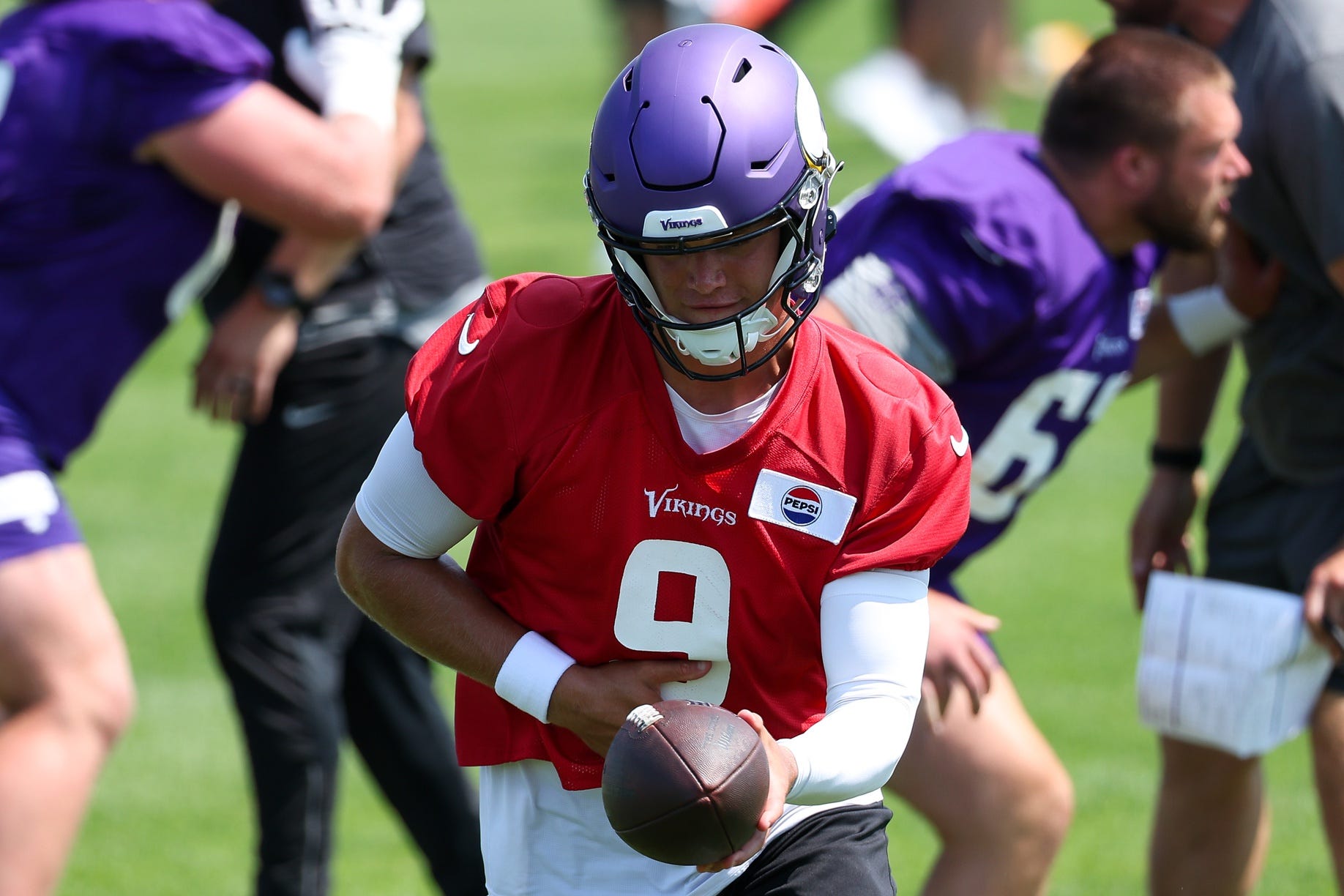
Sitting around waiting for the competition to begin, I started wondering: What are Kyler Murray and JJ McCarthy going to be going through during this competition?
Neither of these guys have ever been in a position like this before. McCarthy’s first season he was the clear No. 2 behind Sam Darnold and then he was the uncontested starter during camp in 2025.
Murray has known his fair number of scrapes and bruises as a professional but there’s never been a doubt about him being QB1.
If Murray wins, he will have a chance to prove to the world that he was always a top NFL starter and that Arizona’s ineptitude was to blame for his disappointments. If McCarthy wins, he will have proven to the coaching staff that he’s the franchise QB that they drafted 10th overall and let Sam Darnold walk to anoint.
What will each QB be dealing with mentally and emotionally? What’s the right way for O’Connell to run the QB competition?
To find out what a QB competition is really like, I went to two former Minnesota Viking quarterbacks who know all about it: Sage Rosenfels and Brad Johnson.
Sage Rosenfels is a believer in how people are forged. The 48-year-old former Dolphin, Texan, Viking and Giant loves talking about how Drew Brees went to Purdue and threw a million passes every Saturday and then had to prove himself in New Orleans after the Chargers walked away. He looks at Patrick Mahomes, who played for .500ish teams at Texas Tech that required him to play Superman to win.
He loves the idea of quarterbacks having to fight through the summer in a competition. What doesn’t kill you makes you stronger, so to speak.
Rosenfels remembers his first quarterback battle quite well. He was in 8th grade. His friend got to run the A-team and he was the quarterback for the B-team. Then his friend decided he didn’t want to play QB anymore and he became the de facto QB. He was a backup as a junior in high school until the starter got hurt and then he emerged as a serious talent as a senior.
In college at Iowa State, Rosenfels began as the fourth-string quarterback. He beat out the No. 3 QB, a good thrower from California who wasn’t much of an athlete, and got to run the scout team.
“I do think that forged me as far as mental toughness,” Rosenfels told Purple Insider over the phone.
When Rosenfels arrived at his junior year, he was still part of a QB competition. This time with a QB named Derrick Walker, who had size and athleticism. They competed all through camp and into the beginning of the season. Finally Rosenfels had a game where he brought the team back from behind to win and he was named the starter. Walker moved to linebacker.
“It really did help me persevere, but also gain the respect of my teammates,” Rosenfels said. “The guys that were with me in my freshman year saw me battle on the scout team and saw me battling in the offseasons, saw me like being a good team player and then win that job. I think that’s a huge thing. The element of teammates really like, connecting with the quarterback.”
When he was drafted into the NFL by Washington, Rosenfels was mainly a developmental QB and the same went for his early years (2002-2004) with the Dolphins when they acquired him. But in 2005, Nick Saban took over as the Dolphins’ head coach with former Vikings OC Scott Linehan at his side and Jason Garrett as the quarterback’s coach. Rosenfels and AJ Feeley were set to compete for the QB2 slot behind Gus Frerotte.
As the competition played out during camp, Rosenfels thought that he was beating out Feeley but he wasn’t getting the same number of reps. He wondered why he wasn’t getting snaps with the second team despite commanding the offense better. Garrett gave him a speech that put things into perspective.
“[Jason Garrett] said, ‘at the end of the summer, we’re going to go through his offensive staff and the head coach, a reel that says Gus Frerotte, a reel that says A.J. Feeley, and a reel that says Sage Rosenfels. And whatever’s on that reel is what we’re going to judge. It’s what we see on the reel.’ It made me really realize, basically you are responsible for what you put on your reel. You’re always told that your play is your resume.”
The way things worked on a daily basis is: They would have meetings each day where they would watch film and then the coaching staff would come up with an agenda for which QB was going to take which reps. The QB coach would explain to them how things were going to unfold in practice and they would give them the plays that were going to be run.
“You’re sitting in your locker before practice and you’re like, ‘damn it, he’s got that play?’ Or s—, all I have is a couple of runs in here. I’m not really getting a chance to compete.’ The coaches try to balance out who gets how many throws over time. If someone’s just naturally getting a lot more throws, they might say ‘hey you had the two minute yesterday, we’re gonna get the other guy a little bit more work today.’”
Rosenfels appreciated the professionalism of the way his first QB battle in the pros was handled. He especially felt that Garrett had been fair.
“I think the way he treated us was truly as men,” Rosenfels said. “Men are dealing with way more than just this job. Right? We have families. We have kids. This is our livelihood. This is our dream. And the last thing he was going to do was make that into an experience that wasn’t fair to us.”
One of the dynamics that presented itself already within the Vikings’ current QB situation is the matter of how the players are interacting with each other. McCarthy made headlines by suggesting that he and Murray were sitting on opposite sides of the room like they were in school and said it was the coaches’ jobs to teach them the offense.
O’Connell responded to that by saying that his players “need to attempt to be a great teammate” in the throes of a competition.
Rosenfels never saw any benefit from straining a relationship because of a QB battle. He remains friends to this day with Feeley and Walker.
“I’m not wired that way to look at someone I compete with as an enemy,” he said.
No matter how friendly the atmosphere and how professional the coaching, Rosenfels had to fight a battle against himself mentally. There was so much riding on every practice that it might as well have been a game every single day.
“I had to give myself a little talk of, like, ‘let’s f—ing go, this is really f—ing important, let’s do this,’ and then bring that energy, like, game-like energy into practice,” Rosenfels said. “A lot of guys don’t have to bring that energy every day to practice. Favre went to practice and it seemed like he was thoroughly enjoying himself. He was so f—ing good that it’s like he makes hard things look easy.”
In the end, Rosenfels won the QB2 job and they traded Feeley.
After getting the job, Rosenfels was summoned to Nick Saban’s office. Apparently years ago, Jimmy Johnson had installed a garage door on the office that Saban enjoyed using himself as well. So Rosenfels walked in and Saban pushed a button and the door closed behind him.
The head coach wanted to make it clear to Rosenfels that winning the QB2 job came along with a very clear assignment. Saban told him:
“Gus is the number one quarterback and your job is to support Gus in any way possible, to be positive, to always be there, try to help him, help the receivers,” Rosenfels recalls Saban telling him. “That’s your role. And I don’t want to hear anything from you or your agent or anybody associated with you that if we lose a couple of games in a row or Gus plays bad, that Sage should be playing. I don’t want to hear it. You hear me?”
Saban added something that Rosenfels took with him forever. He said that the head coach drives the bus and decides where everyone sits on the bus and that everyone on the bus should be happy that they are there.
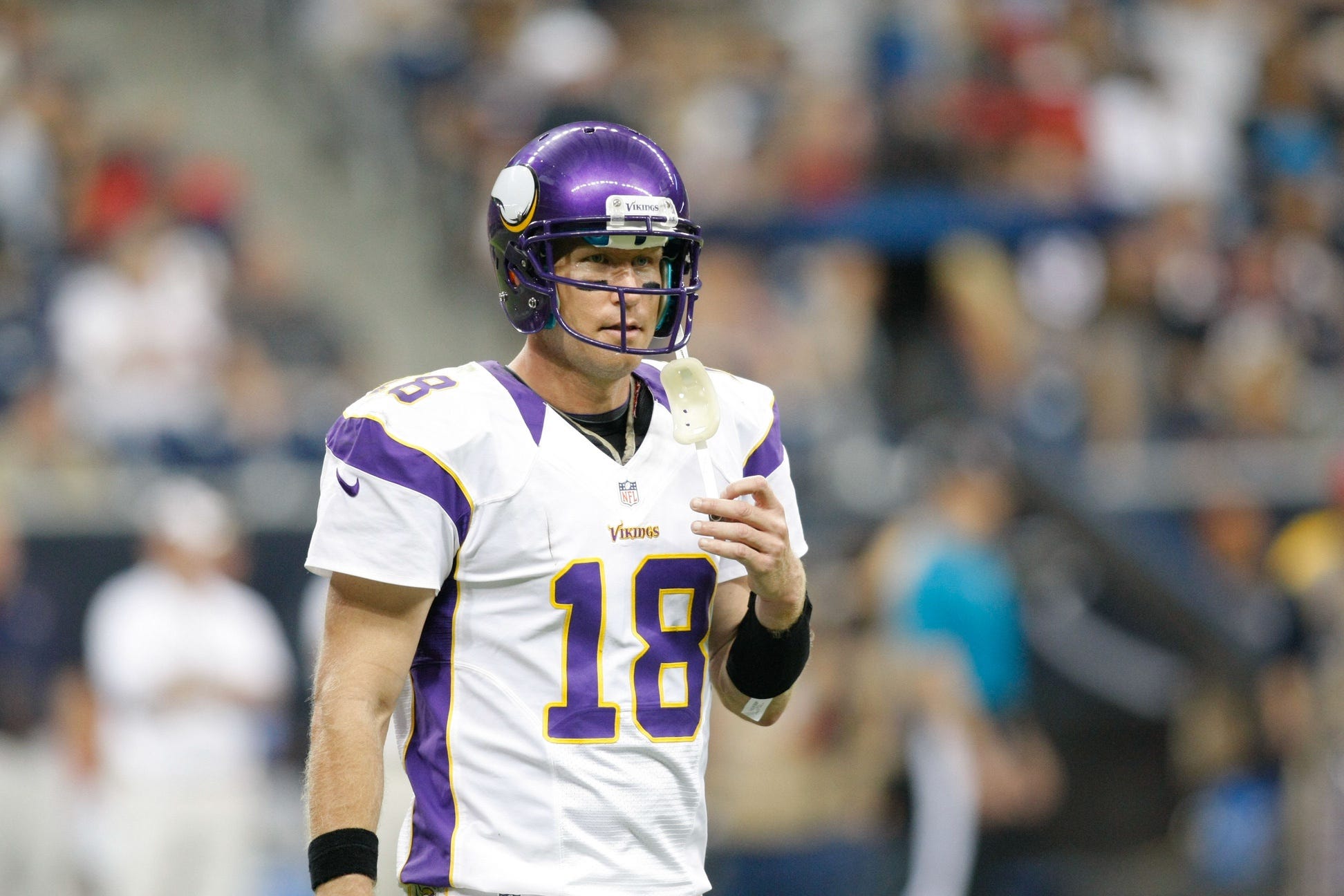
Rosenfels had to keep that in mind when he arrived at another quarterback competition in Minnesota. After a successful tenure as a backup in Houston that included a 4-1 stretch in 2007, he expected to get the same fair shake that he had in Miami when battling Tarvaris Jackson in the spring and summer of 2009.
Instead he felt that Brad Childress, who drafted Jackson, had already decided the QB competition before it even started.
“That was hard because right away I could tell that Childress didn’t like me,” Rosenfels said. “Right away. I’d never experienced that in my life. To show up to a team and have the head coach, or really any coach, not like me. And that was really hard to deal with. It felt like I’d make a lot of plays, and they just didn’t really care because it was like OTAs. I’m sitting there going, like, I feel like I’m getting an edge here. And everything was sort of slanted in Tarvaris’ favor.”
While Rosenfels and Jackson got along well together amidst their competition, the uphill battle wasn’t just with Childress. Jackson was known as a good teammate and was well liked within the other players who had been there for years. Being the new guy added another layer of discomfort.
When he did make plays in practice, not getting the head coach’s support didn’t help him win everyone over.
“I would go and make a play on that and I’d get, ‘uh, well now if they do this, you gotta make sure you do this,’ rather than, ‘hey, that was a really great throw,’ Rosenfels said. “It was always minimizing. When Favre showed up, I couldn’t wait to get out of there.”
Rosenfels spent the entire season as QB3 behind Jackson.
What we’re all wondering is which one of the quarterback battles that Rosenfels was involved with will closer reflect the Vikings’ competition between Murray and McCarthy.
Is the coaching staff going to look at both players’ tape in camp and decide which one performed better than the other or is McCarthy going to feel like the battle was decided before the first pass was thrown?
Logically speaking, O’Connell and the coaching staff must factor in prior performances. Murray has been a Pro Bowler and McCarthy struggled in every area last season. At the same time, McCarthy is the QB that they bet their reputations on last year when moving on from Darnold and it would be favorable long term to see him succeed.
Does McCarthy’s comments from OTAs suggest that he doesn’t think he’s going to get a fair shake? It’s hard to know.
Brad Johnson got his break in the NFL by winning a quarterback competition with Andre Ware and Geno Torretta. Well before that, he gave himself a chance to play in the NFL by beating out Casey Weldon at Florida State.
“We played golf together, tennis together, we hung out together, I mean, we were best friends,” Johnson said of Weldon. “And then it got real.”
While Johnson and Weldon are still friends to this day, the competition strained their relationship. They stopped hanging out and Johnson couldn’t help but pay close attention to what his friend was doing on every rep.
“We still made it work, but we didn’t hang out as much and the more I fought against him, the better he did,” Johnson said. “You’ve really got to get caught up in it. ‘OK, he went 8-for-10 today, I went 7-for-10 but he had a screen pass that went for a touchdown and it looks like he threw a touchdown pass.’”
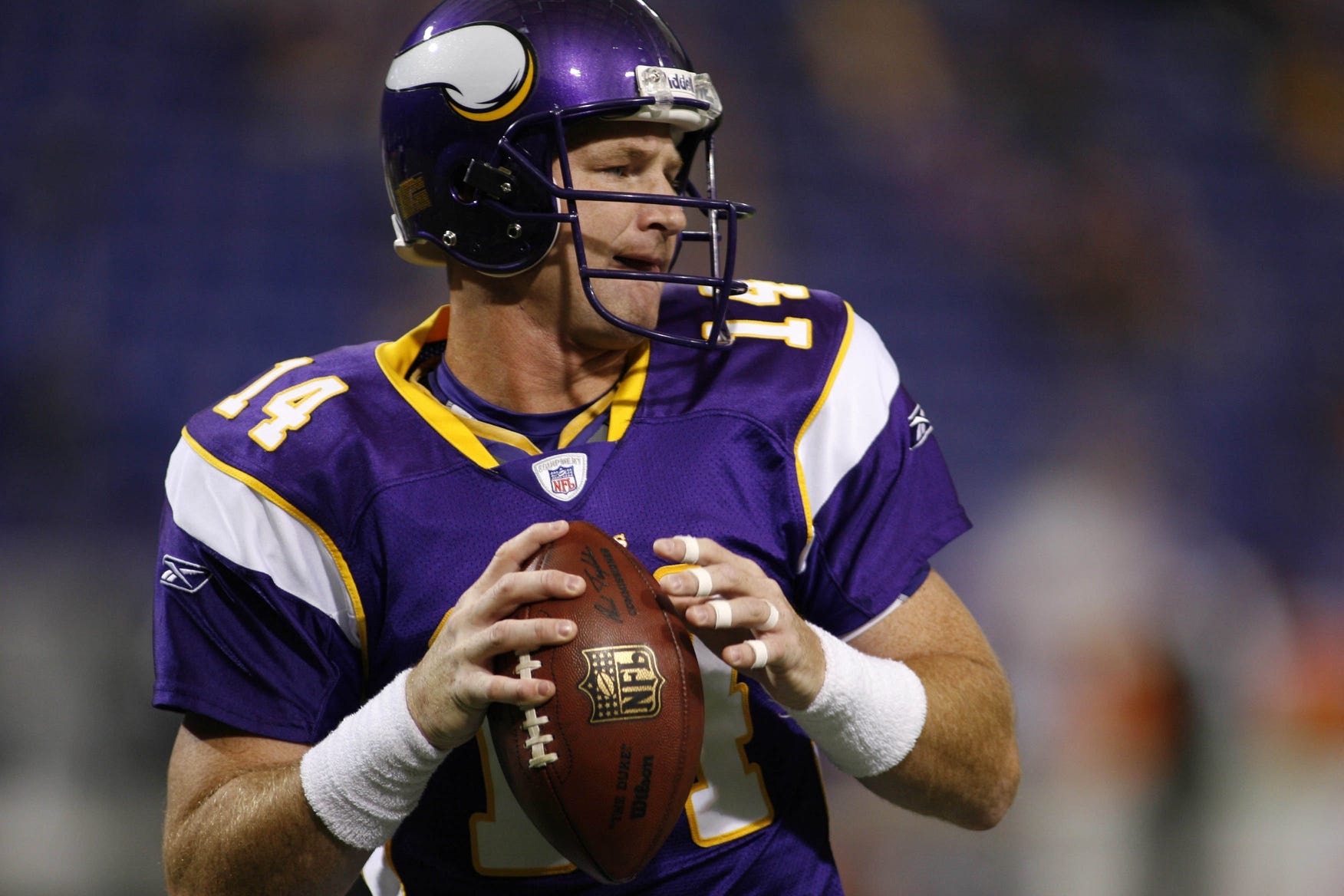
There were so many layers to the mental part of the competition for Johnson. He would be asking himself, was the QB coach talking to him or the other QB in the meeting room? Is he talking to the other guy more? When explaining a play, why did he say, “the quarterback” rather than saying “Brad?” Why is that guy getting the red zone drill?
“It’s a mental game for everybody in the freaking building,” Johnson said. “It’s like, it’s middle school, high school stuff. Who did you talk to? Who did you talk to more?”
Obsessing over every detail happens in part because there are only so many reps to go around. Back in Johnson’s day, there were two-a-day practices and it was still hard for a quarterback to feel like he had enough work to prove himself when splitting with someone else. These days, it’s much more difficult with the lack of full-effort workouts in camp.
Johnson heard Murray’s comments about splitting reps for the first time being the hardest part of the competition and he could relate.
“He didn’t say anything wrong,” Johnson said. “The more reps you get, the more comfortable you get, the longer leash you get. But now everything gets more scrutinized, you’re not as comfortable, and then you hope to have the right play versus the defense.”
Johnson described how circumstances can play into a battle. If the defense has the right call, the quarterback can look bad. If a receiver makes an incredible catch to keep a situational drill going, the QB gets more reps than he would have had if the receiver dropped the ball.
“Eventually you hope the coaches can see through all that, who the best player is,” Johnson said.
When he was competing with Ware and Torretta, Johnson was the developmental ninth-round draft pick but he credits Denny Green with seeing who the best player was. Johnson had initially been told that they didn’t think he was going to make the team over the other two. So he took the approach of trying to find an edge to prove his worth.
“You’re like, OK, how am I going to outperform them?” Johnson said. “I need a better pass completion percentage. Something has to stand out about me compared to them in the reps that we’re going to get.”
I asked Johnson why he thinks he won that competition.
“I had a better completion percentage,” he said.
When there is a fight for a backup position, it’s different than battling it out with two other guys for QB2. The battle for QB1 holds everyone on the team hostage until they can figure out who’s The Guy.
“We’re not moving on as a team [until the QB1 is named]. We’re just running plays,” Johnson said.
I asked Johnson what advice he would give O’Connell about handling the competition. He thinks the HC should keep in mind that a competition isn’t just impacting two players.
“It’s a big deal how you address it to your team,” Johnson said. “Because every player goes home to their wives and, well, ‘how’d it go today?’ ‘Well, I don’t know.’ ‘I don’t know. I don’t know who the quarterback is.’ You know what I mean? I can’t get in flow with whoever. It’s really difficult. It’s a strain, to be honest with you. It’s a strain on everybody. But you’ve got to get it right whoever it is.”
One of the goals of the competition in Minnesota, it appears, is to get the most out of each player. Murray needing to push as hard as possible to master the offense and garner O’Connell’s favor and McCarthy needing to focus on all the technical aspects of throwing and show that he can master touch.
In terms of Johnson’s thoughts about how the two quarterbacks should handle the new terrain that they are trekking this summer, he said:
“Be professional in the locker room, be a pro in the meeting room, be prepared and then when your rep comes, be great,” Johnson said. “Get your snap count right. Get your huddle right. Make the right read. Make the right throw. And then let’s move to the next play. Don’t compound it. They want to know where that ball is going to go. And if something bad happens, what are you going to do with it? What’s going to happen when the guy misses his block? Are you taking a sack? Are you throwing it away? How you handle the huddle, just be as good as you can be. It’s out of your hands.”
“And when they do name the starter, back up, be ready to play.”
When I asked Johnson if he thought that his QB competition early in his career helped him grow as a player, he didn’t buy into that idea. In his eyes, no coach or circumstances should have to pull a competitive drive out of a QB.
“No, I don’t think so,” he said. “I do know this. You gotta fight every day you’re in there to prove your worth. Number one, you gotta fight to prove your worth and you gotta be ready when your opportunity comes. That may be as a backup and that may be as a starter. You don’t know when your opportunity is gonna be there. If you do get ahold of it, you better hold on tight and run with it.”
Only time will tell which of the Vikings’ quarterbacks will hold onto the job tight and run with it.
This article was fantastic! Thoroughly enjoyed hearing their perspective. I remember the Sage/T-Jack "competition" well. I was studying for my CPA exam that summer. Then Favre flew in and I think I was glued to the live coverage for 3 hours that morning. It did feel like Sage was getting the shaft even pre-Favre.
Just went down a rabbit hole figuring out what Brad Johnson is doing these days.