
By Matthew Coller
EAGAN — If I told you that the Minnesota Vikings had a unit that ranked No. 1 in the NFL and that their coordinator should get attention for head coaching positions in the next hiring cycle, you would assume that I’m talking about defensive coordinator Brian Flores.
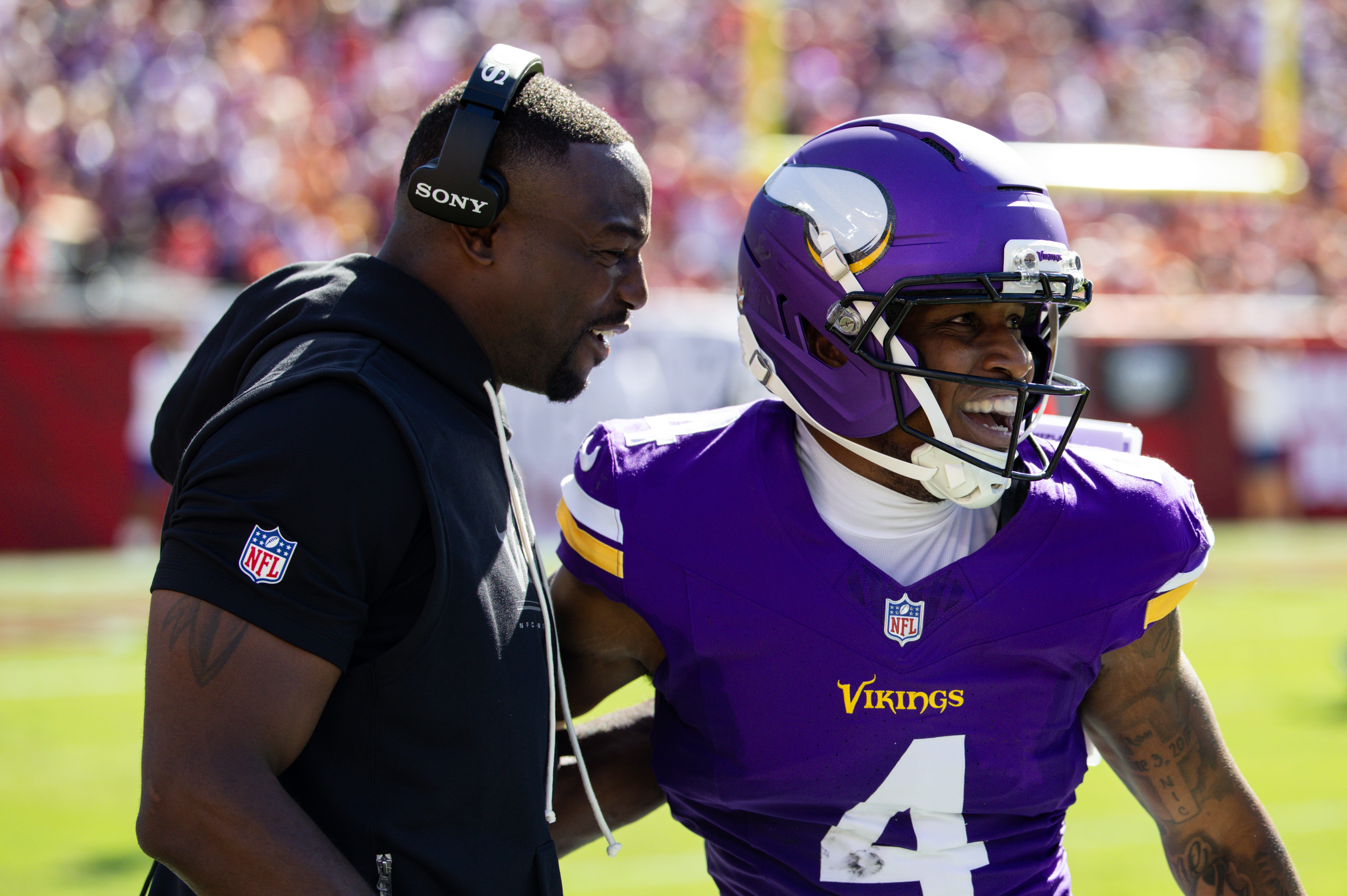
While Flores is certainly deserving based on the Vikings’ remarkable defensive success, that sentence also applies to special teams coordinator Matt Daniels.
The Vikings rank No. 1 in Expected Points Added via special teams. They are No. 1 in punt return average, second in kick return average, third in field goals made, third in 50+ yard field goals, seventh in punts inside the 20, seventh in punt return average against and second in kickoff EPA.
Fantasy Points Data’s EPA estimates the top-ranked special teams has been worth 33.3 points for the Vikings this season.


“I think it’s been a huge year for us from a return game standpoint and our coverage units,” head coach Kevin O’Connell said. “Winning the field position battles become a very, very critical thing that we talk about a lot and how we go about doing it against some of the challenges that you face in that phase.”
We can connect Daniels’ coaching directly to the success on the field, whether it’s in terms of drafting/developing kicker Will Reichard, picking UDFA rookie punter Brett Thorson after a camp competition, identifying/developing top returner Myles Price or pouring into numerous young players who have very little or zero previous special teams experience.
Last week against San Francisco, 17 players who participated in special teams were either in their rookie year or second season.
“I think it’s been a lot of young players stepping into roles and really thriving in those roles,” O’Connell said.
Vikings All-Pro long snapper Andrew DePaola told Purple Insider on Friday that the team puts together a video showing rookies and new players’ tape from OTAs and minicamp in comparison to the middle of the season to show how much they have grown throughout the year.
“It’s supposed to be funny but it’s also very eye opening,” DePaola said. “The raw material you get on Day 1 of the offseason program versus like week 16, just the stuff they did early on to how they’ve developed throughout the year. It’s extremely eye-opening about development.”
One of the best examples is rookie linebacker Jake Golday, who ranks as Pro Football Focus’s fourth highest graded special teamer in the NFL this year. He knew very little about special teams when he arrived.
“When I first got here, I was just kind of a raw athlete out there, just kind of just trying to run down there and make plays,” Golday said. “But once [Daniels] got behind me and coached me up on the scheme of things and techniques, I feel like the level that I’m playing, especially going against vets…that wouldn’t be possible if I wasn’t going to meetings with Coach [Daniels] and spending time with him.”
The job of the special teams coordinator has never been tougher with the fact that they have to teach rookies the kick return play on the fly. This summer, Daniels sat down with Purple Insider to explain the development system that he has built for players to quickly adapt to the new kickoff and assignments on special teams that they’ve never had before in college. He said that nothing was more rewarding than seeing players get it.
“That’s why you do it,” Daniels said. “That’s the beauty of it. That’s why they call you ‘coach.’”
It isn’t just player development that Daniels has mastered, it’s also relationship building.
“[Daniels has] touch points with so many of the players on your team, offense and defense, so relationship building, player development, and getting the most out of a player that we might be thinking long-term about an offensive or a defensive position,” O’Connell said. “Watching those guys get maximized in that phase is critical, and I think Matt’s done a phenomenal job at it. He’s got great leadership qualities, and he’s a guy that I love going to those meetings because of the way he commands the room, and you can feel a level of player ownership that really fits with. what I came here trying to really build within this organization, and he’s been phenomenal.”
O’Connell also pointed to his work with Daniels in terms of putting together the gameday roster because teams can only dress 48 of the 53 players.
“[Special teams coordinators] are heavily involved in game management, they’re heavily involved in all three phases, they’re heavily involved in the roster management of what that looks like week in and week out,” O’Connell said. “I think the guys like Matt Daniels who can be flexible and understand what we’re going to need for that given weekend, whether it’s offense or defense, whether we’re going an extra D-lineman, an extra DB, what the edge situation looks like…You’ve got to have a big-picture feel to that.”
O’Connell added…
“I think sometimes those guys don’t get enough credit for just how they can respond, react, and then prepare that group week in and week out.”
You would think that elite production along with player development, game management and leadership would put someone in the limelight for head coaching attention, particularly as a former NFL player who has a unique ability to connect with his players.
Not to mention that Daniels went to Duke and has climbed the ladder from an assistant coach under Sean McVay in Los Angeles to working under legendary special teams coach John Fassel to building a top unit in Minnesota that has included all sorts of development projects who have gone on to offensive and defensive success.
“I think [special teams coaches] should get looked at more,” DePaola said. “I can’t tell you why they don’t [get opportunities] but talk about having hands in the entire roster. Having to develop players who have never played special teams before. I would feel like that would be something that teams really want for a coach, or somebody who has this ability to kind of see players longer term, bigger view pictures.”
So why don’t special teams aces like Daniels get more opportunities?
A few theories.
First, because the numbers aren’t as obvious on special teams as points for or points against offensively/defensively, it’s harder for special teams coordinators to get recognized.
You rarely see broadcasts talk about special teams unless something goes extremely right or extremely wrong. They don’t often isolate the ST coach on TV when there’s very strong punt coverage by an undrafted free agent. But they show the offensive and defensive coordinators constantly.
Who’s the next QB whisperer or defensive mastermind? Can they get a cheat code on one side of the ball by hiring a particular guy?
While that’s a fair way to go about it, it ignores possibly the most important element of coaching, which is an ability to manage hundreds of people in an NFL building, from the 53rd man on the roster to the trainers to the starting quarterback.
Detroit Lions head coach Dan Campbell was an offensive assistant in his background but he is an example of a head coach who plays the role of his team’s leader while his OC and DC call the plays. Carolina’s Dave Canales moved to that role and gave up play calling this season and saw his QB’s performance improve. Everyone doesn’t have to be Kyle Shanahan or Sean McVay.
But owners are also usually looking for splashy hires. Nobody who hires a special teams coordinator is winning the internet on that day. Of course, NFL history certainly shows us that hiring the flashy offensive or defensive coordinator doesn’t always work.
There is, however, a history of great coaches who had special teams in their background.
Tom Landry hired a former tight end named Mike Ditka as a special teams coach on his staff in 1973. Also Buffalo Bills legendary coach Marv Levy was in charge of ‘teams in the 70s with L.A. and Washington. Bill Belichick coached special teams with the Lions, Broncos and Giants before becoming Bill Parcells’ defensive coordinator. John Harbaugh was Philadelphia’s special teams coordinator from 1998 to 2007 before landing the HC job with the Baltimore Ravens.
But recently we haven’t seen the NFL consider many special teams coaches. The last hire from ‘teams was Joe Judge, who was plucked from the Patriots’ special teams to lead the New York Giants in 2020. Also Raiders ST coach Rich Bisaccia took them to the playoffs in 2021 after Jon Gruden was fired four weeks into the season.
The Vikings were also coached recently in one game by a special teams coordinator when Mike Priefer filled in against the Dallas Cowboys in 2016 after Mike Zimmer injured his eye and wasn’t able to be on the sidelines.
That’s about it, though. We rarely see special teams coaches even get interviewed. Last year there was only one instances of an ST coordinator getting a chance and that was Baltimore interviewing Denver’s Darren Rizzi, who also carries an assistant coach title.
So we might not see Daniels given deserved attention no matter how good his special teams unit performs this season.
But if you ask around the Vikings’ locker room, there are a lot of folks who believe that Daniels could shine if he were ever given the chance to get in front of NFL decision makers.
“Personally, I think he’d be great at it,” DePaola said.