
By Matthew Coller
EAGAN — Imagine being the best football player your town has ever seen. You get recruited, go to a Division-I school, put together an impressive NCAA career and then get signed by the Minnesota Vikings as an undrafted free agent.
And then when you arrive to start your career as a professional, they tell you that you have to play a completely different role than you have ever done before.
Oh, you’re a receiver? Not anymore. Oh, you’re a linebacker? Not now. You thought that all those sacks you got as an edge rusher were going to set you up to become the next Danielle Hunter? First you have to excel at a job that you have no experience doing.
Welcome to Matt Daniels’ special teams boot camp, kid.
The special teams coordinator has a job unlike any other within the franchise. While the position coaches are tasked with refining the skills of players who have played in that spot for their whole lives, Daniels’ gig is to onboard dozens of rookie players, 90% of whom have either never played special teams or haven’t done it since they were a freshman in college.
As the Vikings prepare for their first preseason game, Daniels is preparing to see all of his pupils in action for the first time.
But how does this process actually work? What are Daniels’ key points for young hopeful special teamers? What’s the most complicated part? How does he evaluate it and what might it mean to these players’ careers?
I spent time with Daniels at TCO Performance Center this week and asked him to take me through, step by step, how he teaches players from all sorts of different positions to band together to execute on special teams.
The message
When Daniels gets his crop of young players, he breaks down how NFL rosters work for them. There are 90 men on the roster during training camp and that number gets cut to 53 before the season and only 48 of those fellas ever get to see the field.
“If you are a backup player — you’re not a top-two corner or a top-two linebacker — and you have no special teams value or if Coach Hat [Daniels’ nickname] does not trust you in that phase — you will be in street clothes right on the sideline with me, right?” Daniels said. “That has to be an understanding.”
Basically, he is letting them know that whether they get a helmet on gameday or not is likely to be dictated by how much they buy into what he’s coaching.
But he doesn’t have a lot of trouble with the buy-in aspect because of the makeup of the special teams units and the players who are involved in those meetings. Safety Josh Metellus, for example, went from a sixth-round pick who was cut out of his first camp to a special teams standout to a starting hybrid player making $12 million per year. Linebacker Eric Wilson, an undrafted free agent who has carved out a long career, became a starter last year and re-signed with a lucrative contract. Both players are still in every special teams meeting. If that doesn’t inspire the newbies, nothing will.
Daniels’ message goes beyond just the buy-in part. He also lays out how he is going to evaluate players.
“You’re trying to grade every single rep, not only from a physical aspect, but also from above-the-neck aspect, because there is football IQ that comes in and play when you start talking about special teams,” Daniels said. “You’re not just running around with your head cut off and thinking that the ball’s just gonna fall in your lap. It doesn’t work like that. You gotta have football IQ. And what does your tenaciousness look like? The tenacity to play, the strain, the execution is always at a premium.”
Then there is the most important part: Discipline. A lack of discipline on ‘teams can completely turn a game. A penalty on a punt that gives life to the opposing offense or a flag during a return can negate a momentum-shifting play.
Daniels loves his phrases. He has a phrase that every player should be able to recite.
“Discipline is freedom disguised as restriction,” he says.
I had him repeat it twice to make sure that I got it.
The teaching
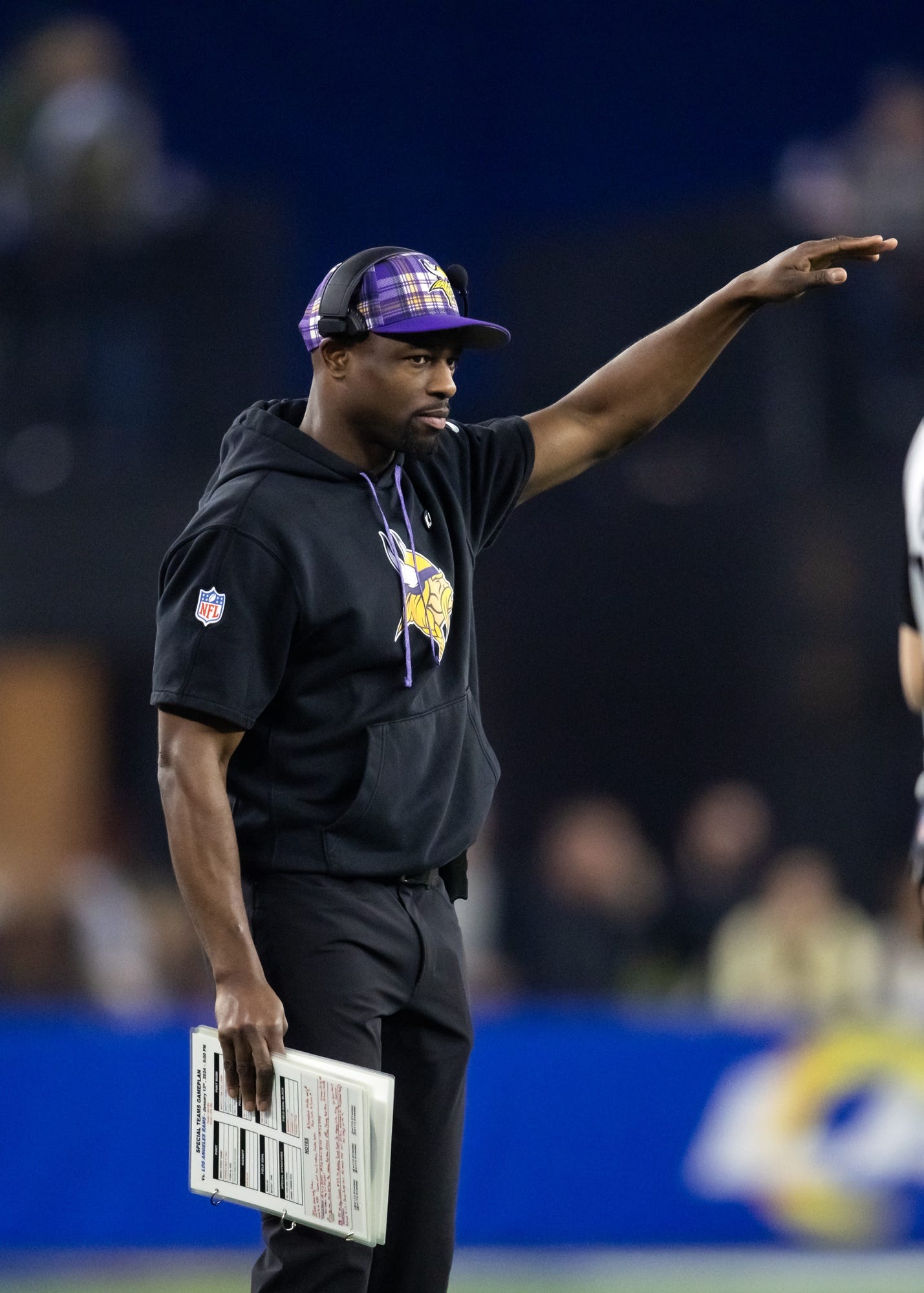
The Vikings’ special teams coordinator, who played on ‘teams himself in the NFL from 2012 to 2015, wants them to first understand that special teams might seem totally foreign at first but it’s really just a collection of other skills from playing offense and defense applied differently.
“It’s no different from a technique and fundamentals aspect of it, but everything is so much more of a matchup based,” Daniels said. “So now you start talking about one-on-one matchups, and there’s so much crossover, but the language can sometimes be a little bit different.”
Daniels will meet with the other position coaches to try to hone in on particular things that they are teaching and find ways that he can fit it into what he needs for his punt return, punt block, kick return, kick block and field goal units. What does the running backs coach preach in terms of certain techniques that they use to break tackles? What is the linebackers coach telling his guys about how to defeat blocks or to make tackles? Daniels doesn’t want it to be apples and oranges.
Daniels then has to explain to his new pupils how the plays actually work.
Take for example, the kickoff. In college football, they are still using the old NFL kickoff, which is quite a bit different from the new NFL kickoff, so these fellas have never seen anything like it before.
Daniels has a three-step process for that. First, he explains the fundamental rules of the play itself. How it works. When they can go. What they can and can’t do. Step No. 2 is the jobs and techniques once the ball is caught by the returner, whether that’s on kick return or kickoff. How the setups work and the types of blocks players have to make on the return side and how each player should go about defeating blocks on the kickoff side.
“Let’s talk about ball-blocker relationships,” Daniels said. “How close am I to the ball? Where is my blocker in relation to the ball? Oh, sure, yeah. Allows me to be able to say, ‘Can I make a back door move and have enough time to be able to steal down the football? Can I work to where the ball gets kicked and still be able to get to the football?’ We try to be very, very detailed oriented in terms of how to defeat blocks.”
Step 3 is schematics. Different formations, different techniques that will be required with each potential option that could arise from how they have gameplanned for their opponent and understanding the “why” of each play call.
In terms of degree of difficulty, mastering all of the elements of the kickoff is nothing in comparison to learning punt protection. Daniels said that is the most complex part of special teams by a wide margin.
The craziest part of that play is that players have to go from blockers to tacklers. Basically, play offense and defense on the same play. Punting in the NFL is also nothing like it is in college, so it’s just as new to the players as the kickoff.
“The punt play is the hardest in terms of, how do we go about communicating and the footwork is much different,” Daniels said. “And how do we get off of blocks? Then, you start talking about the hashes being much wider in college and you’re up covering so much space at the NFL level.”
Then it’s about teaching players how to avoid committing penalties. That’s no easy task because most of the guys are trying to make an impression and want badly to make a key block or tackle and they only get a handful of chances to do it every game.
The biggest thing is learning how to block when the ball is getting outside of you. Meaning, if you are blocking for a returner and the guy with the football breaks outside, the defender is going to go in that direction and you can’t grab him.
The mantra there is: “Plain hands, better feet.” Get the job done with your footwork, not by grasping at the jersey.
There is also a feel to it. If a player is instinctual, he will be able to read the guy he’s blocking and have a sense for where the ball is headed but slow responses cause over reactions. The better you understand from the scheme where the returner might be bouncing, the less likely you are to have to scramble to recover.
“You don’t know what a returner is, but what you feel is that a [defender] trying to leave you,” Daniels said.
It’s not easy to practice penalty avoidance because the game is moving at a different speed and there are so many different ways it could go in real time, which is why instincts are so important on special teams.
The returners
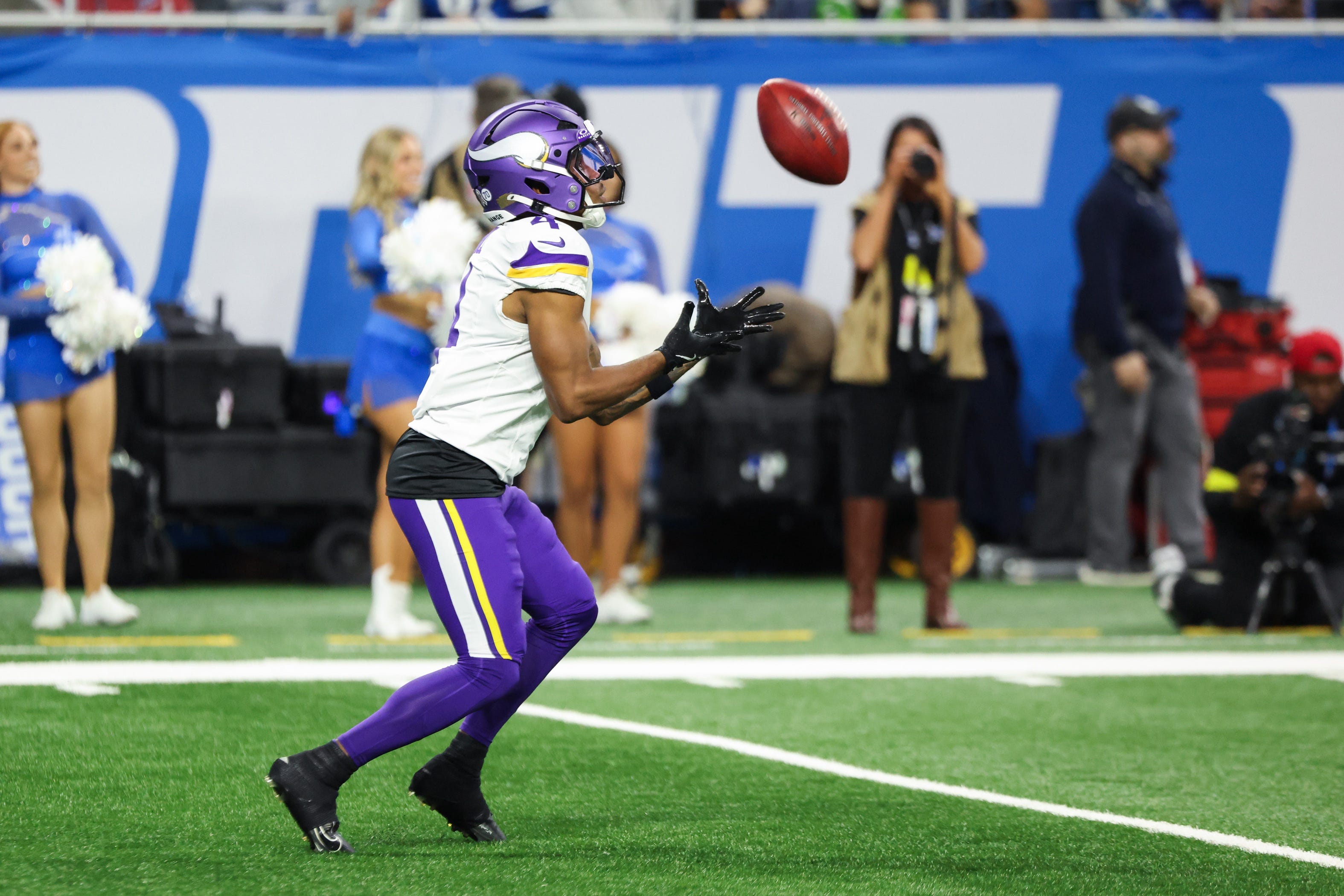
Over the years, Daniels has essentially created his own prep school for kick and punt returners.
Some of the players involved in the return game have done it before in college, like Vikings returner Myles Price, but others may have been the centerpiece of their team’s offense in college so they rarely handled return duty. For example, former Tulane receiver Dontae Fleming, who has been taking returns in camp, only had seven kick returns and 19 punt returns in college. He’s basically learning from scratch.
The first part of the returner program is tracking and catching the ball during punts. Daniels explains that the returner has to see which way the ball is facing while it’s a million miles up in the air. If the nose of the ball is up in the air, it’s going to fall short of how far you think it’s going to go and more to the right. If the nose of the ball is down, it’s going farther and more to the left. I’ll need to find a scientist to explain why that might be but the players have to identify that pretty quickly to get to the right spot early and then square up underneath the falling object.
The second part of being a good returner also comes before there’s any running or juking with the football. It’s decision making in the “sky” area. That’s down by the goal line. Returners have to understand when to call fair catch, when to return the ball and when to yell “Peter! Peter!” which means that there could be danger of the football hitting someone and creating a live ball.
Finally, Daniels teaches what to do when you actually return it. If you think that returners are just grabbing the ball and going full Deion Sanders mode and dancing around dudes until they see daylight, well, you’re not correct.
“I think the biggest thing from collegiate versus NFL level is understanding how you set up return,” Daniels explained. “It’s even more important at the second level. Because when you are able to set up second level blocks….that’s what explosives happen.”
While Daniels works on the details every day with his crop of prospective returners, that spot often comes down to who can show in real games that they have the “it factor.” Last year Myles Price went from an undrafted free agent that was hardly touted coming into the NFL to a legitimate return weapon after he showed in preseason that he could make things happen with the ball in his hands.
The reward
Over the years, the Vikings organization has seen many players who have been rewarded after grinding it out in anonymity on special teams. Adam Thielen first made the club as a special teamer. A major part of CJ Ham’s value for a decade was that he was a leader and played all phases. Andrew Sendejo, Anthony Harris and plenty of others. Metellus and Wilson are two great recent examples.
There is nothing better for Daniels than seeing guys become more complete football players. He uses second-round pick Jake Golday as an example. Daniels said that when Golday arrived, he wasn’t even close to where he needed to be in terms of the special teams techniques but he worked every day after practice to get it down.
“That’s why you do it,” Daniels said. “That’s the beauty of it. That’s why they call you ‘coach.’”
As the Vikings prepare to play the New York Giants in their preseason opener, Daniels gets to see his work throughout the spring and summer to onboard a bunch of rookies come to fruition on the opening kickoff.
As you’re watching it at home, keep in mind how much work went into coaching and learning every detail of that play.
I get that it’s a very hard job, and Daniels probably dealt with more UDFAs than other teams the last few years, but I still feel like he deserves more criticism than he generally gets. I don’t have the numbers in front of me, but I gotta imagine his units have committed more penalties than most since he’s been here. The bears return probably makes it feel worse than it was, but between stuff like that and the penalties, it just felt like an undisciplined unit last year. Now that I’m done complaining, great article. Cool to get a more inside look at how he coaches.