
By Matthew Coller
You will hear this statement made everywhere that Kwesi Adofo-Mensah’s firing is discussed: His drafting was bad.
Overall, that’s factual. Perhaps the most telling way to present how fruitless the draft has been for the Vikings since 2022 is this: They have only selected eight players who have played more than 600 NFL snaps over their last four drafts and four of them are currently playing for other franchises.
Only Jordan Addison, Jalen Nailor, Donovan Jackson, and Dallas Turner meet that threshold. JJ McCarthy, Ty Chandler have barely cleared 500 snaps. Kicker Will Reichard also deserves a mention here.
Out of 28 total selections, only 14 are still on the team and only three are projected starters for 2026 if we don’t count McCarthy or Reichard and Nailor leaves in free agency.
For four years of drafting to only yield one high-quality No. 2 receiver, one promising pass rusher, one promising guard and a good kicker is a pretty damning indictment of the front office.
But it does not tell the whole story.
HIT RATE
When we start to pick apart the Vikings’ issues with drafting during the Adofo-Mensah era, what we find is a mixture of questionable decisions, bad luck and a win-now mentality that helped them create a very good overall team and cost them in the draft and development.
When looking at the Vikings recent draft history, one thing pops out: They have barely picked any players.
Since 2022, the Vikings have eight selections in the top 100 picks and The Athletic’s draft analyst Dane Brugler pointed out this week that they have not taken a single player between picks 25 and 100 over the last three drafts.


How does that compare to other franchises?
Just within the Vikings’ division, the Chicago Bears have taken 14 top-100 players since 2022, the Packers have taken 12 and the Lions have picked 15.
The Lions had almost as many top-100 selections in 2023 as the Vikings have had since Adofo-Mensah arrived.
It’s hard to win the lottery when you never play.
But in the lottery, everyone has an equal chance. That’s not how the NFL Draft works. With every single selection that goes by, the odds of success go down. The Vikings have also not had a single top-10 pick outside of JJ McCarthy since 2014.
Last year Pro Football Focus published a chart of historical success rates over the last 15 years based on draft position. Unsurprisingly, each pick has lower chances of working out. There’s something else to notice: The odds of nailing a top-10 pick are much, much better than hitting picks 16-32. The gap between pick 65 and pick 80, for example, is much smaller.
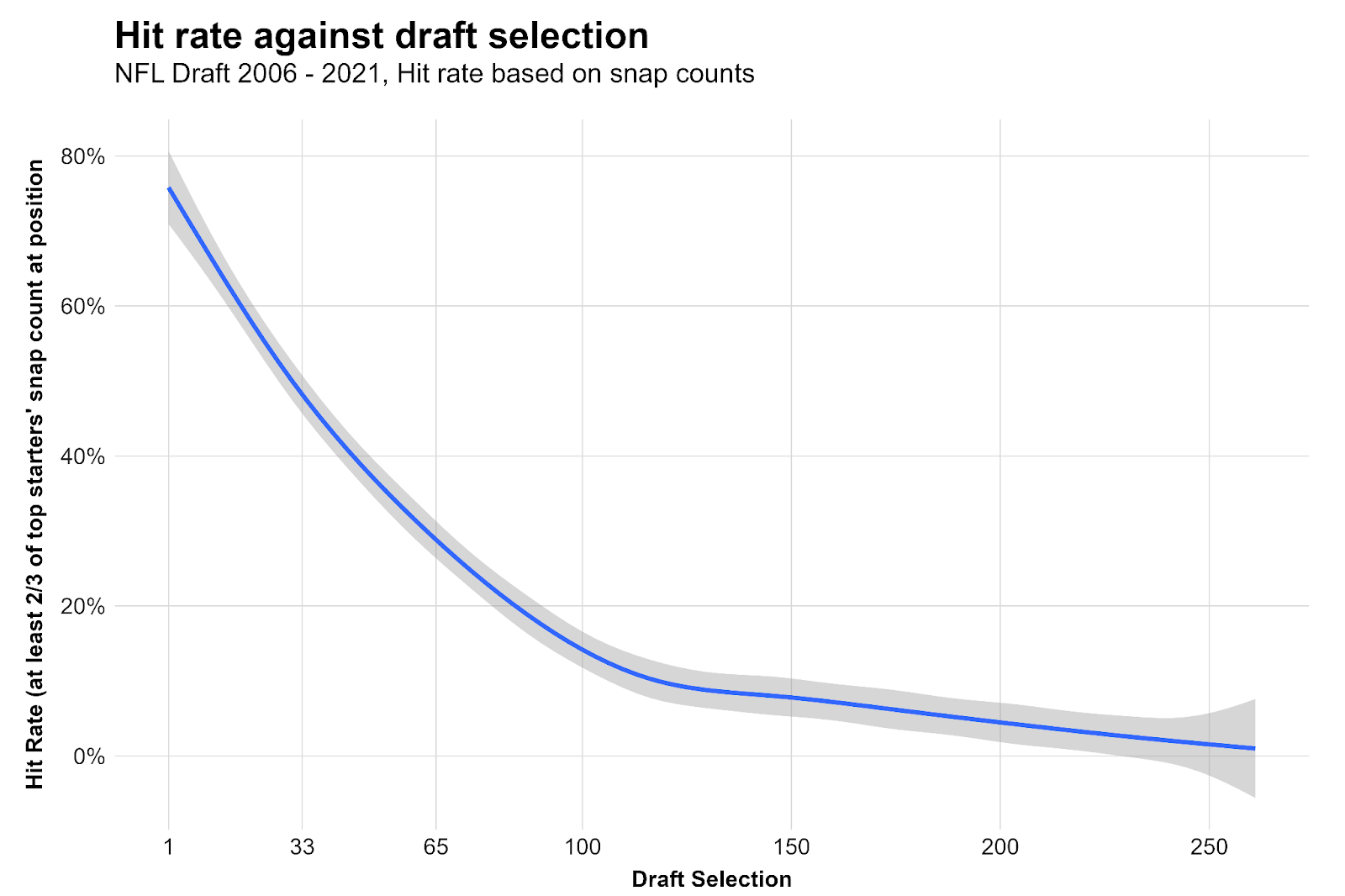
If we use the chart (which defines a hit by snaps played) to eyeball where the Vikings picked out of their 28 selections, here’s what we get:
— They took four players in the back half of the first round, ranging between 50%-60% odds of a hit. They hit (relatively speaking) on Addison, Turner and Jackson and missed on Lewis Cine. You could say they performed either on par or outperformed expectation for their first-round picks.
— They picked three players between 50-100, landing in the 20%-30% range of success. That was Andrew Booth Jr., Ed Ingram and Brian Asamoah. Ingram was a starter for the Vikings and started this year for the Texans. It’s questionable whether to call that a success but by the definition of the chart it would be 1-for-3.
— They took six players between picks 100 and 150, which have odds somewhere in the ballpark of 10%-20% of working out. Two of them are from 2025 and we can’t say yet. One is Mekhi Blackmon, a starter for the Colts. Safety Jay Ward is ascending and not yet decided. Akayleb Evans is still in the NFL as a backup.
— There are 13 players who went after pick 150, which has a 10% or less chance to work out. Jalen Nailor has become a very good No. 3 receiver, Will Reichard is the best kicker in the NFL, Levi Drake Rodriguez was a regular rotational player and Vedarian Lowe became a swing tackle elsewhere. Again, ballpark of expectation.
While these numbers come out right about in the range of expectations versus draft slot, you could reasonably argue that part of hiring Adofo-Mensah, the dubbed “analytics GM,” was to outperform expectations. Having a hit rate right in the middle doesn’t really get you ahead.
Of course, if they had a lot more picks and had an average hit rate, well, you can figure that out.
Another thing that has cost them picks is the lack of compensation picks that they have been awarded. Per OverTheCap.com, since 2022 the Vikings have been given two sixth-rounders in 2023 (Xavier Woods and Mason Cole) and a third-rounder in 2025 (Kirk Cousins). That’s a product of signing/extending free agents or having to cut players before their contracts are up.
TRADES
It doesn’t seem fair to analyze the Vikings’ shortage of draft picks without asking: Where did they all go?
Back in 2022, the Vikings were in the midst of an outstanding start to the Kevin O’Connell, Kwesi Adofo-Mensah era when they made a trade for tight end TJ Hockenson. They got the veteran tight end and two fourth-round picks for a 2023 second-rounder and 2024 third-rounder.
Hockenson became a Pro Bowler and one of the best tight ends in the NFL in 2022 and 2023. He was still helpful in 2024 to Sam Darnold’s run down the stretch after coming back from an ACL tear.
The move for Hockenson fit into a theme for the Vikings: They were trying to win. Would it have been prudent to stock picks for the eventual rebuild? Sure but in 2022 they knew that they were on the last legs of Kirk Cousins, Adam Thielen, Eric Kendricks, Dalvin Tomlinson, Dalvin Cook, Za’Darius Smith, Patrick Peterson, Jordan Hicks etc. and the NFC North was struggling so they had a chance at the No. 1 seed in the NFC.
Even though they eventually lost to the Giants in the playoffs, the team’s leadership knew there was only one swing left with the last of the Spielman-Zimmer core. They also knew that they could keep Hockenson long term as a major piece to rebuild with. He was a lot more of a sure thing than a draft pick.
In 2023, they did a bunch of shuffling, trading Za’Darius Smith, Vedarian Lowe and Ezra Cleveland for late-round picks and using some late-round draft picks to get Josh Dobbs and Cam Akers.
But it was 2024 that really saw the Vikings’ draft capital drained.
Because they were desperately in need of drafting a quarterback and couldn’t leave the ‘24 draft without one, they bought an insurance policy from the Texans. The Vikings traded two second-round picks and a sixth-rounder to Houston for their 23rd overall selection and a seventh. With the extra first, if they needed to move up from No. 11 into the top five to get a QB, they would have the capital to convince someone to do it.
There’s also a chance that they believed the Patriots might play ball with the No. 3 overall pick, set to either be Jayden Daniels or Drake Maye. It turns out they didn’t need to trade the house to get Maye because the Patriots rebuffed their offers.
They felt that they needed to trade up one slot on draft night to secure JJ McCarthy, which required a fourth and fifth swapped with a sixth. While Sean Payton swears he duped them into it, it was certainly justifiable either way to give up capital to land their QB. However, by the analytical chart from OverTheCap.com, the Vikings gave up 2,412 points to get 1,651 points.
The Vikings then dealt No. 23, a 2024 fourth, a 2025 third and a 2025 fourth to move up to draft Alabama star Dallas Turner.
By OverTheCap.com’s chart, the Vikings’ bevy of picks sent to the Jaguars was worth 3,097 points to just 1,564 points for the No. 17 selection. Twice as much value sent out than gained.
In total, the Vikings gave up equal value to two top-10 draft picks to end up with Turner.
In an interview with Purple Insider following the draft, Adofo-Mensah referenced the Minnesota Timberwolves’ trade for Rudy Gobert and the way in which elite players drive success when talking about the move. They may have felt that Turner was that type of franchise-shifting player. Still, that’s an incredible amount of value sent out and not long the lines of the analytical way of thinking.
Normally taking massive risks for one player is frowned upon because of the aforementioned PFF chart. If a 50-50 pick goes sideways, it’s going to be very costly. Adofo-Mensah’s background was rooted in determining proper value, yet they seemed to sell the farm for a middle-of-the-first-round edge rusher.
Turner began showing signs of being a worthwhile 17th overall pick last season when he went on a hot streak to end the year and ended up leading the team in sacks. He has shown flashes of someone with high-end potential and is still very young. Still, that move has not been the same type of game-changer that, say, Will Anderson has been for the Texans after they spent a future first to get him.
You have to wonder if the 2022 trade back impacted the approach to trade picks for current players and swing for a big hit in the first round.
This offseason, following a 14-win season, they used more draft capital on proven players, dealing a fifth for running back Jordan Mason and the equivalent of a fourth for Adam Thielen. The Mason deal went well with the 26-year-old RB gaining 758 yards and scoring six touchdowns. The Thielen trade, not so much.
The result of all of the moves was the Vikings having five draft picks in 2025.
Rather than trade down from their spot in the first round (which may have included an opportunity to pick up a future first from the Falcons), they stayed and picked Donovan Jackson. After the draft, Adofo-Mensah compared it to keeping a golf ball on the fairway.
Play it safe, don’t mess up and fill a need for 2025. Jackson is a good player with a high ceiling but it spoke even more to the win-now approach. No getting cute.
The only time the Vikings under Adofo-Mensah took a long-term strategy to the draft was 2022. They traded down from No. 12 to 32 in order to pick up another second-rounder from the Lions. It was nearly unprecedented to let a team move up that far and not get a first-rounder in exchange.
When Adofo-Mensah was asked about the catastrophic failure of that trade, he suggested that he had attempted to fill every single problem with one draft. He tried to do too much. Maybe he was trying to prove his savvy. Maybe he got unlucky.
It should be noted that trades set the Vikings up to have a good amount of future draft capital. They got a sixth for Ed Ingram, swapped a sixth and Sam Howell for a fifth and seventh, got two sixths for Harrison Phillips, a sixth for Mekhi Blackmon and picked up draft capital by moving down twice. Unfortunately for Adofo-Mensah, he stockpiled those late-round picks for the next decision maker.
The 2022 draft
There are a lot of things that go forgotten when people tweet out screen captures of Adofo-Mensah’s 2022 draft.
The first is that the Vikings were in dire need of secondary help. When KOC and KAM took over, they brought back Patrick Peterson and signed cheap veteran Chandon Sullivan to patch things over but they were lost at sea when it came to that position. Rick Spielman pick Cam Dantzler wasn’t working out and they were completely lacking in other promising prospects.
At safety, nobody knew that converted corner Cam Bynum was going to become a borderline star. Nobody knew Josh Metellus would become a cornerstone. They assumed the cupboard was bare and had no idea that Harrison Smith would still be playing in 2025.
The idea was that by trading back, the Vikings could get multiple defensive backs rather than just, say, safety Kyle Hamilton. They also badly needed a starting guard (if you remember the good old days).
So Adofo-Mensah made two deals with two division rivals to move back and then moved up to pick Andrew Booth Jr. In total went from the 12th overall pick and 46th overall pick to No. 32, 42, 59 and 66 and a fourth-rounder that turned into Akayleb Evans.
The traditional “Jimmy Johnson chart” thought the deal with Detroit was a loss for the Vikings, scoring 1,640 points given up by Minnesota and 1,410 by Detroit. Some charts were more favorable. On the OverTheCap.com chart liked the deal with the Vikings spending 2,801 points vs. receiving 3,334 points.
All of that is theoretical though. The actual results were brutal.
Because we know the outcome, it’s easy to lose sight of 32nd overall pick Lewis Cine being a very good prospect. He won the national championship with Georgia and was named defensive MVP of the game. He ran a 4.37 40-yard dash at 6-foot-2, 200 pounds. NFL.com analytics scored Cine as the 4th best player at his position when combining athleticism and production.
NFL.com’s Lance Zierlein wrote of Cine:
“Cine plays with a willing aggressiveness that fit right in with Georgia’s talented stop unit. He plays with an urgent, downhill approach, which leads to memorable collisions but he’s not always under control in getting there. He doesn’t have desired mass and stopping power for his style of play, but the work gets done.”
Mock Draft Database ranked Cine 34th on its consensus big board.
Cornerback Andrew Booth Jr. also had good reviews from draft analysts.
Zierlein wrote:
“A press/zone combo corner with good size and length, Booth plays with an urgent, competitive nature. He has the strength, balance and foot agility to press and slow the release. He has limited starting experience, though. He will need more development to prevent route specialists from manipulating his feet and hips. Booth has the ball-tracking and play strength to find and maintain top-dog positioning through catch tries.”
Mock Draft Database’s consensus board had him ranked 28th.
One of the issues with Booth Jr. was health concerns. When he was drafted he said that he had “not been healthy since high school.” On draft night, Adofo-Mensah admitted to asking his medical team, “are you sure?”
It did not help that Kyle Hamilton and Jordan Davis became instant key players for their defenses, though there were six other players between picks 12 and 20 who went sideways for their franchises. That always gets forgotten when a team is criticized for not picking Player X or Y.
The reach of that draft was guard Ed Ingram, who ironically ended up playing more than anyone else from the draft class except Jalen Nailor (though he was benched in 2024). Ingram was picked 59th despite being 101st on the Mock Draft Database consensus board.
Brian Asamoah appeared like a fit for a Vic Fangio-inspired defense as a sideline-to-sideline, undersized linebacker who played aggressively. But he was also a reach, landing at pick 66 when he was 95th on the consensus board.
At the time, there were pretty big debates over the draft class. Some were concerned about how far they traded back, others thought they landed a lot of good prospects.
Sports Illustrated gave them a D-
In the end, each pick had its own story for why it went wrong.
Cine suffered a gruesome injury when the Vikings played in London, breaking his leg and being forced to remain overseas for surgery. Maybe he never would have made it anyway but he didn’t have his first year to develop and then the Vikings fired defensive coordinator Ed Donatell and changed to a completely different system that requires experience and extremely high IQ. Cine was buried from the start.
Booth Jr. never seemed to play with the physical nature that Flores required. Tackling is big in his system.
After flashing in 2022, Asamoah never seemed to click with Flores. He was taken off the first team midway through the first training camp.
That was that.
The top two picks were fairly good prospects and the idea about trading down that was defensible in context of the roster but the risk did not work out.
When we consider the PFF chart, the biggest criticism of the trade down would be that KAM was torpedoing his odds of a hit. He went from near 70% chance of success to sub-50% with the next two selections. How often does a coin land on tails twice in a row? Well, that’s what happened.
Development issues
Because he wasn’t a fit, the Vikings traded Andrew Booth Jr. for a cornerback who played 1,040 snaps and picked off five passes this year. Only he did it for the Chicago Bears.
The Cowboys sent Nahshon Wright to the Vikings in exchange for Booth Jr. but after a year on team team he was cut before they even reached training camp and signed by Chicago. The Vikings elected to sign former top Lions pick Jeff Okudah instead and eventually brought back veteran corner Fabian Moreau.
It’s tough to make a case that the Vikings put an emphasis on player development when they cut everyone who wasn’t ready to help them right away.
Ed Ingram was a starter for a playoff team this year. Their 2022 sixth-rounder Vederian Lowe is a role player for a playoff team. Their 2022 fifth-rounder Esezi Otomewo is a role player for a playoff team. Their 2022 fourth-rounder Akayleb Evans is depth for a playoff team. Their 2023 third-rounder Mekhi Blackmon is a starter for a team that was in the playoff race.
They never trusted 2022 fifth-round RB Ty Chandler despite his explosiveness and success in 2023. They cut 2025 fifth-round LB Kobe King midseason and he was picked up by the Jets.
We also have to mention the tragic passing of rookie Khyree Jackson, a promising young cornerback who never got an opportunity to grow into a role.
Not that anyone should blame them for wanting veterans. In 2022, they won 13 games and set the bar very high. In 2024, they won 14 with a team largely made up of experienced players. In 2025, they saw themselves as a legitimate playoff contender whose vets were wearing shirts saying “more is required.”
Another part is that unexpected players rose to the challenge.
Bynum was on that list. Also former special teamer Josh Metellus became a 1,000-snap key player. Instead of the late-round defensive tackles working out, they landed Jalen Redmond. At guard, they upgraded with Dalton Risner and ultimately Will Fries. Eric Wilson eventually became a stellar flexible linebacker rather than Asamoah. Stephon Gilmore played a key role in their 14-win season and then Isaiah Rodgers ranked in the top-15 by PFF in 2025.
The impact of missed draft picks was mitigated by other signings and they finished the 2025 season with a top five defense in points and yards allowed per drive. The Vikings offensive line was good when it was healthy. The receivers have a track record of elite play. But…
JJ McCarthy
Ah yes, that brings us to the elephant in the room. It’s easy to wonder if the draft would have been much of a discussion had JJ McCarthy been ready to roll in 2025 and brought the Vikings to the postseason. Everyone would have praised the way they built the team to win now around a budding young QB, just like the 49ers when they traded for Trent Williams and Christian McCaffrey or signed Javon Hargrave to a massive deal.
The process of drafting McCarthy was as thorough as you could hope for. The team’s leadership, with KOC leading the way, visited with the prospect QBs around the country. They did a film analysis on “NFL throws” that each player had made in their college careers.
When they selected him, they had a good plan. Develop him behind Sam Darnold and then turn the ball over to him when he was ready.
But much like a lot of the issues with drafting over the last couple years, the Football Gods were not on the Vikings’ side. McCarthy made significant progress during 2024 camp and convinced the team that he was ready to start in 2025 despite the injury.
After they let Sam Darnold walk, McCarthy was thrown into a very difficult situation with a team that had high expectations and no time for development. And then he got hurt again in Week 2, making it even more challenging for him to get into a groove and for O’Connell to work the offense around his skills and understanding of the offense.
They finished 9-8 and McCarthy ended the season in the bottom of the NFL in most categories despite showing signs along the way of having the skills to eventually be a good quarterback.
We can all agree: If Darnold stays or McCarthy hits, this article isn’t being written.
The bottom line
The Vikings missing the playoffs with McCarthy only playing 10 games put every other thing that had been done on the roster — particularly the drafting — under scrutiny, even if the impact of the 2022 draft’s failures had been mitigated by 2025 and even if the mail reason for not producing many key players recently was the team’s willingness to spend picks to win right away.
Was problematic drafting a main reason for Adofo-Mensah’s firing? Well, it’s a results league, so yes. It also hurt him significantly that his big idea in 2022 went so poorly. After that, as The Athletic reported, the coaches wanted to get more involved and it seemed to muddy the waters of who was calling the shots in the draft room.
Some of it was bad luck. Some of it may have been poor process i.e. the reaches. Some of it may have been the realities of the NFL Draft: It’s all about where you pick and how often you pick and how lucky you get.
The insurance policy analogy is apt: one doesn't just send State Farm a cheque for $10K, wait until the boat sinks or the house burns, and then ask for some coverage. Good GMing is having the discussion with HOU and then getting a framework in place with NE before making any trades.
The problem with the Hocks trade was paying a premium of draft capital and then having to extend him the following offseason. It should be either/or, not both. Likewise, there is a hidden benefit to hitting on day 2-3 picks. They haven't made life-changing money yet, the floor from which they negotiate is a lot lower, and so it's much easier to negotiate team-friendly contracts. We see examples with the JJ, Barr and Darrisaw extensions vs the Hunter, Diggs and Thielen extensions.
Ancient wisdom: the dose makes the poison. One dubious trade of draft capital has limited harm. When it's a continued pattern of behaviour, the result is a roster without young, cheap talent. That, in turn, requires overpaying in UFA and here we are. Problem 1 is the worst QB situation in the conference and that overwhelms everything else. Problem 2 is an old, very expensive roster.
Heckuva job, KAMie.
Also, I think our particular coaches / schemes need not only specific skill sets but also the right personalities. Rookies are going to have a harder time with some of the complex stuff KOC and Flo want to do. It's probably quite challenging to draft for them, and likely a learning curve for everyone to communicate, etc. Having young (in their career) coaches and a similarly young GM was probably going to result in some bumps - regardless of who was at the helm.