
EDITOR’S NOTE: Joshua R. Smith is a sports editor/writer at The Frederick News-Post in Maryland. He’s a lifelong Vikings fan (80s era) who contributes occasionally to Purple Insider. You can follow him on Twitter/X at JoshuaR_Smith
By Joshua R. Smith
The noise it likely made, if it made one at all, would’ve been hot and fast sounding. Something like this:
“Fzzzzzzzzzzzzzzzt.”
The date was Oct. 24, 1999, and the 2-4 Minnesota Vikings had fully handed their offense over to another different veteran. Again. Down by three against visiting San Francisco, in desperate need of a turnaround in a season with high hopes, that sound probably could have been heard at field level in the always-raucous Metrodome.
Jeff George took a seven-step drop to the Vikings’ 12 yard-line and ripped a scorching liner 37 yards — fzzzzzzzzzzzzzzzt — that landed perfectly in the arms of a striding Matthew Hatchette, who took it the rest of the way for an 80-yard TD.
Minnesota went on to rout the 49ers, sparking a run to the Divisional round of the playoffs.
That day marked a QB first for the Vikings — who in 2026 are set to record yet another.
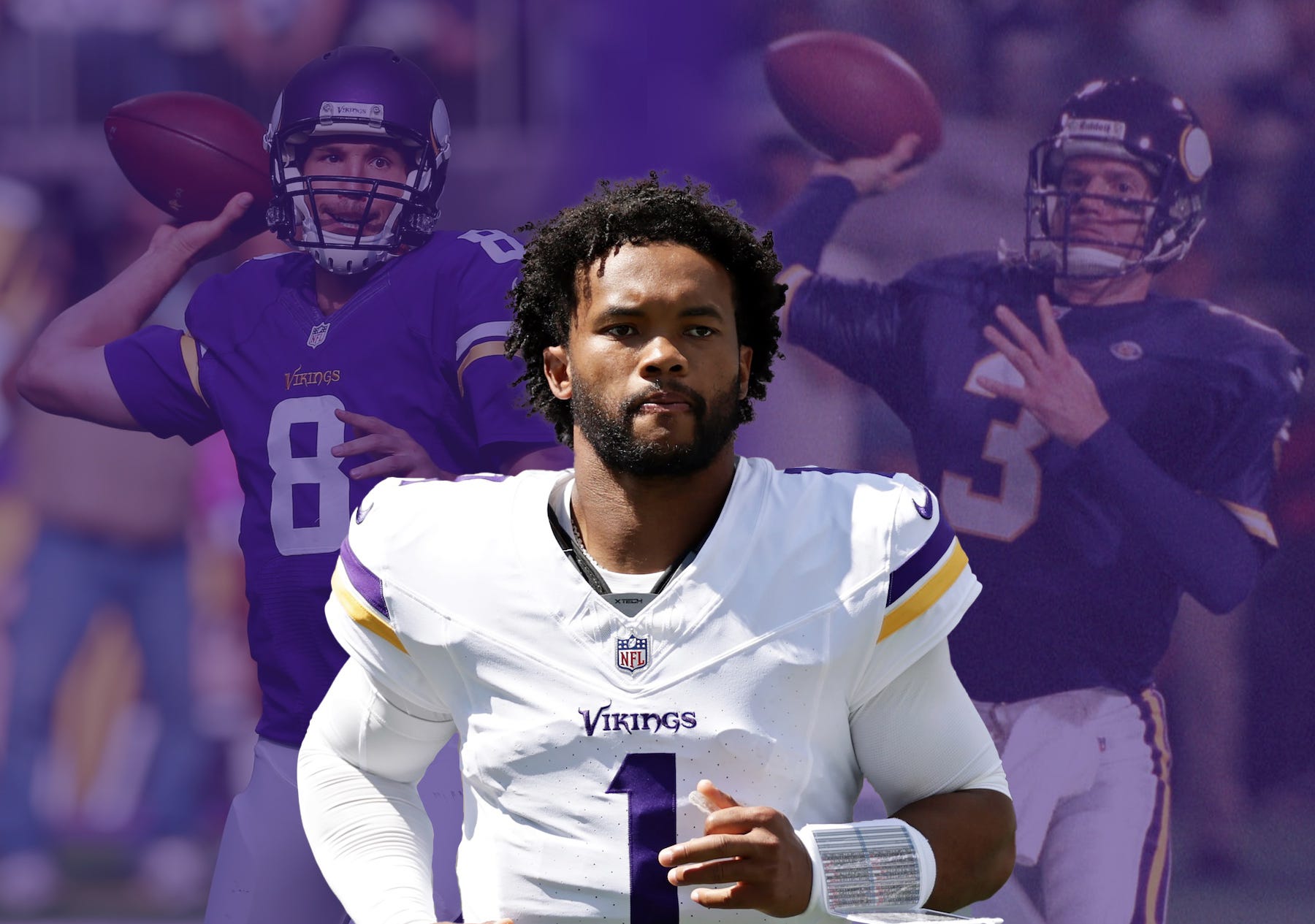
When Kyler Murray takes his first snap Sunday against Green Bay, he will join George and Sam Bradford (2016-17) to make Minnesota the answer to a unique piece of trivia:
If all goes as planned, the Vikings will become the first NFL team since the merger to have started — for most of a season — three quarterbacks who were drafted by someone else with the No. 1 overall pick.
(The Rams and Panthers have also started three, but mostly for interludes.)
The honor will be fitting for this challenged franchise. Few teams have cycled through as many name quarterbacks as the Vikings over the past 40 years.
Therefore, on the eve of the occasion, it’s a fitting time to examine how those two previous instances shook out for Minnesota and compare them to the situation Murray enters as he tries to revive his career with a franchise that is perhaps unmatched in its attempts at such resuscitation.
Maybe the process of looking back at the other two can serve as a fortune teller for this year’s Minnesota Vikings. Through this lens, let’s dissect and grade several categories from 1999 and 2016 to project this year’s support system and how Murray might fare as he takes the reins for the Vikings’ latest dance with a former No. 1.
The three QBs’ profiles could not be more at odds, yet some commonalities to their situations could help determine whether Murray is positioned to have more or less success than his No. 1 predecessors in purple.
(A scale of 1 to 10 is used to rate each category, with 10 being strongest and only whole numbers awarded.)
1999 — Jeff George
Overview
By 1999, Jeff George had become versed in wearing out his welcome. The No. 1 pick by the Colts in 1990, he was entering his 10th season when he joined the Vikings on a cheap, one-year deal with his fourth team to backup Randall Cunningham.
He was available for many reasons, few positive. He could make eye-popping throws, yes. But too often, he propped himself up on that awesome arm. He was just a thrower. There were also contractual arguments, public sideline spats, too many sacks and too few wins.
When he arrived in Minnesota, his record was 37-70 (.345).
Oakland, where he had started for the previous two years, jettisoned George in favor of former Viking Rich Gannon, who could better operate second-year coach Jon Gruden’s complex offense.
With the Vikings, the 31-year-old George would be one play — or one poor stretch of play by the 36-year-old Cunningham, as it turned out — from leading a loaded team that had Super Bowl aspirations a year after its gutting championship game defeat.
Tangible QB skills (6)
Google “Jeff George highlights” and behold. His throwing style and insane trigger generated nonchalant velocity that could fit balls into the unfathomable. His arm talent was top tier, on par with Dan Marino and John Elway.
However, overconfidence in that ability and relative immobility — his era being owned by pocket passers — led to 285 sacks, or 31 per season, by the time he arrived in Minneapolis.
Intangible QB skills (2)
Stellar ESPN reporter John Clayton had an anonymous source tell him in 2001 that George was “a traveling computer virus who keeps getting into different laptops.”
To alter that metaphor, George’s software was faulty. He didn’t devote himself to technique or scheme mastery, and he had trouble connecting with teammates. There are stories of him clashing with coaches whose calls he ignored to spite them or just because.
Infamously, late in his career, he was quoted as saying leadership is overrated. Those words might mean more to his reputation than any bullet he fired into tight coverage.
Coaching/scheme (8)
Dennis Green proved over his career that he could find ways to win with QBs of varying styles and levels of experience. To that point in his Vikings tenure, he’d ridden with mostly veterans. However, in that regard, he had been a victim of his own success, as Minnesota was never in a position to draft a QB high — until the team traded the one Green had developed, Brad Johnson, and spent the acquired pick on Daunte Culpepper in 1999.
Bottom line: Experienced quarterbacks could easily learn Green’s scheme because it was set up logically and coached well.
It didn’t hurt that the personnel executing the plays was splendid.
Receivers/Tight ends (10)
This was peak Three Deep. In ’99, Randy Moss and Cris Carter each went over 1,200 yards, while Jake Reed — Purple Insider’s Most Underrated Viking of the Past 50 Years — added 600 more. None were shorter than 6-foot-3. All were dangerous.
Carter led the NFL with 13 TD grabs (Moss added 10) and was named First-Team All-Pro. This bonkers trio helped George zip spirals at a league-best 14.7 yards per completion over his 10 starts.
At tight end, Andrew Glover stood an imposing 6-foot-6 but didn’t stand much chance at accruing many targets given the talent around him. Still, he finished with 28 receptions and gave defenses something else to worry about.
Running backs (7)
The reason this rating isn’t even higher comes down to starter Robert Smith missing three games due to hernia surgery just as George was stepping in.
When healthy, Smith brought dual-threat juice to the backfield, and he finished the season with 1,000 rushing yards.
We all know the well-worn statement that accompanies the name of his backup, Leroy Hoard, who was always good for three yards. Sure enough, Hoard went for 10 TDs, seven from 1 yard and none longer than 4. (Gosh, remember when the Vikings could score short-yardage TDs?)
Offensive line (8)
This stalwart group included three first-round picks, two 1999 Pro Bowl selections and one eventual gold jacket owner.
From left tackle to right, it was Todd Steussie, Randall McDaniel, Jeff Christy, David Dixon and Korey Stringer. By ’99, Steussie, McDaniel and Christy had been starting together under Green since 1994. Stringer, a massive athletic marvel, was in his fourth season.
If there was a perceived weak link, it was the mountainous Dixon, a former project who had come into his own (all the way from New Zealand) but wasn’t a high-level pass blocker.
Even so, together they provided ample time for George to drop back and fire. George — one of the most frequently sacked QBs of the 1990s — was taken down 28 times in his 10 starts. But his formidable line helped Minnesota’s offense rank third by yards and fifth by points.
Overall defense (3)
These Vikings were light on defense, in the general size of its players by NFL positional standards and also in its ability to halt offenses. Minnesota was 27th ranked by yardage, with abysmal pass defense as the main culprit.
Much of coordinator Foge Fazio’s starting group was either aging or young and unspectacular. Their top players were defensive lineman John Randle and safety Robert Griffith. Seeking more talent and fewer double teams on Randle in late September, Green re-signed Chris Doleman, bringing the franchise great and 38-year-old off the golf course to help rush the passer.
With those two, the line was productive enough to register 43 sacks, but the Vikings’ speedy linebackers were small. At corner, Jimmy Hitchcock was serviceable, but slight rookie Kenny Wright was a liability.
The unit was fully exposed by the Rams in the playoffs.
Overall special teams (6)
Mitch Berger was a Pro Bowl punter, but 40-year-old Gary Anderson, by then, had one of the weaker legs in the NFL. Attempting field goals near or beyond 50 yards was almost out of the question.
Moss returned punts and David Palmer handled kickoff returns. While Moss had one memorable prime-time return TD, it came in a loss to Kansas City. Otherwise, this unit was average.
George’s final regular-season stats: 191 completions in 329 attempts (58.1%), 2,816 yards, 23 TDs, 12 INTs, four game-winning drives.
Final result: Minnesota went 10-6, beat Dallas 27-10 in the Wild Card playoffs, then lost to St. Louis 49-37 in the Divisional round.
Overall score (out of 80): 50
2016 — Sam Bradford
Overview
Defcon 1 had been entered when the Vikings acquired Bradford on the eve of the season. Shocked and desperate after Teddy Bridgewater’s knee injury, Minnesota sent first- and fourth-round picks to the Eagles for an injury-plagued QB with a premium arm who had fallen out of favor in Philadelphia after it drafted current Viking Carson Wentz. (Gosh, we could play an NFL version of “Six Degrees of Kevin Bacon” with Vikings QBs.)
It was the second time in two years that Bradford — the top pick by St. Louis in 2010 — had been traded. He was becoming the poster child for unfulfilled promise.
The hope in Minnesota was he could stay whole and sub well enough to keep the reigning division champ’s lofty ambitions afloat. It seemed reasonable, with Adrian Peterson in the backfield, young receivers ready to pop and Mike Zimmer’s defense rounding into destructive form.
It continued feeling reasonable once they started hot.
Then, injuries struck. Maybe some stuffed animals were sacrificed. Doubts crept in. Losses snowballed.
And no matter how well a healthy Bradford played the hand that was dealt, the Vikings became one of a small group of teams in history that started 5-0 but missed the playoffs.
Tangible QB skills (6)
Recall what Bradford did in his first Vikings start. Week 2. Fifteen days after he was acquired. The grand opening of US Bank Stadium — against Aaron Rodgers’ Packers on prime-time national TV.
Still probably learning who Stefon Diggs was (along with the rest of the NFL-loving nation), Sammy Sleeves showed his best traits no matter how illogical the display seemed given his circumstances. Dropping dimes all night and igniting Diggs’ star, he outplayed Rodgers in a theatrical victory.
All season, Bradford’s accuracy was top notch on all manner of throws, his timing preternatural. He led the NFL that year in completion percentage, with a snap-to-release time that could not have been faster.
A depleted, lackluster offensive line — and Bradford’s non-existent mobility (he was sacked 38 times) — required it.
Intangible QB skills (7)
Bradford’s consumption and execution of Minnesota’s offense at warp speed to start the season was impressive and spoke to his football mind.
He also quickly won over his new head coach and teammates, who, mind you, had just seen their beloved leader, Bridgewater, fall victim to a catastrophic injury as they were set to embark on a season where they were expected to make a playoff run.
Coaching/scheme (7)
Zimmer was focused on his defense. He needed his QB to be professional, in the conscientious, businesslike and smart senses of the word. Bradford fit the bill.
Zimmer left the offense to his coordinator.
And then his coordinator left.
After Minnesota lost its second game, the respected Norv Turner stunningly resigned after (perhaps blowing right by TJ Clemmings on his way out the door). That’s why the rating here isn’t higher. Though Zimmer claimed to be shocked by Turner’s decision, there was clearly discord.
It seemed convenient that tight ends coach Pat Shurmur, who had twice previously coached Bradford and was attuned to his skills, was named the interim OC. Shurmur tailored play-calling to Bradford’s strengths while also accounting for the shortcomings of his supporting cast.
Receivers/Tight ends (8)
This was the season where Diggs and Adam Thielen emerged as a potent duo. Diggs’ breakout was that Green Bay game. Thielen introduced himself by going off in a Week 5 shellacking of Houston.
Both had 900-plus receiving yards, giving Bradford an interchangeable pair.
Cordarrelle Patterson had limited receiver skills but was a solid catch-and-run complement, while first-round pick Laquon Treadwell was very good at snagging passes from the Jugs machine after practice.
At tight end, Kyle Rudolph enjoyed a career year, never mind it was at least partially a product of Bradford needing to compensate for limited time. Rudy vacuumed short passes all season, recording 83 receptions (one less than Diggs) for 840 yards and seven TDs.
Rhett Ellison was a serviceable blocking tight end.
Running backs (4)
Peterson tore his meniscus in Week 2, leaving the rushing duties to Matt Asiata and Jerick McKinnon for the rest of the campaign. Each had limitations, and the drop-off from a superstar was as drastic as one might have imagined. The pair teamed to produce just under 1,000 yards. Asiata provided some value as poor man’s Hoard, while McKinnon’s receiving skills were useful.
But this tandem did not strike fear.
Offensive line (1)
In a word: Ugh.
Starting left tackle Matt Kalil got hurt, and before that he had regressed. Starting right tackle Andre Smith got hurt. The next starting left tackle Jake Long, signed off the street, got hurt.
Clemmings, an ill-equipped rookie, got thrust into the lineup, as did utility man Jeremiah Sirles. Steady Joe Berger started at center, and the guards were Alex Boone and Brandon Fusco. There were some solid pieces, but the unit was an average mash-up. Shuffled personnel made cohesion challenging.
Also challenging: Running the ball and pass protecting long enough for routes to develop.
These Vikings finished with the NFL’s worst rushing offense by yardage and yards per attempt.
Overall defense (9)
By this point, Zimmer had the players to start digging into his bag and making life hell for opposing QBs.
Pro Bowl picks dotted each level: Anthony Barr, Everson Griffin, Linval Joseph, Xavier Rhodes and Harrison Smith. Not to mention, Danielle Hunter came into his own with a team-best 12.5 sacks.
They finished as the third-ranked defense in yards and sixth in points.
But it wasn’t enough to offset offensive limitations.
Overall special teams (7)
Patterson and Marcus Sherels might’ve been the best return duo in the game.
Patterson was named All-Pro after leading the league in kickoff return average. Sherels took two punts to the house.
But this was the season when Blair Walsh melted, getting cut in November after missing extra-points in consecutive weeks. The steadier Kai Forbath came aboard.
Bradford’s final regular-season stats: 395 completions in 552 attempts (71.6%), 3,877 yards, 20 TDs, five INTs,
Final result: 8-8, third in NFC North.
Overall score (out of 80): 51
2026 — Kyler Murray
Overview
Signing Murray, the best QB available on the market, to a one-year deal this offseason gave coach Kevin O’Connell the type of coveted veteran his offense has thrived with in Minnesota.
Murray, of course, was cut loose by the Cardinals despite an enormous salary after he failed to lift Arizona from the dregs as the potential savior for a historically bereft franchise.
The Vikings hope the 2019 No. 1 overall pick will be able to rescue them, too — if not from the dregs, but high enough to see over the dreaded mediocre middle as O’Connell tries to cement his job security with postseason success.
The idea was that Murray would have little trouble beating out JJ McCarthy in whatever camp competition KOC designed.
The idea is that Murray’s best will be brought out by an infrastructure the likes of which he has never enjoyed — including a flexible, QB-whispering coach, terrific receivers, solid protection, an overhauled running-game approach and a vicious defense.
Not to mention, he should be internally motivated to prove his talent and rejuvenate his career in a potentially make-or-break situation.
Tangible QB skills (7)
Murray has at times been one of the most accurate, exciting quarterbacks in the NFL.
He is a high-level quick-game artist who can make anticipatory throws but cannot lean on the type of arm possessed by George or even Bradford.
He uses footwork in the pocket to compensate for a height disadvantage. He doesn’t take a high percentage of sacks, nor does he throw a lot of picks.
Murray’s hay has been made as a top-tier athlete whose scrambling helps create off-script completions and chunk gains with his legs. But it’s hard to build an offense around unreliable playmaking.
Still, he has averaged 456 yards rushing over seven seasons — despite missing portions of 2021 and ’22 with a torn ACL and effectively getting put on ice last season after five games as the Cards tanked. That trait can help extend drives or demoralize defenses.
With a clean pocket, Murray has also proven to be one of the best QBs in the league. Additionally, as has been reported by Purple Insider, from 2020-24, Murray created the eighth most Approximate Value by Pro-Football Reference’s WAR-like metric.
Intangible QB skills (5)
Negative narratives are what prevail here, shaping overall perceptions of Murray.
He’s too tiny to succeed. He’s not rah-rah enough to lead men. He forsakes studying for gaming. He can’t stay healthy. He lacks fire..
It became easy to latch onto such storylines as he went in and out of the lineup, faltered late in seasons he completed or wore blank expressions as the Cardinals remained mostly on the periphery of average NFL fans’ consciousness.
What’s not taken more into account is that he was mired amid an organization that struggled to build around him.
To boot: His QB record of 38-48-1 (.437) in seven seasons with the Cards is not encouraging, but it’s worth noting Arizona went 5-25 (.167) in games he didn’t start since 2019.
Coaching/scheme (8)
O’Connell’s success rate with experienced QBs is proven. He runs one of the league’s premier passing games — provided his trigger-man grasps and executes gameplans.
The key will be how well KOC uses schematics and the benefits of a strong supporting cast to mitigate Murray’s deficiencies. The question is how the coach will tailor his system to get the most out of Murray’s strengths, or maybe even develop what have been weaknesses.
O’Connell’s offense has strict principles. Yet, year to year, it has also looked subtly different under Kirk Cousins, Sam Darnold and the struggling McCarthy. That should be expected again in 2026, perhaps with some pistol formations or movement of the pocket to create clearer passing lanes for the diminutive operator.
Also, it appears there might be a more concerted effort to produce the type of running game that can make life easier for any style QB.
Receivers/Tight ends (9)
No matter how strong this group looks, we can’t rate it a 10, because this isn’t Three Deep.
Still, it’s arguably the best cadre of weapons in the league — and maybe the best the Vikings have had since the late ‘90s. Plus, each man mentioned here should be highly motivated to help Murray.
Justin Jefferson will be striving to prove, for anyone who has such doubts, that last year’s blip should be placed at the feet of the team’s QBs.
Jordan Addison will be similarly driven. After several uncharacteristic drops, he’ll seek to parlay a rebound season into an enormous contract.
New addition Jauan Jennings, who is on a one-year deal as WR3, has RAC ability and an aggressiveness that should abet the running game.
Tight end TJ Hockenson, who will hit free agency in 2027, seeks to rediscover the level he reached before a late-2023 ACL tear.
Josh Oliver remains a great blocking TE, while Myles Price and Tai Felton hope to make noise with a big play or two as supporting WRs.
Running backs (6)
It’s hard to grade this group as anything other than slightly better than average. Jordan Mason appears primed to break out — but that bandwagon has plenty of open seats because everyone knows how much the team trusts and adores Aaron Jones.
Jones’ age (he turns 32 in December) and history of getting banged up make it stand to reason the Vikings will rely more on the tough-running Mason as they implement a blocking scheme with a history of gouging gains.
Either way, they are a competent if not dangerous duo. While RB depth is a concern, the deployment of rookie fullback Max Bredeson could deliver valuable crunch and confusion to defenses.
Offensive line (7)
The talent of tackles Christian Darrisaw and Brian O’Neill push this group to a decent rating, but big questions remain.
That includes whether Darrisaw will regain his top-end form. And whether the man next to him, guard Donovan Jackson, can take the next step. And whether center Blake Brandel can avoid snapping miscues prone to a converted guard. And whether right guard Matt Fries will indeed be a stronger version of himself two years after a tough injury.
Lastly, will the unit allow Murray to flourish and uniformly help them carry out the new rushing plan?
All five starters have at least one year of experience in the system, though they seldom started together last season. If all comes to fruition, this OL could be the finest Murray has ever played behind.
Overall defense (8)
Nearly the entire unit returns after finishing as the third best defense in the NFL by yardage in ’25.
Coordinator of chaos Brian Flores seems assured to continue his dastardly devising. Andrew Van Ginkel remains a unique weapon at OLB, while Dallas Turner might be ready to announce his presence as a star.
The biggest area of concern seems to be the interior line, due largely to inexperience across the board.
Some holes were shored up last-minute with the signings of solid vet Kyle Van Noy and the legendary Harrison Smith.
Smith might be the ace in the hole as he figures to be back to his QB-toying tactics as a pseudo coach on the field and overall defensive confidence booster.
On average, Murray’s defenses in Arizona ranked 21st in yards allowed.
Overall special teams (7)
The presence of All-Pro kicker Will Reichard bumps up this unit’s grade.
But a rookie takes over as the Vikings’ punter and holder, and a slew of young, inexperienced players will be counted on to fill out the coverage units.
Price has big-play potential as a return man after some near-misses last season.
Murray’s projected final regular-season stats (via Mike Clay of ESPN): 373 completions in 552 attempts (67.6%), 3,778 yards, 22 TDs, 11 INTs, 502 rushing yards, four rushing TDs.
Final result: TBD.
Overall score (out of 80): 57
Conclusion
This is almost certainly the best team the Vikings have put around someone else’s former No. 1 overall pick. Murray is in a position to outdo George’s and Bradford’s Vikings.
(That said, Bradford began 2017 as the starter, too, before recurring knee problems flared and Case Keenum took the magic carpet ride instead.)
The pieces are in place for Murray. And it would be so Vikings if they surprised with another random QB they somehow ended up with after he had underachieved elsewhere.
A very flawed George surged to 11 total wins in 1999, while Bradford’s flawed squad failed to get it together after a great start.
Will Murray reach O’Connell’s coveted baseline for QB play? Will he finally find a level of consistency thanks to this fantastic setup? Can his rare gifts make a difference in a league with such parity and small margins of victory?
If he can, the Vikings might explode.
Like, KABOOM!
If he can’t, his time in Minnesota will be brief. The team’s hopes might burn out quickly, hot and fast.
Like, fzzzzzzzzzzzzzzzt.
I don't think Murray is a short term patch job like all of the past Viking examples. He is good enough to be a longer term solution at QB1. Goff and Mayfield became markedly better when supported by some outstanding offensive weapons. I think Murray is as good as Goff and Mayfield.
I don’t know about putting Murray ahead of Bradford in tangible skills. I know Murray is obviously a better runner and overall athlete, especially at that point in Bradford’s career, but Bradford was one of the best throwers of the football that I’ve ever seen.