
By Matthew Coller
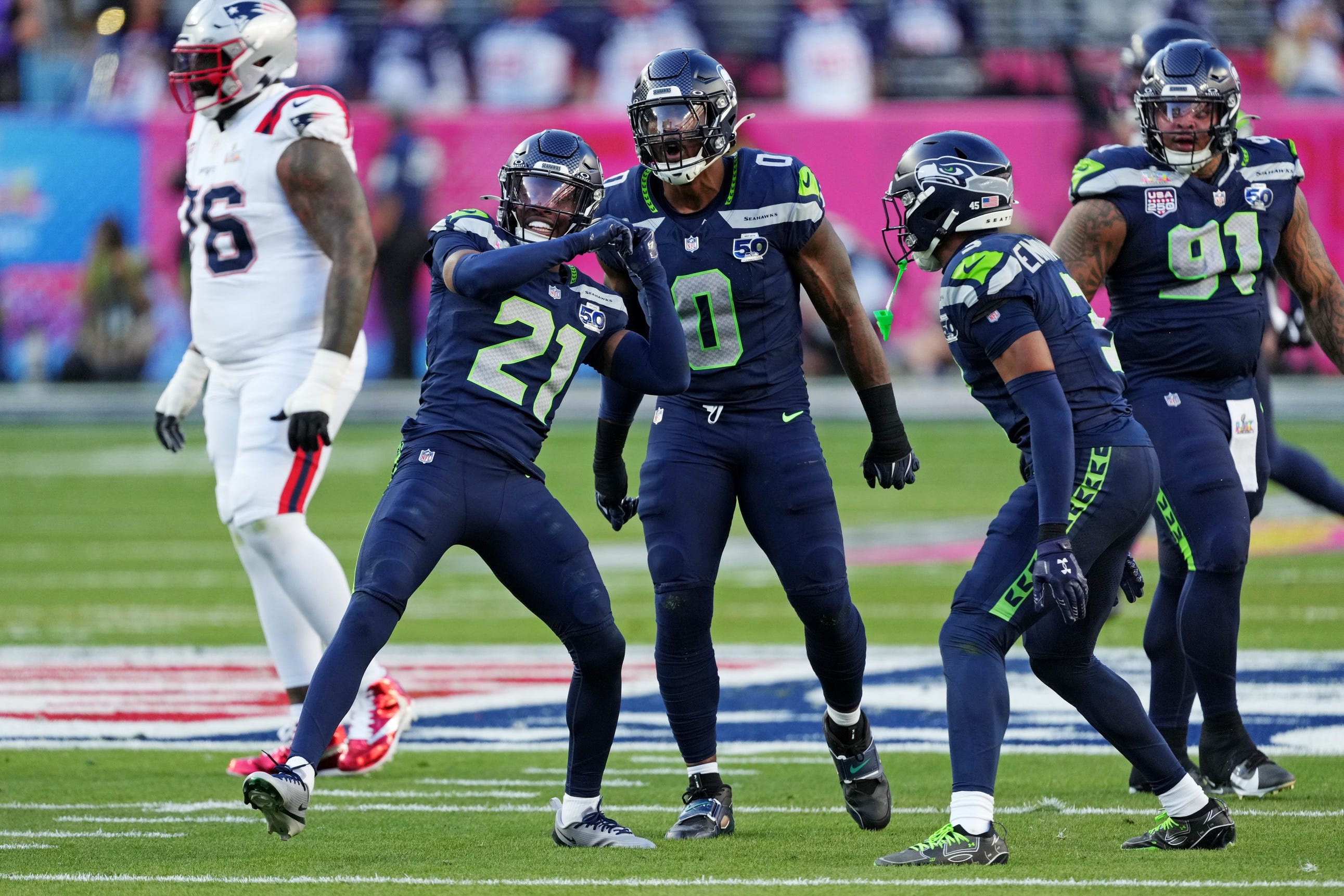
With the hiring of new general manager Nolan Teasley, the Minnesota Vikings will presumably be looking to emulate the Super Bowl champion Seattle Seahawks as the new boss builds the roster.
Key questions that he will have to answer is: How far away are the Vikings now and how can they get to the next level?
For Part 1, we looked at the offense, which was far away in 2025 but has an opportunity to get much closer in 2026. Part 2 focuses on a comparison between the Vikings and Seahawks’ defenses.
Let’s dive in…
Here’s how the 2025 Seahawks defense looked statistically…
PFF run defense grade: 2nd
PFF pass rush grade: 10th
PFF coverage grade: 3rd
PFF special teams grade: 7th
Defensive points rank: 1st
Sacks: 8th
Pressure rate: 6th
EPA vs. Pass: 4th
EPA vs. run: 1st
Turnover percentage: 6th
Blitz percentage: 26th
Two-deep safety %: 12th
It doesn’t get much better than the 2025 Seattle Seahawks defense. They ranked at the top of the NFL in points allowed and were in the top five against the run and pass when it came to Expected Points Added.
How did they get there?
From a performance perspective, it started with their ability to completely eviscerate the opponent’s run game. Ranking No. 1 doesn’t even begin to describe it. They were +41.1 points in EPA versus the run, which is 16 better than the next best team and 30 points better than the top-5 ranked Vikings. They gave up just 3.7 yards per attempt against and allowed only nine rushing TDs.
The impact was Seattle facing 253 of 600 passes on second or third down with more than 7 yards to go. Nearly half the time they were on the field, Seattle’s defense was seeing an obvious passing down, allowing the D-linemen to focus on creating pressure.
The best quarterbacks in NFL history are those who can overcome a sputtering run game and deal with an opponent’s pass rush but most human QBs are made significantly worse by pure passing situations. Of the 32 quarterbacks with over 100 passes on second or third-and-long in 2025, only Aaron Rodgers, Jared Goff, Justin Herbert, Drake Maye, Josh Allen, Jordan Love, Daniel Jones, Tyler Shough, Lamar Jackson, Mac Jones and Brock Purdy had quarterback ratings above 95 (Stafford’s was 94.7). Twelve QBs were under 80.
Seattle made things even more unpleasant for the opposition by leading the NFC in quarterback hits and creating a high rate of pressure while rarely blitzing (19% of the time). Not having to blitz worked to the advantage of Seattle’s cornerbacks, who were rarely left on an island. Seattle had the 4th highest Cover-6 coverage rate in the NFL, per TruMedia.
One stat that stood out is that Seattle’s leader in sacks only had 7.0 in 2025. However, they had three players with 7.0 sacks, one player with 6.0 and six players between 2.0 and 3.5 sacks. They had six pass rushers with 40 pressures or more as well.
How they built a deep defense is interesting. They went for explosiveness in the draft. Some examples:
— DT Byron Murphy had a 90th percentile 40-yard dash and a 91.1 PFF grade in his final year in college
— Devon Witherspoon allowed zero touchdowns and had three INTs and 14 PBUs on 62 targets at Illinois
— ED Boye Mafe had a 98th percentile 40-yard dash
— ED Derick Hall had a 94th percentile 40-yard dash
— CB Tariq Woolen ran a 99th percentile 40-yard dash and had a 92nd percentile vertical
— S Nick Emmanwori ran a 4.38 40-yard dash at 6-foot-3, 220 pounds
The Seahawks also picked up a couple quality veteran players for reasonable prices in ED DeMarcus Lawrence and LB Ernest Jones.
And they made one home run swing to acquire Leonard Williams from the New York Giants for a second and fifth-round pick.
Overall, Seattle had 11 players with at least 300 snaps who graded above average by PFF. It was a group that was built over several years, not with one big offseason. It was built at the top, middle and back end of the draft and it was built with free agency and trades.
Now let’s have a look at the Vikings defense…
PFF run defense grade: 15th
PFF pass rush grade: 14th
PFF coverage grade: 19th
PFF special teams grade: 1st
Defensive points rank: 7th
Sacks: 4th
Pressure rate: 3rd
EPA vs. Pass: 5th
EPA vs. run: 5th
Turnover percentage: 16th
Blitz percentage: 1st
Two-deep safety %: 1st
Something should jump out at you right away: The results were better than the PFF grades.
How does that happen? Brian. Flores.
What you can see from the Vikings’ numbers is how unique their defense is. They play more 2-deep safeties than anyone else in the NFL and blitz more than anyone.
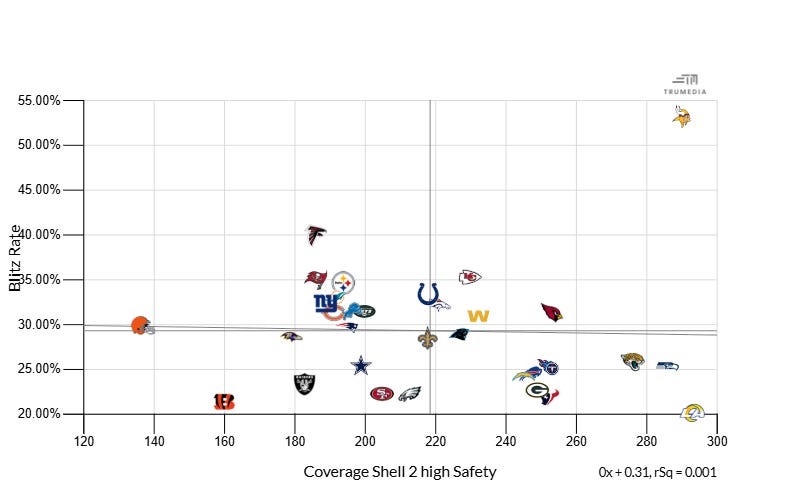
Flores’ defense has won by maximizing players’ skillsets more than freaky athleticism. Not to say that Andrew Van Ginkel, Eric Wilson or Josh Metellus aren’t good athletes but they don’t match the freakshow level of Seattle. Flores puts these types of players in situations where they can be multiple, lining up anywhere and everywhere and then working out with each other on the fly the pressures and coverages.
It was beautiful to watch when everyone was healthy and Flores even worked out a way to play more five-man fronts to slow down the opposing team’s run game without sacrificing a lot in coverage.
As brilliant as Flores is, Nolan Teasley’s goal should be to make his job easier.
If the Vikings could create a deep four-man rush around Turner in the coming years, Flores would have to rely less on blitzing at such a high rate and he could focus more on coverage variance and deception. With more freakshow talent, he might be able to play more man coverage as well.
And he’s going to have to get after that job right away because there are a lot of moving parts to the defense going forward. Outside of Dallas Turner and the 2026 draft class, there aren’t many spots that are guaranteed into the future. Van Ginkel, Blake Cashman and Isaiah Rodgers are free agents, two of the safeties are unproven and Byron Murphy Jr.’s deal is expensive.
In terms of freakishness, Banks is a step in the right direction. He may have been short on college production but he had the type of explosiveness that Seattle would like.
The bottom line is that the Vikings’ defense was close to a Super Bowl caliber defense in 2025 but there is a difference between Seattle’s unit and the Vikings. With Flores in place, they can make a transition from one era to the next without completely falling off because Flores sets a baseline with his scheme that will keep them afloat. If they can patiently build over a couple years with Flores in place, the results could be similar to Seattle. That should be Teasley’s goal.
The Rams play the Seahawks twice. How does the blockbuster trade for Garrett push them over the top in a strong NFC west? I've said it before that I don't think it will work. It should be interesting. I hope Teasley has more patience going forward.