
By Matthew Coller
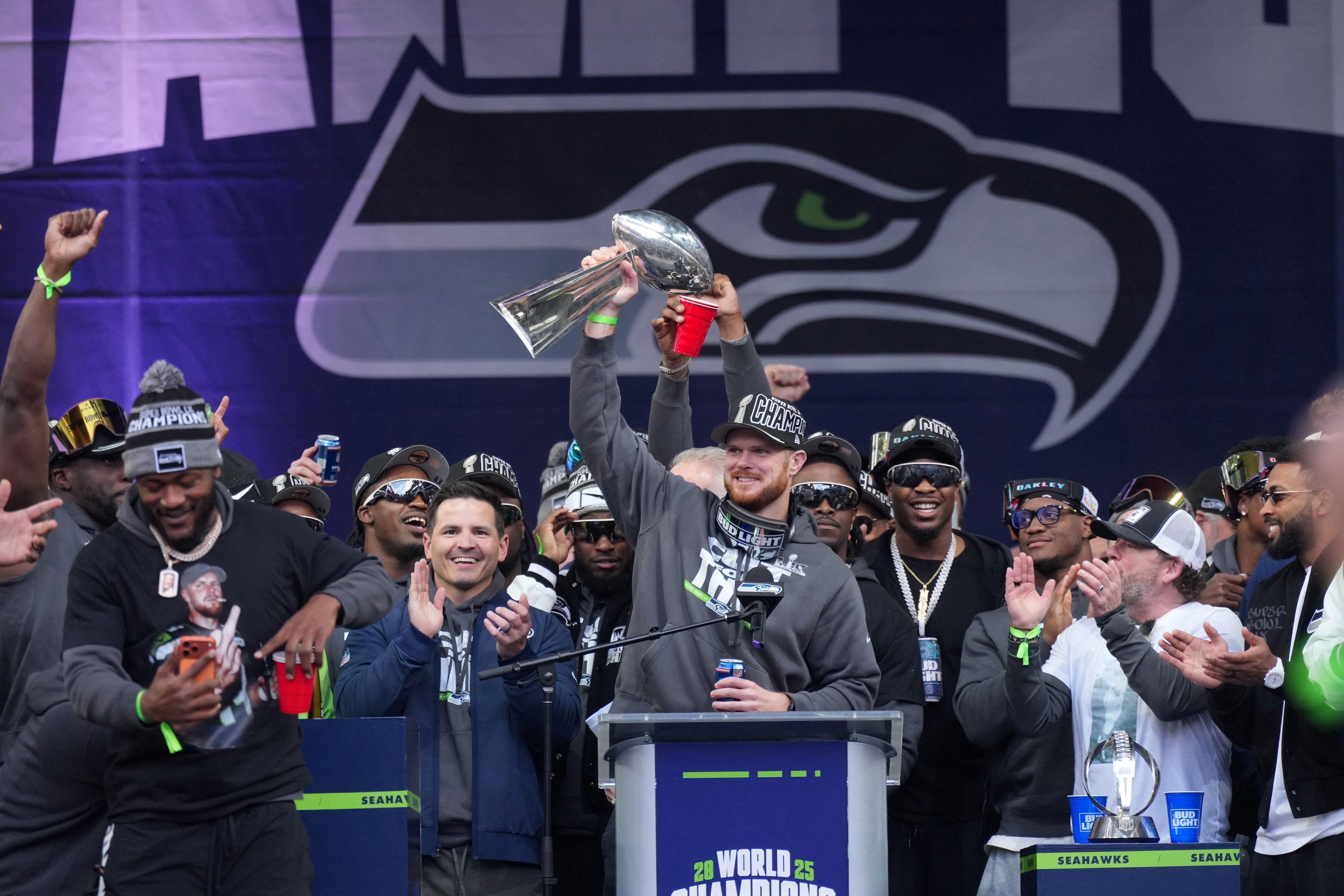
Now that the Minnesota Vikings have hired general manager Nolan Teasley, they will instantly turn into the Super Bowl champion Seattle Seahawks and raise the Lombardi Trophy next season.
That’s how it works, right?
Maybe not but the 2025 Seahawks championship team does work well as the bar to reach for the Vikings both in 2026 but also long term.
So we can look at Seattle’s data profile from last season and their roster strengths to determine how much better the Vikings would have to be in order to make their case for being a Super Bowl-caliber team this season and where they have to strengthen themselves into the future.
In Part 1, we look at the offensive side…
The conversation always has to begin with the quarterback but the fact that Sam Darnold, Jalen Hurts and Brock Purdy have represented the NFC in the last four Super Bowls and aren’t considered megastar QBs like Josh Allen or Lamar Jackson tells a story. Clearly they meet the standard of being quality quarterbacks but they were supported incredibly well.
Here is how they ranked by passing grade, pass blocking, receiving, rushing and run blocking by Pro Football Focus:
PFF passing grade: 9th
PFF pass blocking grade: 20th
PFF receiving grade: 3rd
PFF rushing grade: 2nd
PFF run blocking grade: 15th
Here’s how they ranked in key offensive categories:
Offensive points rank: 3rd
Passing EPA: 9th
Rushing EPA: 26th
ANY/A: 5th
Rush yards per game: 11th
Average time per drive: 22nd
20+ yard offensive plays: 7th
What can we take away?
— There’s some conflicting data when it comes to Seattle’s pass protection. They only scored 20th by PFF, yet Sam Darnold had the 11th best (out of 45) pressure rate and was only sacked 27 times and had the 10th best sack percentage in the NFL.
How is that possible? From a deeper look at Seattle’s O-line, we can see that four of their starters performed at an average or above average level but their right guard Anthony Bradford had massive issues, receiving only a 40.8 grade, which ranked second worst in the NFL among all starting guards. However, there were still 18 guards who gave up more QB pressures, meaning that Seattle was either able to help Bradford or avoid situations where he was most vulnerable.
The Seahawks had the third fewest pass attempts in the NFL on second or third down with more than eight yards to go. Their 169 attempts on second/third-and-long were only ahead of Los Angeles and Baltimore and were 85 attempts behind the league leaders Cleveland and Arizona.
Offensive coordinator Klink Kubiak was able to limit the number of times that opponents could dial up blitzes in the direction of Darnold.
It’s counter intuitive to what we know about maximizing efficiency that Seattle was No. 1 in rush attempts on second/third and longer than eight yards to go but when we consider that Seattle had the No. 1 defense in the NFL and one of the league’s elite punters, you can see why they would have been less concerned about having to punt and more worried about allowing a catastrophic play like a sack, strip-sack or interception.
The Seahawks also ranked No. 2 in the NFL in conversion percentage on third downs with less than five yards to go (63%). So they could run on second-and-long with confidence that they would be able to advance the ball for a first down in short yardage situations.
There’s another thing to note with their PFF pass blocking grade, which is that generally teams are able to cover up one weakness on the offensive line but not two or three. It’s possible to offer help with extra tight ends, a fullback or sliding protections in a certain way to lend a helping hand to a struggling player. Once you have two or three weaknesses, someone ends up getting exposed.
It was also very valuable for Seattle to have a top-notch backup offensive tackle in Josh Jones, who had a 71.9 PFF grade in 118 pass blocking snaps.
— Seattle’s run game is hard to figure out on paper. PFF loved the performances of RBs Ken Walker and Zach Charbonnet and graded Seattle solidly in run blocking, yet they only averaged 4.1 yards per carry as a team and were 26th in rushing EPA.
We can explain some of the EPA stuff with the high number of carries on second-and-long because that’s an EPA no-no. The reason EPA dings second-and-long runs is because avoiding third down altogether is favorable, even if you are good at third-and-short. However, EPA is also a general metric based on points produced by each down-and-distance and location on the field, it’s not a flawless, catch-all that applies exactly the same to every team and situation.
Short-yardage rushing also brings down yards per carry. Charbonnet carried the ball 24 times on third down with less than five yards to go, for example, and averaged 3.1 YPC on those runs. He was stopped 10 times, which would be a big blow to EPA.
— Seattle’s ability to lean super heavy on Jaxon Smith-Njigba without sacrificing efficiency is one of the most impressive jobs of offensive scheme/play design that you’ll see in the NFL. The Seahawks ranked No. 2 by PFF in receiving grade because Smith-Njigba ranked second in yards per route run despite getting 157 targets. Normally as volume increases, efficiency decreases but that’s not the case for the elites.
The other notable thing about Smith-Njigba is that he didn’t line up in the slot very often. Only 21%, which was in the bottom 25 of all receivers. We love the idea of moving receivers around all the time but if someone can dominate from the outside, then that allows the offense to get favorable matchups for weaker receivers and tight ends in the slot. When Darnold targeted Smith-Njigba, his QB rating was 120.8.
But Smith-Njigba wasn’t the entire passing game. Seattle had a good distribution with other receivers without leaning on a clear No. 2 option. Cooper Kupp and AJ Barner both cleared 500 yards, the RB duo added up to 51 receptions and former Saint Rashid Shaheed had 15 catches for 188 yards after being acquired at the trade deadline. So while they had one clear No. 1 option, there were a half dozen others who were capable of making big plays when their time came. Barner and Kupp both had Success Rates over 58%, for example.
Vikings comparison
PFF passing grade: 31st
PFF pass blocking grade: 14th
PFF receiving grade: 23rd
PFF rushing grade: 12th
PFF run blocking grade: 13th
Here’s how they ranked in key offensive categories:
Offensive points rank: 26th
Passing EPA: 28th
Rushing EPA: 13th
ANY/A: 29th
Rush yards per game: 23rd
Average time per drive: 29th
20+ yard offensive plays: 28th
It isn’t a secret to anyone that the Vikings quarterback play was brutal last year but it puts things into perspective when we look at the actual difference in estimated points produced via the passing game.
Seattle’s passing EPA was +93.2 points whereas the Vikings was -40.3. That essentially suggests that if the Vikings could crack the top 10 in passing, it would be worth 133.5 more points.
It’s more complicated than that but that demonstrates how far away they really were from a top-10 passing game.
The question for both the short and long term is whether Kyler Murray can take them into that ballpark to produce a passing game strong enough to compete for a Super Bowl.
There may be an increase in rushing but the passing EPAs of teams that have reached the Super Bowl over the last five years are: 1st, 9th, 11th, 14th, 1st, 12th, 1st, 9th, 5th, 9th.
The only teams to be outside the top 10 were Mahomes’ Chiefs in 2024 and the 2024 Eagles, who had a 2,000-yard rusher in Saquon Barkley.
In 2021, Murray led an Arizona Cardinals team that ranked 7th in EPA at an impressive +146.6.
The passing environment has changed since then and that may have impacted Murray to some extent. In 2024, Murray’s Cardinals ranked 15th at +81.6.
The question is: How much Kevin O’Connell and the Vikings supporting cast can do to enhance Murray’s performance to the point where it reaches the baseline of Super Bowl contenders?
In 2024, the Vikings had the 6th highest passing EPA in the NFL at +136.8 and in 2022 with Kirk Cousins it was 8th at +109.6. And they still finished 15th in 2023 despite missing Cousins for half the season.
Those numbers are a bit skewed by how often O’Connell dials up passing plays. On a per play basis, the Vikings were 18th in 2022 and 11th in 2024 and Cousins was 16th in EPA/play.
Spamming pass plays probably isn’t the best way to approach Kyler Murray.
That’s basically what the Cardinals have been doing with him though. Since 2020, Murray averages the 6th most pass attempts per start since 2020.
There may be something to be borrowed from Seattle in terms of play calling. When it comes to Murray’s major miscues like sacks and interceptions, Murray’s rates since 2020 are decent. He’s 15th of 42 QBs with at least 1,000 passes since 2020 in sack percentage and tied for 13th in INT percentage. But it seems like he’s making more mistakes than he actually is because his team is leaning on him so heavily.
What if the Vikings were able to lean more on the run game and reduce the high-difficulty attempts from Murray while maximizing his opportunities in favorable situations like first-and-10 and second-and-short?
In 2024, for example, Murray completed 71.8% of his passes with 15 touchdowns, six INTs and a 98.5 QB rating when throwing on first and second down.
On third downs with five or fewer yards to go, Murray in 2024 completed 71.2% of his passes with 8.4 yards per attempt and a 115.5 QB rating and converted 60% of first downs (only counting pass attempts).
On third down with eight or more yards to go, he had a 76.6 QB rating and converted 17% of throws.
Does that mean the Vikings should run the ball when it’s not particularly efficient to do so?
Possibly, yes. Particularly because their run game with Jordan Mason was efficient last year.
In terms of Success Rate, Mason was fifth in the NFL last year and he was 11th in yards per attempt. He may not have the same explosive play potential as someone like Kenneth Walker but he has been a handful for defenses in San Francisco and Minnesota.
In the long run, it’s likely that Nolan Teasley will have to find a running back who is a true difference maker.
Also you can only run the ball in unfavorable situations if you trust your defense and the Vikings showed toward the end of last season that they could play and win that way under the right circumstances.
Ultimately, however, getting the most out of Murray will come down to his connection with Justin Jefferson. When Sam Darnold threw the ball toward Jefferson in 2024, he had a 107.4 QB rating. When Kirk Cousins threw him the ball in 2022, he had a 113.9 rating throwing to Jefferson.
It’s been a long time since Murray had a receiver of his caliber. Between 2020 and 2021, Murray had a 109.3 rating throwing to DeAndre Hopkins and that’s the only remotely close comparison to the best receiver of the generation.
The Vikings have the supporting cast around Jefferson to match what Seattle did last year with Cooper Kupp, AJ Barner and Rashid Shaheed with Jordan Addison, Jauan Jennings and TJ Hockenson.
They also have an offensive line that can match 2025 Seattle. The question is going to be about health. Far too often the Vikings had multiple injuries, which left them with multiple weak points. They could manage their way through Blake Brandel not being an elite center or Will Fries’ ups and downs in pass protection but it would be very difficult to manage more than that, even with improvements in the team’s depth.
From a 2026 perspective, the Vikings have a quarterback and play caller who theoretically should be able to match what Sam Darnold and Seattle did last year with some adaptations and some health luck up front.
From a long-term viewpoint for Teasley, he will have to decide whether Murray’s performance meets the markers of a QB who can compete for a top-10 Expected Points Added offense year after year. He will also have to decide whether he can do it at a certain price tag. Seattle was able to add Kupp in the offseason because they had the cap flexibility to do so. It might not have been possible if Sam Darnold was making $50 million rather than $30 million.
There will also be plenty of questions to answer with the weapons going forward. Does Jefferson sign another mega extension? Does Addison sign an extension? Could Hockenson be retained if he thrives with Murray or will they need a tight end in waiting? Who’s WR3 after this year? Can it all be kept together if they pay Murray?
Combining a talented RB with an offensive line capable of pounding away at defenses that O’Connell can trust is also a significant part of the future as well. That might mean getting some linemen whose talents lean more toward run blocking and asking O’Connell to fill in the blanks as opposed to putting a hefty load on the O-line as he’s done in recent years.
Darnold also proved that you can get there when things go right but a top-10ish passing game only reaches the Super Bowl if the defense is the driver of the team. It’s not possible to run at inefficient times if the defense can’t bail you out.
We’ll look at the defense for Part 2…
Great read. My favorite thing about the Vikings organization in the post-Zimmer era (there are a few, no doubt) is their willingness and ability to make adjustments - which is uncommon for a Minnesota sports team. It really gives the fans reason to hope each season. As a long time fan, and all the heartbreak that has come with it, I really appreciate the blend of "let's be competitive now" with "we need core fundamentals to build a strong foundation" (otherwise the highest powered offense in the league can get shutout 41-0 in the NFC Championship game). I really, really hope Murray comes in and just kills it with KOC's guidance. But if he's not the long-term answer, it still feels like we are making pretty good strategic decisions for the long-term. Hopefully Teally adds to the equation. These players have earned a shot at a good season with a competitive team. SKOL.
One of the big surprises to me in the Seahawks stats was how they ranked 26th in Rushing EPA. I keep hearing about how the Seahawks had an amazing run game and they won the Superbowl off of it and Sam Darnold was more along for the ride. This seems to conflict with that narrative.