
By Matthew Coller
EAGAN — As Day 1 of Minnesota Vikings and Baltimore Ravens joint practices was about to wrap up, the two teams’ starting units took the field for a situational drill. These are the 1s vs. 1s that everybody wants to see. It’s the closest thing to real football that the starters will get before Week 1, so they lock in.
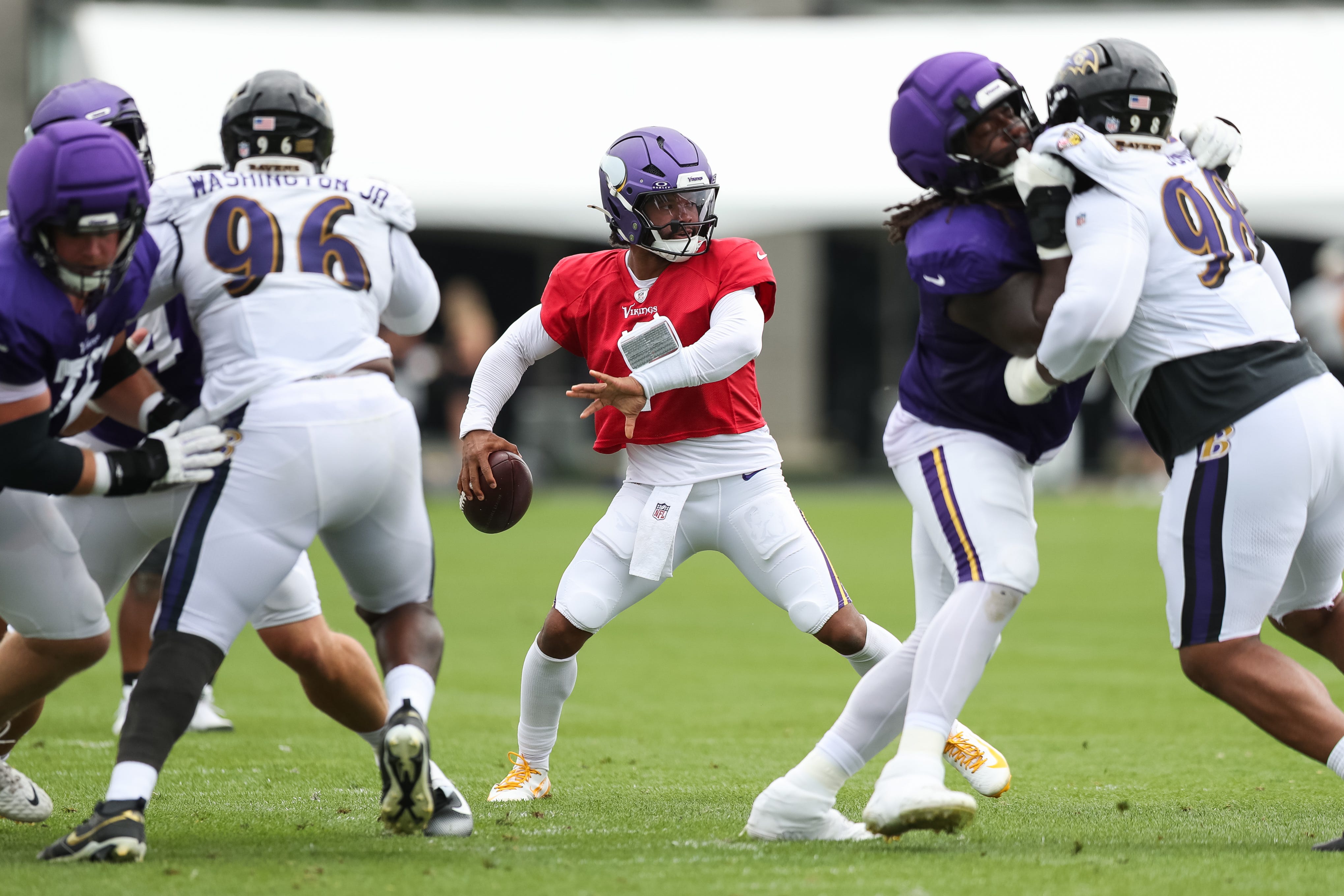
In the arena, surrounded by dozens of coaches and the second and third teamers on the sidelines and a few thousand fans in the bleachers, Kyler Murray stood only a few feet from Baltimore defensive tackle Calais Campbell, who stands 6-foot-8. Between Murray and one of the great pass rushing D-linemen of the generation was 6-foot-7 center Blake Brandel, 6-foot-7 guard Will Fries and 6-foot-4 guard Donovan Jackson.
From the behind-the-defense view, the 5-foot-10 quarterback disappeared into a sea of humanity as soon as he took the snap. Two seconds later, a football emerged in the air, seemingly out of nowhere. As the ball floated through the sky, superstar receiver Justin Jefferson broke away from two Ravens defenders and raced toward the back of the end zone. The ball fell to the earth in NFL Films-y slow motion fashion, right into Jefferson’s outstretched hands. Touchdown.
In total, it traveled about 40 yards through the air. Murray trotted down, gave Jefferson a low-five and went back to the sideline.
How in the world did he make that throw from behind the guys in the trenches that are somewhere between six and 10 inches taller than him?
After that throw, I decided to ask Kevin O’Connell, a coach who worked with Murray in Arizona, a quarterback trainer and a physics professor the same question: How does Murray succeed from the pocket when everyone else around him is so much bigger?
Seeing the field
The most obvious problem of a quarterback who is 5-foot-10 is being able to see his wide receivers through the trees. This can be a problem for quarterbacks who are much bigger than Murray, which makes it even crazier that he’s able to make throws like the one he completed to Jefferson. How does he have any idea what’s going on downfield? How did he know where Jefferson was?
Inside the Vikings’ quarterback room, O’Connell has a rule: If Murray doesn’t throw to the right place, he can’t use the words, ‘I couldn’t see him,’ as an explanation.
“He couldn’t see on a play and he didn’t want to tell me that, so he prefaced it with, ‘I know I’m not allowed to say this, but….’” O’Connell said. “We both got a laugh out of it.”
The Vikings’ head coach showed his quarterback room a portion of 6-foot QB Drew Brees’ Hall of Fame speech that addressed the issue of being able to see receivers. Brees told a story about a film session with coaches Cam Cameron and Brian Schottenheimer in which they questioned why he didn’t make a particular throw.
“I was coming off a tough game, and as we watched the tape together, they asked me the question, ‘Hey, why didn’t you throw to this receiver? He’s wide open,’” Brees told the Canton audience. “To which my response was, ‘I couldn’t see him.’ The tape paused, there was a moment of silence, they glared at me and said, ‘It’s your JOB to see.’”
In the NFL Films’ “A Football Life” documentary about 6-foot-2 Hall of Famer Steve Young, a lightbulb moment in his career came when Mike Holmgren told him that since he wasn’t going to be able to see the receivers, he just needed to trust that they are going to be there.
“It’s going to happen from time to time, depending on the angles and how the protection and the rush kind of pattern works,” O’Connell explained. “But he also has a lot of experience understanding space based upon the defense that they play, space based upon what we’re trying to do from a standpoint of attacking voids and vacancies. We’ve seen some really good examples of him being able to overcome that by playing in rhythm and anticipating some throws.”
While the Jefferson play shined along with a number of other quality completions downfield, there were also times in camp where certain throws did not land in the right spot.
“We’ve seen some times where we’ve got to get more reps of what that throw actually feels like because he’s tried to anticipate some and maybe it’s a little long or he throws at a little higher angle than Justin comes out of it,” O’Connell said. “That’s a lot of time on task from another offense where maybe we have some subtle differences.”
Current UMass wide receivers coach/pass game coordinator Jordan Hogan was an assistant QBs coach when Murray was in Arizona and one of his jobs was to stand behind the QB and shoot video for their virtual reality program. His camera was the QB’s eyes, more or less. What does it look like back there?
“It’s a lot of chaos,” Hogan told Purple Insider over the phone. “Especially when all those arms are up in the air flying everywhere.”
Hogan explained that in offenses like O’Connell’s, there are “progression reads” that focus on how the defense plays against a particular route combination and decisions with the football are made based on the coverage rather than trying to see receivers get open and throw to them. It’s easier for the QB to spot the safeties or linebackers than watch his receiver all the way through the route.
“There’s a progression, so his eyes are going to start at a certain spot…whether you’re reading the [linebacker] or you’re reading the safety, your eyes are going to always start on the [defense],” Hogan explained. “You’re always going to start to one side of the field, and then as the defense takes away one read, you should have another throw coming into your vision.”
It will work “as long as his footwork is tied, as long as his eyes are tied with his footwork,” Hogan said.
The word that keeps coming up over and over is “anticipation.” On Jefferson’s touchdown against the Ravens, the ball was up in the air when Jefferson was at about the 15 yard line and he caught it in the back of the end zone. If the throws are timed correctly, then Murray can throw it to a specific spot knowing his receiver eventually will be there, even if he can’t exactly see him en route.
“It is truly on anticipation, timing and rhythm,” Hogan said.
Because of Murray’s speed and highlight reel, he has a reputation for scrambling around Fran Tarkenton style (or Mahomes, for the younger folks) and waiting to find somebody open downfield. But Hogan said that it’s a misconception that Murray bails from the pocket and tries to play hero all the time.
“He truly wants to stay in the pocket and play quarterback, that’s what he wants,” Hogan said. “He’s not out here to run around and be on the ESPN and get Top 10 plays and things like that. He wants to play the position the right way. He knows that in order to play this position, you have to play it from the pocket, going through progressions and throw with great anticipation because obviously he can’t see. He’s got a strong arm.”
Despite his presence on highlight reels, the numbers would back up that Murray plays inside the pocket much more often than people think. In 2024, he ranked 13th in the percentage of throws that came within 2.5 seconds of the snap. He was in the same ballpark as pocket QBs like Derek Carr and Kirk Cousins.
Requiring him to stay on time with the routes and throw blind sometimes doesn’t mean the Vikings want Murray to throw blind every time or to be a statue in the pocket.
“You have to be able to create throwing lanes…he does a really good job of sidestepping, maybe stepping up into the pocket,” Hogan said. “If there’s a B gap, he’ll step up into it…for small guys, you have to be able to move around within the pocket to be able to create those throwing lanes.”
Hogan shared video of drills that they used to work on in Arizona where Murray would side step in his drop-back in order to create throwing lanes.
Of course, all the anticipation and footwork in the world doesn’t change the reality that Murray’s height will matter sometimes when it comes to seeing the field.
In 2024, only 7.3% of his passes went to the middle of the field while traveling more than 10 yards past the line of scrimmage, per PFF. O’Connell will have to build in answers.


Hogan mentions two solutions: Rollouts and checkdowns.
Under O’Connell, quarterbacks have been under center regularly and used play-action bootlegs where the QB rolls out and has a clearer look downfield. In 2024, Murray threw 121 passes from under center and had a 99.7 passer rating and averaged 8.1 yards per attempt.
Checkdowns are the bane of football fans’ existence but they can also be deadly in a downfield passing offense, especially with a yards-after-catch monster like Jauan Jennings added to the mix. O’Connell has mentioned the “power of completions” and the pressure it puts on defenses as the ball matriculates down the field.
“If you can progress your third read and that’s not there, your check down should always be there,” Hogan said. “That’s really big in this offense. Your check downs will be there. Like, progress, progress. Okay, he’s not there, check it now….you should always have an answer.”
The throwing
When I called University of Nebraska-Lincoln physics professor Timothy Gay, who authored the book Football Physics: The Science of the Game, to ask him how Kyler Murray was impacted in terms of his throwing by his height, he didn’t have an immediate answer. He needed do some math and call me back.
A few days later, Gay emailed over a drawing.
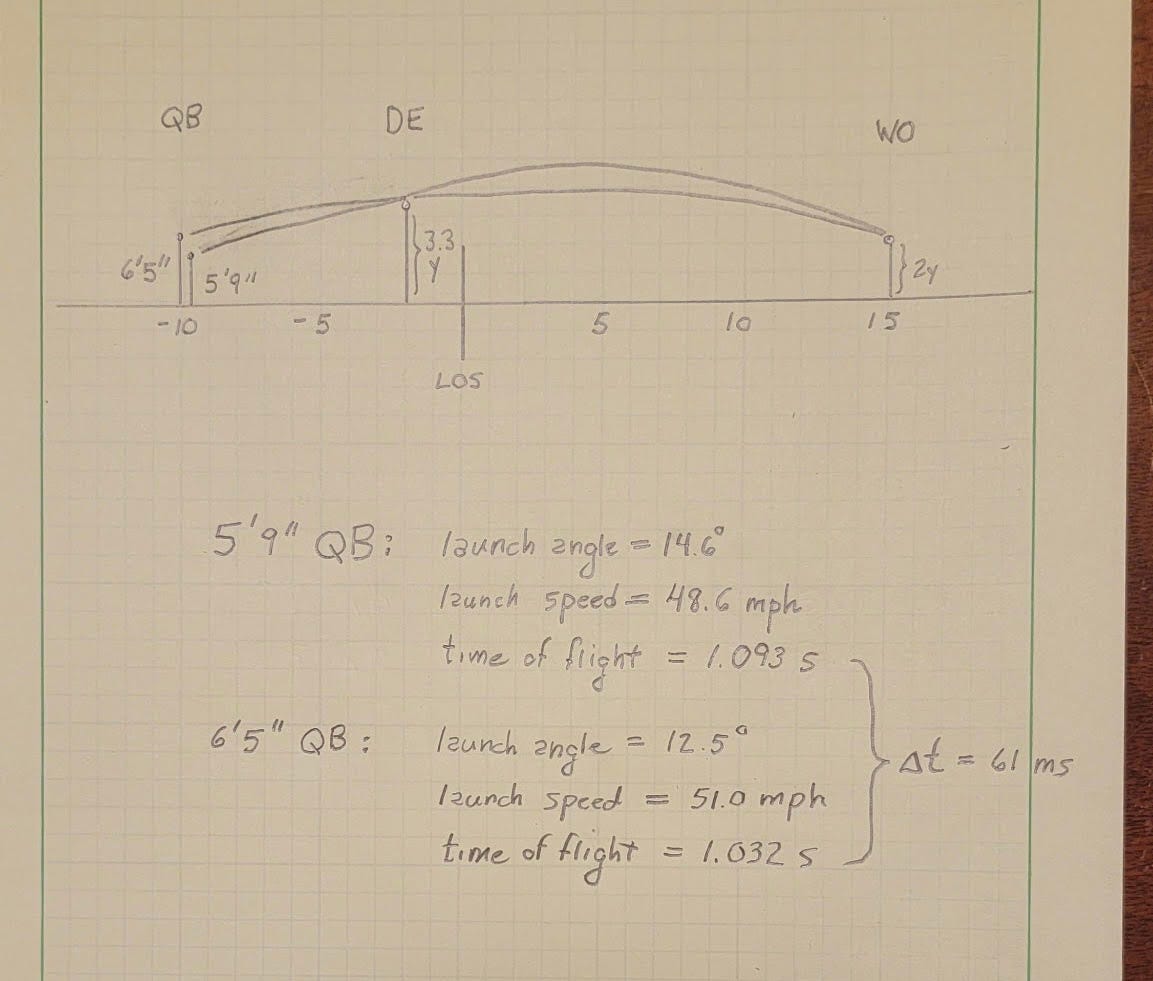
Here’s how Gay decided to solve the problem: He looked at a quarterback 10 yards behind the line of scrimmage throwing the ball over a defensive lineman’s outstretched arms who had pushed the O-line back three yards toward the QB and the trajectory that the ball would have to travel in order to clear the D-lineman and reach a wide receiver that was 15 yards downfield with an accurate pass that was six feet off the ground. He then compared that to a 6-foot-5 quarterback.
What he found was that Murray has to use a different trajectory, from 12.5 degrees for the 6-foot-5 QB to 14.6 degrees, meaning that he has to throw the ball slower in order to get the same result, going from 51.0 mph to 48.6 mph. Slowing down the throw creates a longer time of flight, from 1.032 seconds for the big QB to 1.093 seconds for the short QB.
“There are slight differences,” Gay said over the phone. “You are going to have to practice a lot in order to get the launch angle down. The diagram shows the differences, which are small but significant.”
There’s pluses and minuses to putting more touch on the ball. Last year, Hall of Fame quarterback Kurt Warner told Purple Insider that more loft on the football gives wide receivers more time to adjust. If the ball is slightly over or under thrown, they have more time to tweak their angles on the fly as opposed to the line-drive throws that leave less margin for error.
However, that also gives defenders more time to break up or intercept a pass.
“In the short quarterback’s launch, the ball will go higher, which may give the wide receiver a better chance to get at it,” Gay said.
Gay tried two different versions of the defensive lineman. He had another where the D-lineman got pushed back by two yards from the line of scrimmage. He was curious whether the push from the linemen was going to have a big impact on Murray’s angle.
“I was surprised was how little it changed the launch angle or speed,” Gay said.
Meaning that if Murray can hang in the pocket even with someone bearing down on him, the throw doesn’t require as much of adjustment as you’d think. That might also speak to playing under center, whereas coaches have always seemed to believe that Murray needed to be in shotgun due to his height.
But how do short quarterbacks master the art of trajectory and speed? It’s much more natural to whip the ball like the 6-foot-5 fella.
For that answer, I called quarterback trainer Cleveland McCoy, who is also the head coach at Coon Rapids High School. McCoy was a former quarterback at South Carolina State and had opportunities in camp with several NFL teams. A few years ago he was asked to work with a friend’s son on playing QB and was inspired to turn it into a business called QB Football Training.
He said that one answer for Murray when it comes to trajectories is to use any route to the wide receiver possible. You don’t always have to go up over the defensive lineman, you can also go around him with the pass.
“Kyler has a baseball background, so you gotta think that really helps him,” McCoy said over the phone. “Because he’s got different arm angles that he really perfected over his time. If he always throws over top, he’s going to hit his back of the helmet. So he has a really good grasp on just his arm trajectory as far as finding different arm slots to throw the football. I think that was big for him.”
While the anticipation throws over 6-foot-8 D-linemen are needed in order to win, relying on Murray to nail all the elements of timing, trajectory, velocity, progressions over and over and over can be difficult. McCoy points out that short QBs can be more effective using quick game.
In 2024, Murray ranked seventh in the NFL in completion percentage and had an on-target percentage (per PFR) of 79.1% (sixth best) while having an average depth of target that ranked 33rd out of 44 QBs. He completed 207 of 250 throws that went between 0-9 yards in the air, the 9th best completion percentage on such throws.
I asked McCoy how someone becomes prolific at throwing quick-game passes.
“It’s about being on schedule,” McCoy said. “You drop back and that ball has to be out. I think that’s where smaller quarterbacks really, really, really, really, really focus on that.”
How do you stay on schedule and get the ball out quickly with a high degree of accuracy? Feet, feet, feet, feet.
“Your footwork is very essential because quick game footwork is fast,” McCoy said. “I think in the NFL, those defensive backs are extremely fast. So you have to get that ball and get it out quick. And there’s a lot of this is rhythm and timing. Those are things that you work on before practice, after practice.”
Drew Brees’ name comes up again as the gold standard for an undersized guy playing on schedule with quick game.
“Drew Brees, man, he was one of the best to do it, and he had a smaller stature, but he just knew exactly where to put the football at the right time,” McCoy said.
Why did Brees have so much success getting the ball out quickly and to the right places? McCoy said that something he focuses on with his QB students is what’s going on from the shoulder pads and up.
“It starts from the head, pre-snap,” McCoy said. “Pre-snap is huge because if you know where you’re throwing the ball in a quick game concept before you even call your cadence, then it’s just about getting the ball out.”
McCoy said that fans should appreciate how rare it is that Murray can make it at his size. Most quarterbacks his size get moved to different positions or are ignored by colleges because they don’t fit the prototype. The fact that he’s been above average in the NFL is one in a million.
But it doesn’t happen alone. McCoy emphasizes the importance of Murray and O’Connell being on the same page as they go throughout the 2026 season. The play caller has to be aware of what works best for Murray and Murray has to be 100% locked in on every detail of the system in order to make it click.
“If you can find the right offensive coordinator where you work well in that system as far as getting the ball out fast and being able to stay consistent, that works,” McCoy said. “I feel like that really benefited Drew Brees. We see even with Sean Payton, getting the football out with Bo Nix has been super important. He’s not the tallest guy either.”
This week, Murray will get his first chance to bring it all together. To put footballs up in the air at the best angles for Justin Jefferson to chase them down. To show how much he’s in command of O’Connell’s offense. To play under center, roll out, change arm angles and throw passes blind based purely on reading the defense.
And if he makes it work and pushes the Vikings back to a top-10 scoring offense, Murray can change the narrative about how much his height impacts his performance.
Awesome article. Love the physics diagram. Feels like we never got the full Kyler hype cycle during camp because there was only a day or two in there where people said he looked amazing, but like Coller has pointed out many times, the camp performances aren’t always indicative of what we’ll see during the season. Hoping we see enough out of Kyler the first few weeks to crank up that hype wagon.
Great article. I love the insight. I am going to start out the year with high hopes lol.