

By Matthew Coller
This year’s defensive tackle class leaves a lot to be desired in comparison to some previous groups.
There are only three DTs who are being mocked routinely in the first round: Ohio State’s Kayden McDonald, Clemson’s Peter Woods and Florida giant Caleb Banks.
McDonald has the fewest questions about his game. He is a 326-pound run-stuffing monster who tosses guards around and adds to his intimidation factor by painting his entire face for games. He made an exceptional 65 tackles and ranked as a top run defender in the country by PFF. Plus he only missed two tackles all season.
Woods, a explosive 298-pounder from Clemson, has a bit different of a profile but still stands out as a run defender. He was better during his junior year when he lined up across the line more than just being jammed in the middle to eat up blockers.
Banks has injury concerns but his size is only matched by a handful of NFL defensive tackles. He’s 6-foot-6, 327 and has unbelievably long arms and giant hands. He also has movement skill that is crazy for his size. The problem is that he dealt with injury issues in 2025 and his production in 2024 didn’t match his talent.
The Minnesota Vikings should be considering all three players with the 18th overall pick (or if they trade down in the first round) because their current roster only has one proven defensive tackle in Jalen Redmond and then project players in Levi Drake Rodriguez, Ty Ingram-Dawkins and Elijah Williams. They let go Jonathan Allen and Javon Hargrave and haven’t signed anyone else to take their place.
The question about this set of DTs is whether any of them is actually worth a first-round pick.
There are a wide range of opinions on McDonald, Woods and Banks. For example, Dane Brugler of The Athletic has McDonald as his 32nd ranked overall player with Woods at 35 and Banks at 52. NFL.com’s Lance Zierlein has Banks as the only first-round pick of the three, whereas NFL.com’s Eric Edholm ranks Peter Woods as the best of the group and his 23rd overall player. Yahoo! Sports recently did a mock draft pairing McDonald with the Vikings.
While they are different types of players, the biggest concern for this set of mammoth mem is that none of them have an impressive track record of rushing the passer during their college careers.
Here is how they graded by PFF in their last two seasons versus the run and as pass rushers.
McDonald: 91.2 run stopping, 63.1 pass rushing
Banks (2024): 67.9 run stopping, 73.2 pass rushing
Woods: 74.5 run stopping, 65.4 pass rushing
By these measures, our trio of DTs would make up some of the worst first-round picks that we’ve seen in recent memory if they were taken on Day 1 of the draft.
Here is a chart of how all of the recent first-round defensive tackles graded, with grades over and under 85 (elite) highlighted:
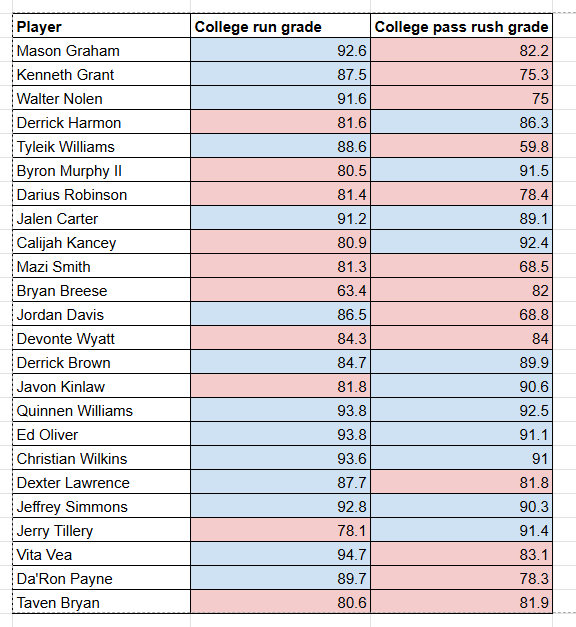
Right away you will notice that very few players were scoring in the 60s or 70s by PFF on either side of the ball. Generally speaking, players without completely dominating performances in college slip to the second round. It’s hardly impossible that it could happen. Back in 2021, there were no first-round DTs.
You’ll probably notice something else: Some of the players that McDonald, Woods and Banks have been compared with have much, much better PFF scores. Vita Vea and Dexter Lawrence weren’t elite pass-rushing talents but for their 340+ pound size, they scored in the 80s, better than all three current prospects. Vea also produced one of the best run defensive grades in PFF’s history.
Here’s how the list shook out by categories of complete DTs, run stuffers and pass rushers:
Players who were elite at both: Jalen Carter, Derrick Brown, Quinnen Williams, Ed Oliver, Christian Wilkins, Jeffery Simmons.
Players who were not elite pass rushers but stopped the run: Mason Graham, Kenneth Grant, Walter Nolen, Tyliek Williams, Jordan Davis, Dexter Lawrence, Vita Vea, Da’Ron Payne.
Players who were not elite run defenders but rushed the passer: Derrick Harmon, Byron Murphy II, Calijah Kancey, Javon Kinlaw, Jerry Tillery
Players who were not elite at either: Darius Robinson, Mazi Smith, Bryan Breese, Taven Bryan
Kinda good at both: Devonte Wyatt
Some observations:
— Every single DT who graded elite at both turned out to be a very, very good or great NFL player.
— The four DTs from last year are not yet determined but none of them were game changers right away. The others outside of Payne are the freakiest of the freaky freak monsters in the NFL and all of them had better pass rush grades than McDonald.
— All the players who weren’t elite at either skill were busts.
It’s worth saying that nothing in the draft is ever totally predictable. This research does not prove that any of the players will or won’t thrive but there is a conclusion to be drawn: Banks and Woods fall under the category of not being elite at either skill. That should be very concerning to whoever decides to draft them.
Woods does have a better argument than Banks because in 2024 he was much closer to the 85 mark with an 81.3 run grade and 74.0 pass rush grade.
McDonald has a much better argument to fall under the umbrella of players like Davis and Vea. But he isn’t quite the same size as those who worked out.
Davis is 6-foot-6, 341 pounds and ran a 4.78 40-yard dash. Vea is 6-foot-4, 347 pounds and benched an incredible 41 reps. Lawrence is 6-foot-4, 342 pounds and has one of the widest wingspans in the entire league.
Another interesting trend in researching defensive tackles who were taken in the first round is that run defense grade doesn’t always translate.
Below is a chart of the final season of each first-round defensive tackle’s college career by PFF run defense grade and their most recent NFL season.

One thing to factor when looking at the chart is that NFL grades are naturally not going to be as high as college grades because it’s impossible to dominate pro competition in the same way but if you consider that a 60.0 PFF grade is the top 30% of the NFL in run defense grade, then we find that 17 of our 24 first-round DTs are below that mark.
Out of the top 20 run defenders in the NFL last year at DT, we find all sorts of Day 2 and Day 3 picks. Baltimore’s Travis Jones ranked third, UDFA Poona Ford was fifth, fourth-rounder Harrison Phillips sixth, UDFA Tier Tart seventh, Atlanta’s David Onyemata (fourth-rounder) eighth, sixth-round pick DJ Jones 10th and UDFA Jalen Redmond 11th.
That doesn’t mean first-rounders can’t stop the run. The top two were Quinnen Williams and Cam Heyward and Vita Vea, Derrick Brown and Jeffery Simmons are all in the top 25 but former Viking Jonathan Bullard is right in that same mix.
We might conclude here that it’s hard to be a one-man wrecking crew against the run as a DT these days.
In 2015, PFF graded 25 defensive tackles over an 80.0 grade. In 2025, there were three.
There’s a few possible explanations for that. Teams have gotten smarter about how they run the football. The NFL has seen a massive jump in Expected Points Added on the ground over the last 10 years. Defenses also have focused more on getting after the passer, so DTs are more often being told to stop the run on the way to the quarterback. The amount of stunts and blitzes that defensive coordinators are dialing up likely makes it more difficult to go straight forward and stop the run.
You might argue that it’s a cheat code to have a guy who does it exceptionally well and that’s fair. But we can’t assume based on the college performances from McDonald, Woods or Banks that they actually will do it well and stopping the run certainly isn’t worth a first-round pick when we look at EPA.
The average NFL team’s total EPA from passing the ball in 2025 was 60.3 points and the average rushing was 11.2 points.
Certainly there are impacts on the passing game from running successfully like having more opportunities to dial up play-action and sack avoidance. It’s also clear that teams are handing off more these days than in the recent past. But pressuring and sacking the QB are still having more impact than stopping runs.
The Seahawks were the NFL’s best run defense last year in terms of EPA allowed but the next six best teams behind them all missed the playoffs. Seattle was also No. 4 in pass defense. Usually it’s best to be good at everything, but if you’re going to choose, you’d still prefer shutting down the pass game.
That doesn’t mean the Vikings should avoid all run-focused defensive tackles in the draft. In fact, there are a high number of players in this year’s draft that would be worth looking at in either Day 2 or 3.
Here are a few of the best names and their PFF run defense grades:
Christen Miller, Georgia (43rd on Brugler’s big board) — 90.2 PFF run defense grade
Lee Hunter, Texas Tech (55th) — 84.3 grade
Nick Barrett, South Carolina — 82.9 grade
Darrell Jackson Jr., Florida St. — 81.3 grade
Dontay Corleone, Cincinnati — 80.9 grade
Chris McClellan, Missouri — 75.2 grade
When it comes to the current group of defensive tackles, it’s worth noting that the possibility exists for there to be extenuating circumstances and each one of them might end up becoming a star. McDonald is strong enough and quick enough to become a version of Vita Vea and Caleb Banks could click and look something like Linval Joseph and Woods might get better usage and become Harrison Phillips-plus. But if we are playing the odds game, the better path is to look for mid-round DTs and sign a cheaper veteran who fits the system.
Three cheers for Derrick Brown. I appreciated these defensive insights.
Well done.... Pick a DB (hopefully after a trade back) and worry about DT in round 2 or 3... I wonder if the foot injury has Banks drop to 49......