
By Matthew Coller
EAGAN — The Minnesota Vikings’ passing numbers are downright shocking in comparison to previous seasons.
In 2024, they were 10th in total Expected Points Added through the air. In 2023, despite playing backup QBs for half the season, the Vikings finished 16th. In 2022, they were 7th. This year? 30th.
On Monday, head coach Kevin O’Connell mentioned that the identity of the passing game had been its explosiveness in previous years. Last season they were second in the NFL in passing plays that went for more than 20 yards. In 2023? Also second. In 2024, 14th. Still above average. This year? 25th.
“We haven’t been anywhere near our standard of doing things,” O’Connell said.
So what’s the next step?
The Vikings have five games left to go and JJ McCarthy is returning under center this week. They are in dire need of improvement and have a favorable group of upcoming opponents in the next three weeks.
The answer: Simplify.
“I’m going to personally look at myself and how I can continue to find a way to coach the details of the plays that are called, and what type of plays we’re going to call, and how many plays we’re going to take into games, and if we’ve got to limit our inventory and just demand execution, we’ll do it even more than we already have,” O’Connell said.
No coach has ever gotten negative reviews for saying that they are going to simplify things. It always sounds like common sense when a team is struggling. Go back to basics. Stop overcomplicating things for players, just let ‘em play ball.
“You can have more consistent formation families and packages, some things where guys have no confusion whatsoever about where to line up, splits, all those types of things,” offensive coordinator Wes Phillips said. “You can have some concept carryover potentially between personnel groupings… you’re hitting these same blocks, same concepts, same types of things throughout the plan, just just from different looks or different personnel groupings that can help at times as well.”
It makes sense to have fewer moving parts. If you are curious, per TruMedia, the Vikings are 30th in yards per play when the have a man in motion.
O’Connell also mentioned limiting the number of actual plays that they enter a game with and shrinking his call sheet.
The challenge with making everything simpler is that the Vikings offense is built to be able to adapt to different types of coverages. It’s tough to be a simple offense in 2025 when defenses have never been more complicated, aggressive and confusing for the quarterback. Giving them fewer formations can lead to being more predictable.
So how can they thread the needle? It seems the answer might be: By playing gnarly football.
“Maybe we’re not going to be a statistically impressive team, but we do have to find a way,” he said.
Against the Chicago Bears and Green Bay Packers, it was clear that O’Connell was moving toward a run-first approach. But even with those more grindy games, the Vikings are still among the most pass-first teams, even when we cut the sample size to situations where the score is separated by 0-8 points. Per TruMedia, they have the fifth highest pass rate and third worst yards per pass play (4.52 per play). Yes, that means running the ball has been more efficient than passing this year, which is rarely the case.
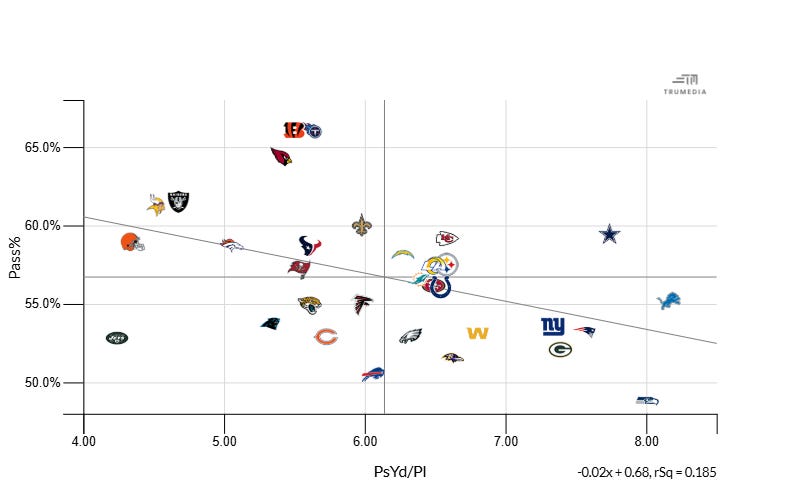
That’s a place to start: Committing to the run, no matter what happens.
The Vikings have actually been a fairly efficient running team this year. While they have only gained 55.0 yards per game (22nd) on first down runs, the Vikings have averaged a solid 4.6 yards when handing off on first down.
At the same time, they have taken sacks on 8.6% of first down passes, which has put the offense at a massive disadvantage.
In terms of second-down running, they are legitimately good at it. Again, the Vikings only average 33.8 per game (22nd) on second down runs but they are picking up 5.1 yards per carry, fifth in the NFL. When it comes to rushing on second down with less than four yards to go, they are fourth best in the NFL in yards per rush.
You always hear that running successfully on early downs can set up the passing game and, well, it’s true.
On second down with between 1-4 yards to go, the Vikings have the seventh best yards per passing play in the NFL (7.7).
Throwing on more advantageous downs and distances can certainly fall under the “simplify” category.
There might be a case for knowing when your goose is cooked on third-and-long too. The Vikings are 13th in air yards per target on third-and-long and dead last in terms of success with 2.8 net yards per play. They have been sacked on an absolutely shocking 25.0% of their third-and-long drop-backs, by far the worst in the NFL.
As you might expect, the Vikings are 31st in terms of percentage of third downs that they have converted on passing plays.
It’s time to take the Alex Smith school of third-and-long. Throw short of the sticks, see if someone gets some YAC and otherwise punt.
That brings us to more about the passing game with JJ McCarthy.
There are a few socially acceptable ways to simplify a passing game without making your quarterback look like Tim Tebow or Kendall Hinton. Those are: Quick game, play-action/boot, screens.
In terms of the short passing game, well, that hasn’t exactly been the Vikings strong suit with McCarthy under center (Midwest polite voice). On throws between 0-9 yards, he is averaging just 4.1 yards per attempt and those throws are making up 34% of his chances.
That makes it tough to argue that the Vikings should have more quick game but that number does not delineate between quick-pass play calls and checkdowns. He is taking 2.75 seconds to throw between 0-9 yards, which is the slowest in the NFL and suggests that the short stuff isn’t his first option (or he’s not getting it out to his first option very quickly).
Simplifying should mean that the short pass game comes fast. Texans backup Davis Mills, for example, got his 0-9 throws out in 2.18 seconds. You can bet that most of those were by design.
McCarthy has the deepest depth of target and the most throws in over 2.5 seconds. That isn’t making anything easier on the O-line to protect him.
Rolling the quarterback out is often considered a way to pare things down. Per TruMedia, McCarthy only has 13 designed rollout passes for 17 yards this year. His play-action percentage is 14th.
While he hasn’t had much success on play-action throws, bootlegs often create straight forward reads in front of the QB that also allow him to throw the ball away or scramble.
McCarthy is throwing screens on 9.4% of his plays, 19th among starting QBs. That’s an area where the Vikings have not been consistently effective but the best teams average over 7.0 yards per play. They can simplify by cranking that number up.
That brings us to the trouble with talk about being more simple on offense…
Carson Wentz played a fairly simple game in his five starts for the Vikings and ranked 13th in the NFL in yards per attempt.
In the five games with Wentz, Justin Jefferson went for 75, 126, 123, 79 and 74 yards. He has one game over 65 yards with McCarthy.
Jordan Addison had games of 114 and 128 with Wentz. His high with McCarthy is 48.
Wentz arrived in August. He couldn’t have been running the Greatest Show on Turf offense out there.
How much more simple can it be?
There’s two minds when it comes to bringing the offense down from 400 to 100 level. You can make an argument that the Vikings asked McCarthy to drive full speed when he needed training wheels. They put the ball in his hands often over the first couple weeks, calling pass plays on first-and-goal or empty protections when they were struggling to block the Falcons. Maybe he wasn’t ready for that in the first couple starts.
But, as KOC slid into his commentary, they made clear changes to the offense against Chicago and Green Bay and that didn’t work any better.
If they simplify even more and end up in elementary school, does that do anyone any good? Maybe it helps them beat Washington or New York. Does it help set up McCarthy to be a better quarterback in the future?
Is there a case that they should just let him run the entire offense for the next five weeks and see what happens in the end? After all, is the plan to have him play like Justin Fields with the 2024 Steelers for the 2025 season or do they need a QB who can really run KOC’s offense next year?
These seem like rhetorical questions but they aren’t. Nobody knows the right answer. Maybe getting McCarthy some confidence with the easy buttons will help him get on track. Maybe it will just provide false positives that will run out of steam when opponents catch wind and/or when they need him to truly step up and play professional quarterback.
Simplifying always sounds good. However, it’s a short-term answer to a long-term problem that the Vikings have at the quarterback position unless it helps McCarthy develop at the same time.
This seems to boil down to two things being true at the same time:
1) With a young QB who didn't have a lot of reps in college, it seems obvious that they should've started at this point and not arrived at this realization in week 13 of the season. KOC needs to adjust his thinking from "OMG, I have Justin Jefferson at WR!" to "JFC, I have JJ McCarthy at QB!" Should've happened in April, but what's done is done.
2) Based on their recent comments and some of the buzz from people who cover the team, it feels like they thought he could handle more based on where he was at when he got hurt in '24 and his seeming aptitude in the classroom, and that they're truly shocked by how he's looked in most of these games.
Unbelievable that they wouldn’t have simplified back in training camp. JJM had zero track record in the bigs and limited passing reps in college.