
By Matthew Coller
The Minnesota Vikings’ ownership may have wanted to cast a wide net in the general manager search but they caught all of the same type of fish.
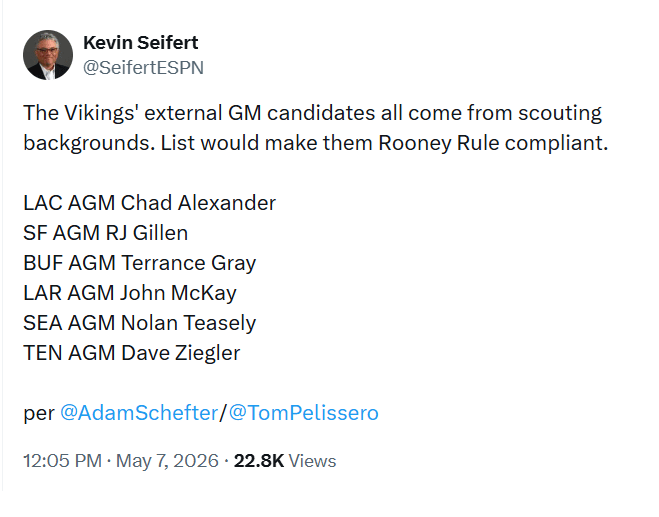
Tom Pelissero and Adam Schefter reported that the Vikings’ list of candidates includes the following job titles: AGM, AGM, AGM, AGM, AGM, AGM.
It isn’t tough to make a case that assistant general managers belong at the top of the pecking order but every single one of them comes from the same exact background. They all started out as scouts, worked their way up to either player or pro personnel director positions and then were promoted to AGM. Only one of the group (Dave Ziegler) has previous GM experience. In a blind resume test, you’d have a very difficult time telling who’s who.
That isn’t necessarily a bad thing. But there are some inferences that we can make from the way that the search is being conducted.
The first of our conclusions might be that the Vikings have picked out folks from the organizations that always seem one step ahead of the rest of the NFL. Yet the orgs have done it in different ways.
Chad Alexander, for example, came from the Baltimore Ravens, who have long been considered one of the sharpest and most analytical/progressive front offices in the NFL.
RJ Gillen comes from a San Francisco squad that built a lot of their success through acquiring talent from the outside and finding the best fits for its coaching staff.
The Rams are at the top of the heap for franchises that use technology and lead the way in schematic advancements that leave the rest of the NFL trying to catch up.
Ziegler came up in the Belichick world where they were very secret about their usage of data but had a remarkable knack for finding players that worked with Belichick’s defense.
Teasley’s team nailed the “competitive rebuild” through an incredible run of draft success and that led to a Super Bowl.
Gray’s roots are with the Vikings. When he was in Minnesota, they built the Mike Zimmer squad that went to the NFC Championship, highlighted by the 2015 draft. With Buffalo, Josh Allen has played a huge role in their success but they also put together top-notch defenses that helped them stay at the top.
While there are crazy similar backgrounds, there are very different influences and lots of ways to go about building a winner.
The similarity is that all the squads they come from have a track record of building successfully through the draft. The Rams were forced into a very fast rebuild around Matthew Stafford and were able to hit on a bunch of draft picks in order to get back to relevance in short order. Seattle paid Sam Darnold, yet still had the foundation to build a Super Bowl champion roster around him.
Most of the teams that developed these GM candidates had multi-year builds rather than reactionary “all-in” type plays. Yes, the Bills, Ravens and Tom Brady-led Patriots were always trying to make swings knowing that their QBs could win the Super Bowl in any given year but New England was famous for moving on from players a rather than overpaying and the Ravens and Bills have built two iterations of winning squads around their QB with some leaner years mixed in to reload.
While the franchises producing these AGMs have been good at asset management, the main emphasis based on their backgrounds seems to be on drafting.
The Vikings have been one of the worst drafting teams in the NFL for the last decade. Per the website PerThirtySix.com, the Vikings have produced zero drafts in the top 10 in value since 2016 and only one within the top 14 (and that featured Justin Jefferson). Since 2022, they have ranked 29th, 17th, 28th and 23rd.
In the NFL, the chase for hitting on draft picks has always been on and front offices have mostly been at the whims of randomness. Even the most successful GMs go through hot and cold streaks. It wasn’t long ago that the Seahawks ranked 25th, 19th and 30th by PerThirtySix.com but then they went on a drafting run of 1st, 6th, 12th and 12th and they built a Super Bowl team through those drafts.
There is an evaluation arms race currently going on in the NFL where teams are using more resources, more data and more unique processes than ever, there appears to be an opportunity for teams to get an advantage by applying everything at their fingertips.
The Vikings’ candidates may have similar experience but the question that needs to be answered when making the hire is: Which GM is going to keep them ahead of the game?
That was supposed to be the reason for hiring Kwesi Adofo-Mensah, yet it was hard to find evidence from the decisions that the Vikings actually made during his tenure that point to the franchise being pushed forward to the head of the line.
There should be a lesson in that fact. No one on the outside knows how much of Adofo-Mensah’s plans saw the light of day but we do know that his leadership of the current front office and collaboration with the coaching staff was not strong enough to keep his job.
These AGMs all come from franchises who have implemented plans good enough to be in contention consistently, so we know that they understand the path. Can they actually get everyone on board to work together in order to get it done? When Mark Wilf highlighted leadership when talking about the next GM at the owner’s meetings, he wasn’t just giving a throwaway line.
There’s another very important element of the search that may dictate success or failure: Asset management.
For years, Vikings leaders have used the Wilfs’ open wallets to push the chips to the middle of the table when they sensed a window to win. The problem is that spending more money doesn’t always result in success, particularly as teams increasingly sign their own draft picks and free agency is sparce. A more methodical approach is required for the next GM.
Stockpiling draft capital, gaining comp picks, trading players before they have lost their value, setting up for cap flexibility long term rather than once every few years.
This is where it’s interesting. Everyone on the AGM list except Ziegler is lacking in GM experience, which makes you wonder if having Rob Brzezinski remain in a position of power may be the best path.
Brzezinski demonstrated both leadership and asset management this offseason. The trade of Jonathan Greenard and handling of free agency (i.e. waiting for Jauan Jennings rather than overspending) were evidence of that.
It might make sense for the Wilfs to pair Brzezinski with a top-notch evaluator from one of the best franchises to play off each other’s strengths.
Whether that comes in the form of Brzezinski as team president or another title, it’s clear that the best teams can’t just rely on hitting on more picks than everyone else, they must play the economics game better as well.
We’ll see how things ultimately play out but we can see the Wilfs’ vision through the candidates that they have interviewed.
My wife does executive recruiting. A "headhunter" if you will. Her clients give her parameters of what they want in a client. Education, accomplishments and so on. She says when it comes down to deciding who to hire between very similar candidates the client usually picks the person they like the most. Analytics, success history and all that is important but the fact is people are people and they'll pick the person because they have a good feeling about them.
I have a hard time formulating a hot take on any of these guys. We generally have little to no idea on the decision making process of our own team that we obsess over 365 days out of the year, so I have no idea whether Seahawks guy had any actual role in the good decisions they’ve made the last few years. The Jennings signing is good work, obviously, but I could go either way on the Greenard trade, and Rob was the one who pushed the awful Thielen trade over the line, so his record isn’t flawless. I’d be fine with him taking over, though. If anything, he should have the benefit of knowing that he’ll still have a place in the building even if it doesn’t work out. Kwesi pushed in all of his chips before the chip pushing evidence was in, so you gotta wonder if he felt pressure to win now with the apparent tensions in the building. Can’t have your GM making short sighted decisions.