
By Matthew Coller
When the Minnesota Vikings fired Kwesi Adofo-Mensah, it looked like the Minnesota Vikings’ roster was going to be turned over to the coaches and all hell was about to break loose.
We started imagining all the wild stuff they could do. Trade the 2026 first-round pick for a current player? Hand out some crazy contracts to free agents. Restructure everything under the sun to the point where the 2028 salary cap would be so full of void years and dead cap space that the squad would look like the team from The Longest Yard.
However, at the NFL Combine, acting general manager Rob Brzezinski pulled up a fire truck full of cold water and dumped it all over the notion that the Vikings were going to go all in on the 2026 season and sacrifice their future.
He used the term “guard rails” and said that he fundamentally believes in building through the draft. The long-time salary cap specialist also noted that restructuring contracts was not favorable.
All of that came across as very reasonable, especially from someone who has been at the helm for the Wilf ownership for the entirety of their tenure.
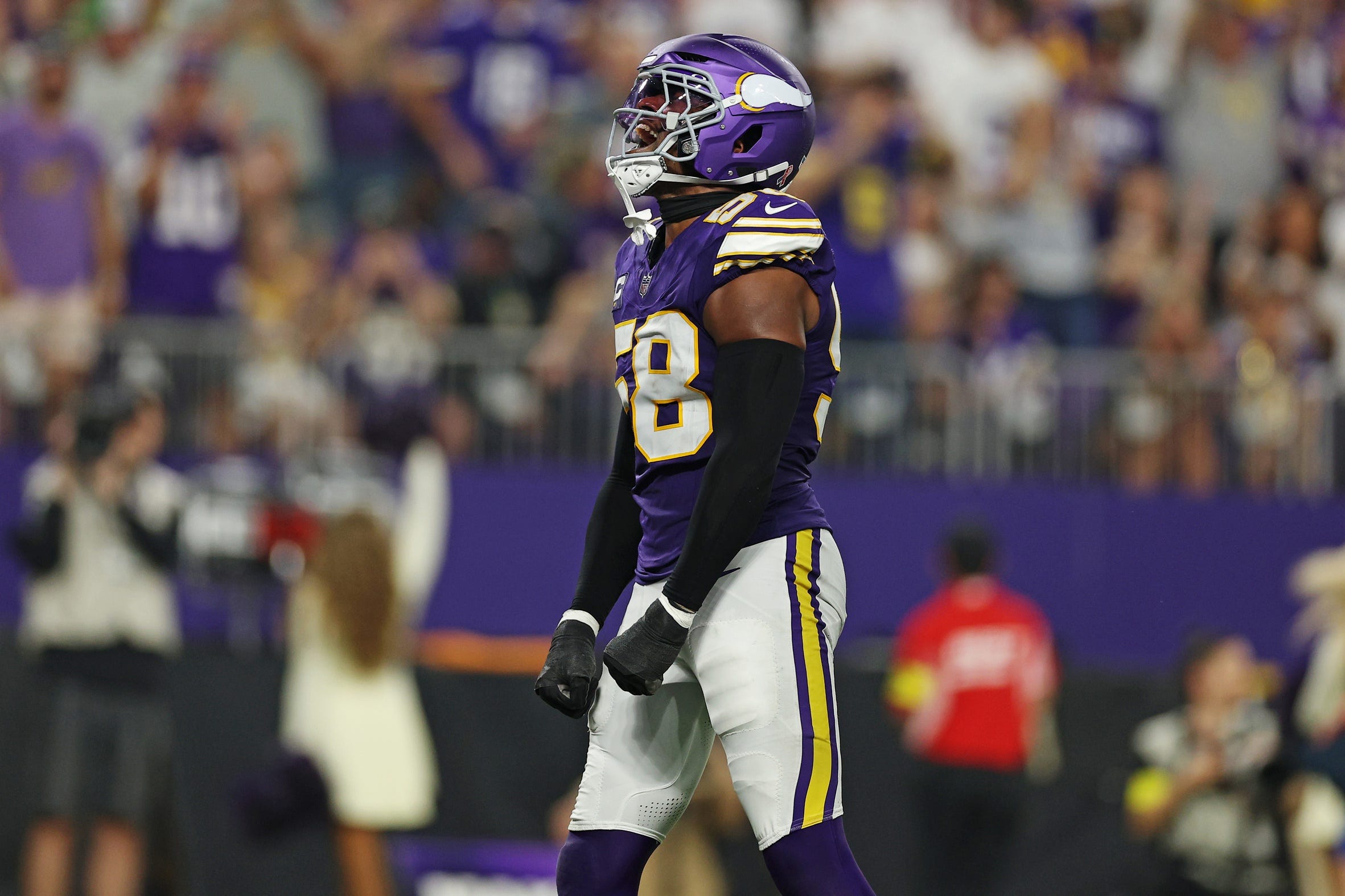
But on Tuesday ESPN’s Adam Schefter dropped a serious dose of reality on Vikings followers that came as quite a shock. He reported that the Vikings are willing to trade star edge rusher Jonathan Greenard.
Albert Breer of Sports Illustrated added to the context of the report by saying that Greenard wants a new contract and that the team is “comfortable” with his current deal. If he doesn’t want to play on his agreed upon 2026 numbers that they will listen to offers.
The fact that it’s out there alone suggests that are putting the call out for suitors. ESPN’s Jeremy Fowler said they are looking for a Day 2 draft pick.
While Greenard’s sack numbers went down in 2025, he was still a top-notch pass rusher by the underlying metrics. Out of 121 full and part-time edge rushers last season, Greenard had the 18th best pass-rush win rate 16th best Pass Rush Productivity Rate (pressures per snap weighted for sacks) and the 19th best pass rush PFF grade.
His production matches up with his slot in terms of salary. He is the 17th highest paid edge rusher in the NFL in terms of average annual value.
However, Greenard could argue that recent contracts for top rushers should be bringing his guaranteed dollar figure up. He was guaranteed $38 million in his contract with the Vikings signed in 2024. Micah Parsons, the league’s top rusher not named Myles Garrett, received three times that number in his contract with Green Bay. There are three others with double Greenard’s guaranteed money.
Because Greenard had become such a key member of the franchise’s core, it seemed like a foregone conclusion that they would aim to extend him but when you view the franchise through the lens of wanting to preserve — and even set up for — the future, it starts to make more sense why they would consider moving such an excellent player.
If the Vikings do not want to restructure deals all over the place in order to get on the right side of the salary cap, trading Greenard is a good way to do it. Per OverTheCap.com, a trade would clear $12 million in cap space this year and $15 million in cap space next year.
The return would give the Vikings a chance to begin the process of getting younger. They desperately need to form the next core of the franchise and an additional second-round draft pick in a draft that appears strong in the late first and early second rounds could be big for the “competitive rebuilding” process that is bound to happen in the coming years.
There’s another benefit to moving Greenard: The development of Dallas Turner.
Last year we saw Turner become a completely different player when he was filling in for Greenard. He finished with 8.0 sacks, which is a good number, but if we look closer we find that Turner was the 8th highest graded PFF pass rusher past Week 10 when he was often taking Greenard’s place due to an injury. During that span, Turner was 11th in Pass Rush Productivity as well.
Handing the pure pass rushing job over to Turner for a full season would give the Vikings an opportunity to find out whether he’s ready for that position and gives him a chance to truly maximize his skills rather than trying to rotate in the game or emulate the impossible-to-copy Andrew Van Ginkel.
Rookie contracts go fast in the NFL so the Vikings need all the information that they can get their hands on about Turner before they look at potentially giving him a long-term extension or picking up his fifth-year option. If they got through three years of asking “what is he really?” then it’s harder to make those decisions.
There’s another point to be made about potentially stockpiling as much draft capital as possible: The 2027 draft could be another opportunity to pick a quarterback if the Vikings do not find a multi-year option in the coming days or if JJ McCarthy does not emerge as that player.
If the Vikings can gain a high pick that they might be able to flip into more future capital by moving down in the draft, it would give them more ammunition for a possible trade up for a quarterback in 2027. Or they could even deal Greenard for more capital in 2027 because teams rarely like to make trades for the upcoming draft when their franchise has put so much work into picking this year.
It is clear that these are the types of conversations that are happening now. It’s much more big picture. It’s much more 3-year plan. A new timeline has emerged when we thought that the team was still working on the KAM era timeline that had been hatched from the day KAM and KOC arrived.
That’s what happens when you have a shift of power. It’s also what happens when the ownership spent more money than anyone else in the NFL and it didn’t work.
It makes sense from the Wilfs’ perspective to ask that the purse strings get tightened. They have been incredibly accommodating with dollars over the last decade but it’s hard to blame them for saying, “we gave you everything you asked for, make this work.”
What does that mean for O’Connell and all the other offseason decisions?
For starters, he and Brian Flores might have to do their best coaching yet because the roster isn’t likely to be beefed up by big free agent signings. They may need to find ways to implement young, inexperienced players into certain positions because they have no other choice.
If the Vikings are cutting Aaron Jones, Javon Hargrave, Ryan Kelly and possibly moving Jonathan Allen as well, that opens the door for potentially young defensive tackles taking over, a less experienced center, a younger or cheaper running back room. That’s not to mention if Harrison Smith retires that they will have to find an answer at safety.
Because they sold their draft capital for the move up to get Turner and a bevy of patchwork guys over the years, there aren’t a lot of up-and-coming players currently on the roster to jump into those spots. Or at least we don’t think so right now. Guys like safety Jay Ward or DT Levi Drake Rodriguez may be in for increased playing time. Tai Felton may need to emerge as WR3. Blake Brandel might need to become a full-time center.
There’s a lot of work to be done on the shoestring budget.
It also could mean that the Vikings might consider other players’ future down the road two years. Would they consider trading Jordan Addison if they aren’t interested in picking up his fifth-year option or giving him a contract extension considering his off-field issues?
Will they sign players like Blake Cashman and Brian O’Neill to extensions? Will TJ Hockenson be retained or could they look for potential suitors for him too?
A total rebuild does not appear to be on the horizon considering the Wilfs want to return to the postseason and Brzezinski mentioned wanting to maintain their core. But everything might be on the table as they try to get things back under control after pushing the chips to the middle of the table failed in 2025.
That doesn’t have to be a bad thing. Sometimes the most shrewd moves end up turning out the best. Think of last year’s free agency. The smartest money the Vikings spent was on smaller contracts for cornerback Isaiah Rodgers and linebacker Eric Wilson.
Pushing the front office to hunt deep into the weeds of free agency could cause them to be more intentional rather than throwing dollars around.
Back to O’Connell for a moment.
Does this shift give him grace or not?
There’s an argument for both sides of that. Certainly the Vikings’ head coach has been given ample time to win a playoff game and that hasn’t happened. Regardless of how Adofo-Mensah took the public blame for the botched quarterback situation in 2025, we all know that O’Connell was a (or the?) central figure in drafting McCarthy and the decision to move on from Sam Darnold. In a league where there are zero current coaches that have gone five years without a playoff win, it’s tough to see another middling year be tolerated, especially if a new GM is brought in from the outside and has his own ideas about the HC job.
But boiling down KOC’s tenure into “no playoff wins” is a pretty shallow interpretation. The recently-leaked NFLPA survey scored KOC an “A” again. That’s been the case every year since they started doing it. When he’s had quality starting QB play, his record is 31-11 and his overall .632 win percentage is 23rd all time, just below Andy Reid and just ahead of Sean Payton, Mike Tomlin, Bruce Arians and Bill Cowher.
That doesn’t sound like somebody that should be blasted into the sun if the team doesn’t reach the top of the mountain, rather someone who could guide a franchise from one side of a roster restructure to the other.
All of these discussions lead back to the quarterback position though.
On Tuesday, Arizona told Kyler Murray that he’s going to be released and the Vikings instantly became the favorite for his services.
While picking him up would only cost $1.3 million due to the Cardinals having to foot the bill, adding a legitimate starting quarterback who would put JJ McCarthy on the bench adds to the intrigue about where they are headed in the future at that position.
There’s a world where Murray plays so well that they have to extend him and then building through the draft becomes even more important.
There’s a world where Murray plays one year and then goes on his merry way and McCarthy develops enough to take the job back.
There’s a world where the whole thing blows up and they have no answers after 2026.
Nobody knows where it’s going to go but each one of those outcomes has implications for the future. If McCarthy ends up back as the starting QB somehow, then they are crunched into a small window to take advantage of his rookie QB contract.
If they are completely in need of a QB again in 2027, that means building an infrastructure around the young QB or finding another bridge type.
You could go on forever with all of these different scenarios.
You could also reasonably ask: If the Vikings are moving on from Greenard and doing some type of reset, why not roll with McCarthy and see if it clicks?
That appears to be a bridge too far. No matter what plans the Vikings have for 2027 and beyond, Justin Jefferson is part of them. They want him to be Larry Fitzgerald and spend his entire career in purple. If they don’t have reasonable QB play that can get him 100 catches and 1,300+ yards, then there’s a chance he could think about playing somewhere with a stable QB situation.
Can they thread the needle of getting into the playoffs in 2026 with a veteran starter, developing McCarthy, making Jefferson happy, maximizing the remaining talent, stockpiling draft capital, getting cap healthy for the future and setting themselves up to potentially take a QB in 2027?
If building a roster was easy, it wouldn’t be so darn fascinating.
That’s the best way to describe what’s about to happen to the Vikings in the coming weeks: Fascinating.
More signs that the Vikings are looking at all options. And starting a new 3-year plan makes sense. They need to start getting younger. I wonder how that affects the QB discussion. Maybe keep JJ, but avoid the older QBs like Carr or Cousins.
I mean... we kinda knew Dallas Turner was drafted very high for possibly this exact play... hopefully they don't get fleeced