
By Matthew Coller
I wonder if this has ever happened before. From one year to the next in the NFL, an entire conference barely budged.
Across the NFC, there are only two teams that have different quarterbacks than they did in 2025: The Minnesota Vikings and the Arizona Cardinals.
You could say that the Atlanta Falcons, after acquiring Tua Tagovailoa, might have a new starter, but Michael Penix Jr. is still a possibility to start depending on his recovery from an ACL injury.
Every other quarterback is the same. Washington gets Jayden Daniels back from an injury-riddled season. Tyler Shough gets his shot at being a full-time starter after playing 11 games last year.
Everyone else: Same QB.
Think about how much changed from 2024 to 2025 at the QB position in the NFL. The Seattle Seahawks signed Sam Darnold, the Vikings switched to JJ McCarthy, the Giants drafted Jaxon Dart, Atlanta swapped out Kirk Cousins for Penix Jr. and the Saints started Spencer Rattler and drafted Shough.
The NFC also had almost no movement in terms of head coaches.
The only teams to make a switch were the Giants, Falcons and Cardinals. Everyone else is returning their HC.
Over in the AFC there are likely going to be five new starting QBs and six new head coaches.
Even in free agency the AFC was more aggressive than the NFC. Per OverTheCap.com, AFC teams handed out a total of $2.4 billion in contracts this offseason whereas the NFC gave out $1.8 billion.
The least active team in the entire NFL: The Minnesota Vikings.
Which brings us to an interesting trend around the NFL analysis and betting universe. Everyone seems to think the Vikings are going to be bad.
ESPN’s first power rankings following the NFL Draft ranked them 24th. NFL.com placed them at 28th. FanDuel has the Vikings at +600 to win the division, which is fourth out of four teams in the NFC North. In terms of the over-under, the Vikings are 8.5 but it’s juiced toward the under.
Now this might seem a little odd to everyone who closely followed the Vikings last season. They had just about everything under the sun go wrong. Injuries on offense and defense, poor quarterback play, drops, miscues at the wrong times, back-to-back overseas games and on and on. Yet they came away with a 9-8 record.
So it stands to reason that if the Vikings are running it back with an improved quarterback situation that they would be better than last year. Not only that, they are also only a year removed from destroying over-unders and power rankings by winning 14 games in 2024 with Sam Darnold under center.
What gives? The Vikings didn’t lose anybody off the roster except for their two underperforming (sometimes) defensive tackles, they still have Justin Jefferson, they brought back Brian Flores and they have more home than away games this year with one of the biggest home edges in the sport.
The ranking doesn’t make any sense whatsoever when you think about it like superimposing Kyler Murray onto the 2025 team. If Murray had his 2024 season, where he ranked as the 12th best QB in the NFL by PFF, as the leader of the 2025 Vikings, then they would have been in the playoffs as a pretty darn scary team.
It’s very possible that the morphing of those two things will happen in 2026.
Unfortunately that’s not how anything works. For now, the onus is on the Vikings to prove that they belong among the best teams in the NFC because they are easily the team with the most uncertainty in the conference due to the quarterback situation.
It seems the markets and the power rankers tend to lean away from things that are unclear in favor of teams that they think they can easier project. Even the most cynical power ranking expert would have to admit that there’s a world where everything clicks for Murray and the Vikings are very dangerous in the NFC.
Power rankings just don’t cover ranges of outcomes.
Luckily we can use our brains to do it.
Let’s go through the most stable and volatile parts of the Vikings roster and then look at the other most stable and volatile teams in the NFC.
Stable parts of the 2026 Vikings
1 — Coaching
We have a big sample size on Kevin O’Connell and Brian Flores as coaches. Certainly there will always be critiques of the play calling but the Vikings passing game was 9th in net yards per pass attempt between 2022 and 2024. We know what the passing attack can be with KOC at the help and what the peak looks like.
It’s also pretty clear that Flores can squeeze as much out of a defense as possible. The Vikings have had good rosters defensively in the three years that he’s been at the helm but you wouldn’t call them elite rosters despite the production.
2 — Weapons
If we agree that last year was a crazy outlier in terms of the team’s inability to get Justin Jefferson, Jordan Addison and TJ Hockenson the football, then we can say that the weapons are one of the most reliable and consistent parts of the Vikings team. The fact that Kirk Cousins, Nick Mullens and Sam Darnold were all able to get huge production out of this receiving group is strong enough evidence to say that they still have driving-force type receiving options.
3 — Veteran presence, continuity
Of course O’Connell and Flores deserve credit for getting things turned around at the end of the season after a miserable 4-8 start to the year but that probably wouldn’t have happened if the roster was full of youth. The Vikings are losing Jonathan Greenard and (maybe?) Harrison Smith but they are carrying over Justin Jefferson, Aaron Jones, Brian O’Neill, TJ Hockenson, Andrew Van Ginkel, Blake Cashman, Eric Wilson, Byron Murphy Jr. and a handful of others who have been around the block.
Even if we factor for possible age regression, those players’ preparedness and understanding of how to succeed in the NFL gives them an edge versus less experienced teams.
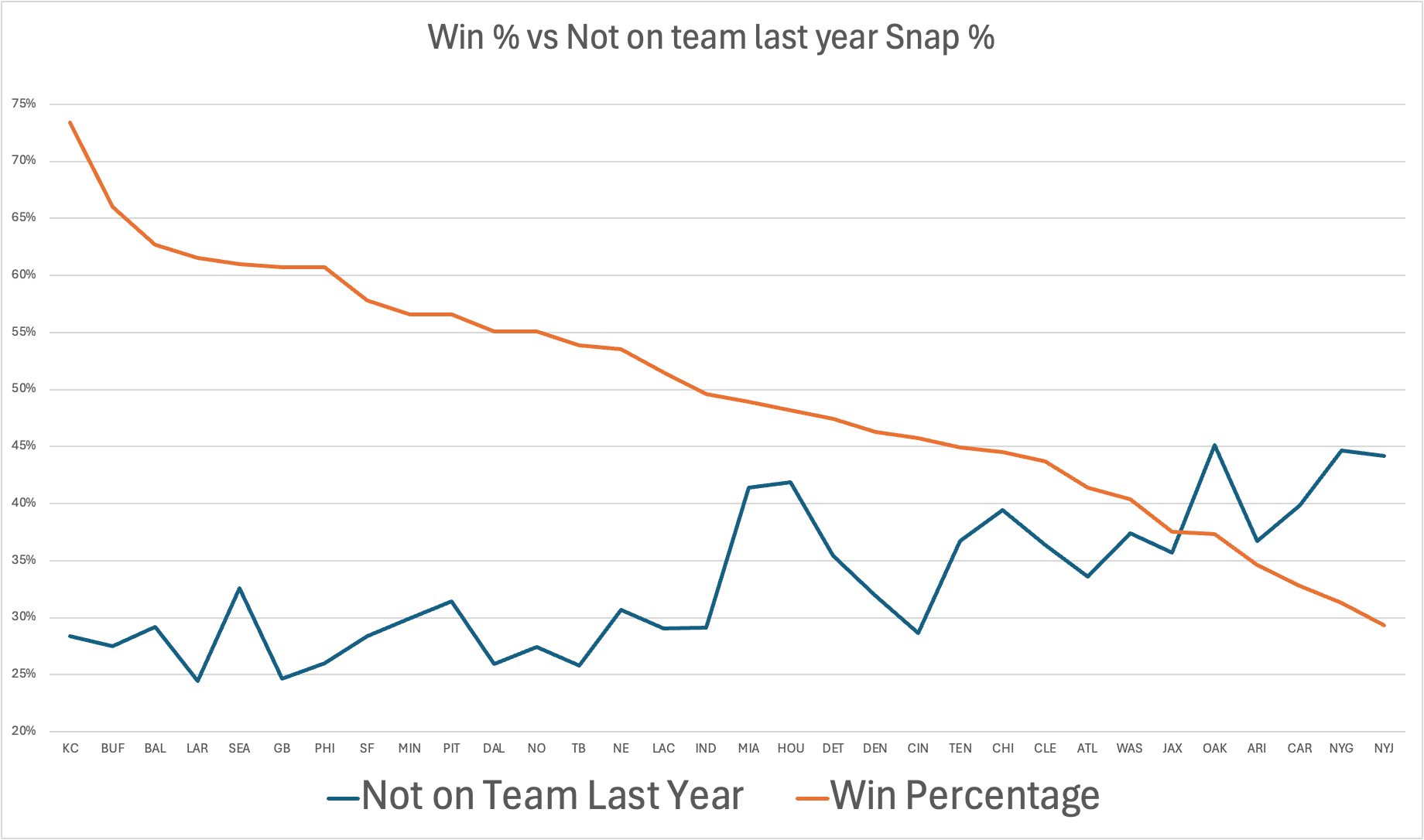
The fact that a very large percentage of the Vikings roster is still in tact from last year and 2024 could be a benefit too. Purple Insider reader/listener Tracy sent over this chart looking at continuity from year-to-year compared with win percentage. Obviously good teams stick together and bad teams make big changes but there appears to be some signal in the idea of continuity being beneficial for setting a higher floor.
Non-stable parts of the Vikings
1 — Quarterback
It isn’t very hard to look at the way Kyler Murray has played during his best seasons and project that to the Vikings offense and start seeing a 12 or 13-win season incoming. He’s never had this type of organization, this type of passing attack and this level of weapons around him. However, Murray has been a very volatile player over his career, both in performance and health.
He missed big chunks of 2022 and 2023 with an ACL injury and he was out with a foot issue last year. When he has played full seasons, they have been filled with very high highs and he’s been talked about as being in MVP conversations early in some years but then faded toward the end of the season.
We really have no idea — good, bad or middle — Murray is going to fit into the offense or how many games he will ultimately play as the Vikings QB. If there are injuries and JJ McCarthy or Carson Wentz have to play, then all bets are off in terms of consistency.
2 — Offensive line
The Vikings’ O-line has a chance to be legitimately excellent but that requires multiple things to happen. First, they need Christian Darrisaw to play a very high percentage of the games in 2026. While they did sign a more effective swing tackle, there’s no replacing Darrisaw, as we saw last year. Playing Blake Brandel at center is another element that has volatility because he only played there for a small sample of games last season. We also aren’t yet sure of where Donovan Jackson’s ceiling lies (though he showed a lot of good signs last year).
The depth is better at tackle but it is presently very questionable on the interior. Health, as always, will be a huge factor.
3 — Run game improvement
The hiring of new O-line coach Keith Carter along with assistant Frank Smith from Miami and the addition of a new fullback and running back in the draft is certainly an indicator that the Vikings want to run the ball better but whether they can truly take it to a next level is yet to be seen. The offensive line still has questions and the Jordan Mason/Aaron Jones combo was more solid than it was explosive.
4 — The secondary and interior D-line
The Vikings nailed a free agent signing last year in Isaiah Rodgers and Byron Murphy Jr. is in line for a bounce-back season but the safety position has been enormous in Brian Flores’ defense and it was clearly not the same without Harrison Smith early last season. Will they be able to manage that position? What if the corners don’t stay as healthy as they were last year?
On the interior of the D-line, the Vikings have Jalen Redmond and a bunch of question marks. How ready will Caleb Banks and Domonique Orange be to take on significant roles? Will someone take another step forward? It could either be a strength or be an issue, especially early on.
5 — Special teams
Nobody is doubting the gifts of Will Reichard. Everything else is up for debate. Last year the Vikings got tremendous punting from Ryan Wright, who signed with the Saints in the offseason. Will they be able to recreate that this year with Johnny Hekker? Also the returning from Myles Price was either boom or bust. He had some electric returns and some big miscues. With the state of the roster, Matt Daniels will likely have to be in teaching mode again as they build out the special teams units with UDFAs and late-round draft picks.
The bottom line
The world’s power rankers aren’t hating on the purple, they just have no idea what to make of this team. With so many other squads returning coaches and quarterbacks, it’s easier to project them.
As the Vikings roster stands right now, there are a lot of things that could either go very well and they could thrive or they could undo the Vikings chances to win the NFC North. And in a division with all good teams, there isn’t much room for error.
NFC’s most and least volatile teams
Most volatile
Chicago Bears
Last year was a magic carpet ride for the Bears that saw them lead the NFL with 33 turnovers forced. That’s unlikely to happen again and Chicago did not wildly overhaul their defense. They will have to be more consistent offensively to repeat the same results. Whether they can do that depends on Caleb Williams. If he takes a step forward with his accuracy, Chicago could be scary on offense. If he doesn’t they could be on the outside looking in.
Washington Commanders
Two years ago the Commanders were in the NFC Championship and in 2025 everything went sideways. Jayden Daniels got hurt, their defense fell apart and they ended up firing their offensive coordinator Kliff Kingsbury. The Commanders signed the most players in the NFL in free agency this year (per OTC) in order to rework their entire team and they hire Daronte Jones as their defensive coordinator.
They could quickly bounce back with an infusion of talent and a top draft pick in Sonny Styles or they could end up as a flash-in-the-pan.
New Orleans Saints
Kellen Moore made a good first impression getting the Saints to play competitive football and having Tyler Shough look like he’s ready for NFL action. In the NFC South, the door is wide open for anyone to emerge and it wouldn’t be a shock with Travis Etienne in the backfield and 9th overall pick Jordyn Tyson in the mix that their offense takes off and they become relevant again.
It also wouldn’t surprise anyone if Shough wasn’t really a starting-caliber quarterback and they continued to bumble around in mediocrity.
Least volatile
Green Bay Packers
Outside of an injury to Jordan Love, it’s tough to believe the Packers can be anything other than pretty good. Love was playing some of his best football last season when the offense went through a bunch of injuries and they stumbled down the stretch. They didn’t do a ton to improve the O-line or the backfield in an offense that wants to run a lot.
On defense, Micah Parsons will return from an ACL injury and probably be just as dominant as ever but Green Bay lost more talent from the defense than they gained in the offseason, putting a ceiling on how good they can really be on that side of the ball.
Philadelphia Eagles
Even if they trade AJ Brown, the Eagles have so much talent on both sides of the ball that a total implosion just doesn’t seem possible. Adding Jonathan Greenard helps them in one of their biggest weak areas on defense and drafting Makai Lemon should assist with Brown’s expected trade after June 1.
Philly doesn’t look like a team that can reach the heights of their Super Bowl team, yet they are far from disaster with their roster.
Seattle Seahawks
There is a reason that teams do not repeat. Klint Kubiak getting hired away from Seattle and a couple of their key players like Ken Walker leaving are going to make life a little harder. At the same time, Seattle did a good job of retaining most of their talent and they have drafted so well in recent years that the roster still ranks among the best in the NFL. Worst case scenario is that they’re in the playoffs, best case is that they’re in the Super Bowl again.
The Rams are also deserving of a spot for least volatile teams because they are usually always good. However, with Matthew Stafford’s age, Davante Adams’ age and Puka Nacua’s off-field issues, there’s at least some question about whether they will be able to climb up the mountain the same way they did last year.
28th is a crazy power ranking for a team that finished with the 14th best record in the league last year despite having QB play for 17 games that was somewhere between Josh Freeman and Joe Webb. I’m probably just being a homer, but I can see the Bears taking a step back. They didn’t improve their roster a ton and I’m not convinced Ben Johnson won’t see the second year struggles that a lot of coaches seem to have after the team has had a full season to get sick of them and the league has a full year of tape on what they want to run. He’s a good enough coach where I don’t see them crashing and burning or anything, but I could see a bit of a sophomore slump.
Minnesota sports teams play better when they are the underdog. I'm fine with the ranking. I also think the NFC in general is likely to improve vs last year (until the unpredictable happens), meaning a bigger challenge for the Vikes. Prove them wrong guys.