
By Matthew Coller
EAGAN — The Minnesota Vikings head to Soldier Field to face off with the Chicago Bears on Sunday. Let’s dive into five things that stand out from this week’s lead up to the game…
1 — Carson Wentz gives the Vikings a fighting chance (but it’s Kyler Murray’s show)
There’s a reason that the Vikings brought back Carson Wentz. In 2025, he proved capable of showing up with very little work (he didn’t sign until after camp) and finding a way to perform. He won two of his first four games and was one red zone trip away against the Eagles from taking three wins away while he was the starter.
While he said that he spent last week preparing for the game as if he was going to be the starter so he was ready when his number was called, it’s remarkable to come into a game on the 12th offensive play and find a way to win, regardless of how ugly it might have been at times.
A performance like that was exactly why so many teams in NFL history have opted for journeyman backups rather than putting a younger player in the position to be “one snap away.”
With a week to prepare, Wentz gives the Vikings a fighting chance against the Chicago Bears, especially since their defense looked like swiss cheese against the Carolina Panthers. With two top-notch receivers and two tight ends who can make plays, Wentz is capable of finding his weapons and moving the offense well enough to keep the Vikings in the game.
If they could go 2-0 without their starting quarterback, it would put the Vikings in a tremendous position going forward in the NFC North and the NFC playoff race, which projects to be tight when we get into December.
But this isn’t a tryout for the starting job. With no disrespect meant toward Wentz, he’s in the perfect spot in his career to start a couple games, help his team survive and then head back to the QB2 job.
If the Vikings are going to be a serious contender, Murray has to be the starter. It’s amazing how fast people forget about the bigger sample sizes as soon as a single game happens. They forget that Murray was the 12th best QB by PFF and top-10 by ESPN’s QBR in 2024 and forget that his top weapons in Arizona Trey McBride and DeAndre Hopkins thrived with him at QB and they forget that he’s in the top three in rushing EPA since 2020.
Since 2022, Wentz has an 85.1 passer rating and has been picked off 15 times and sacked 54 times in 14 starts. Just as a Viking he’s taken 22 sacks and been intercepted five times in five starts and has a 90.9 rating. Those numbers are good for backups, who historically only win about 30% of the games they start. But it’s not good enough to compete for an NFC North crown. Not to mention that his tendency to hang in the pocket results in taking a lot of hits.
Because folks only saw 11 plays of Murray and they didn’t go well, there’s a natural desire to overreact. But there’s no reason to believe that Murray won’t be the QB against the Tampa Bay Bucs and going forward, regardless of how well Wentz plays vs. Chicago.
The goal for the Vikings is to seriously compete in the NFC, so they have to roll with the player who gives them the best chance to do that. They are lucky that Murray’s injury isn’t going to keep him out longer.
2 — Demond Claiborne will be active but DeeJay Dallas has the coaches’ trust
The Vikings’ sixth-round draft pick, who showed some very impressive flashes of speed and agility during training camp, will be active for the game according to Kevin O’Connell. I’m not sure we can expect to see a ton of him on the field though.
The Vikings’ coaching staff has always leaned into veteran players that they can trust over young players. That means veteran DeeJay Dallas will most likely be in the game on third downs as a pass protector and spelling Aaron Jones when he needs some rest.
While Dallas doesn’t have a ton of carries during his career, he has impressed the coaching staff greatly with how well he picked up the playbook — enough to get him reps in some of the biggest third-down moments in the game against the Packers.
It’s possible that the Vikings could turn to Claiborne in the game if they spot a possibility of breaking off an explosive play or they are desperate for one. Otherwise, Dallas will be the guy.
That doesn’t mean that Claiborne has no future. Aaron Jones told us this week that he was inactive for his first game and he told Claiborne to watch closely and give him feedback on the sideline.
“It’s going to happen, I told him I was inactive my first NFL game,” Jones said. “I told him just take it as a chance to watch the game. It’s a little bit different from preseason. It’s a little bit faster. So stand next to the coach, hear the call and what’s being called and picture yourself in the game or what you would have done on that play.”
Jones continued…
“Then we also talk to each other every time we come back [to the sideline]. I told him, ‘I need you to be locked into the game because i need your feedback when i come to the sideline. ‘What did you see? Do you think I could have done anything different?’ He’s done a great job and I think he’s in a very great spot and i’m excited to see him.”
There is no better mentor that Claiborne could ask for than Jones.
3 - Kevin O’Connell’s commitment to the run is about desperation more than a newfound football theory
Having grown up when Barry Sanders, Thurman Thomas, Emmitt Smith, Ricky Watters and so many other great running backs dominated the NFL — and were led by amazing fullbacks in front of them (shout out to Cory Schlesinger, Carwell Gardner, Daryl Johnston and William Floyd), nobody is enjoying the running revolution more than this guy.
There’s something unexplainable about watching a team bully an opponent, even if it’s four or five yards at a time. When Max Bredeson ran an I-formation iso up the middle and lowered the boom on linebacker Zaire Franklin, I considered hiring an artist to paint it and hang it in my vestibule.
However, I’m not sure that the Vikings’ newfound love for ground-and-pound means that Kevin O’Connell has suddenly become an unofficial member of the Shanahan/Kubiak family. He isn’t Bill Parcells or Vince Lombardi. He wants to throw the ball. The reason that the Vikings have taken this track is that it’s going to give them the best chance to survive without having a Matthew Stafford or Caleb Williams at quarterback.
O’Connell deserves credit for making the switch — maybe a few Josh Dobbs, JJ McCarthy and Carson Wentz throws too late — and the increased emphasis on the run gives Brian Flores every opportunity to cook and win games like the defense did (eventually) against the Green Bay Packers.
That doesn’t mean it’s a model to be a serious contender.
This research by Eagles Eric (yes, he’s a real guy, he’s been on my podcast) shows that Passing Expected Points Added is still the stat that has the highest correlation to winning. If you out-pass the other team, you win 83.4% of the time. If you out-rush them, you win 61.5% of the time.


Now you could argue that there’s something missing a little bit in the analysis because the more rushing success, the less likely the team is to turn the ball over. See the cliche about three things happening on a pass play and two of them being bad.
But every team to reach the Super Bowl except the 2024 Eagles over the last 10 years has ranked in the top 10 in passing EPA.
When KOC was asked about his run revelation this week, he did point out that when he arrived in 2022, he had the personnel to throw the ball 40 times a game and win.
“I think it’s just the pathway with guys, whether it was with Kirk and my belief in him in year one and then knowing we had Justin and Adam and KJ and we acquired TJ, you’re looking at the strength of your team as the ability to throw the football,” O’Connell said. “We had a lot of success doing that. But then as you work through some of the adversity at different positions we’ve experienced from injury and other reasons, you have to navigate whatever that is.”
What you’d like to see from O’Connell is knowing when to lean on the run — not making it the center of the offense.
Last week is a great example of that. When Wentz went in the game, he hammered down on the “run” button because he knew that leaning into a backup QB with no practice was a recipe for disaster. When Dobbs was the QB in 2023, there were times that he trusted the long-time backup too much and lost games because of it. The same happened in a few games (Pittsburgh, Philly) last year with Wentz.
We do have to acknowledge that KOC has done a good job of adjusting while also pointing out that passing still drives winning and they can’t go too far with the run-to-win strategy.
4 — How good can Caleb Williams and the Bears offense actually be?
I was on Da Windy City podcast and they asked how good I think Caleb Williams and the Bears offense can be. The comparison I made was to 1990s disaster movies when the computers start showing that a volcano is about to blow or a tornado is about to wreck a small town but it hasn’t happened yet. That’s pretty much were Williams is right now.
His command of the offense is what really stands out. Last year it felt like Williams was still a little slow on things sometimes, whether it was getting the calls in and ball snapped or if it was diagnosing things at the line of scrimmage. There were a lot of times against the Panthers where he played fast and made quick decisions to find open receivers. If he does that consistently, it’s going to be a nightmare for opponents.
Remember Ben Johnson inherited Jared Goff when he was at his lowest and folks were mock drafting Malik Willis No. 2 overall to the Lions. Then they went on to have top-five offenses with Johnson and Goff together. This might be just the start, only Williams has way more freakish athletic gifts when it comes to running.
I saw that there was a controversy over PFF’s grade of Williams last week. One thing that people weren’t aware of was the fact that PFF graded a play that didn’t count where Williams threw a horrendous INT. Personally, I wouldn’t grade plays that didn’t count and I didn’t know that PFF did that. I can’t imagine over the large sample size of a season that it matters much since there aren’t a lot of those plays but it impacted the grade significantly. Take that one play away and his grade would have looked much more like what we all saw with our eyeballs vs. Carolina.
It is worth noting that Teamworks owns the PFF grading now, so there is a difference. Years ago, guys like Sam Monson and Steve Palazzolo might have seen a grade that didn’t match up and worked on it. Now that’s not the case and Cris Collinsworth didn’t do a great job on his own podcast of explaining what happened.
That doesn’t make PFF’s grades irrelevant, as some are saying. They still have the same graders as before (made up of a lot of former players/coaches) and they still paint a fair picture of what happened but there’s just a gap that wasn’t there in the past.
However, we’ve always had to do the work when it comes to analyzing football. The grading system never gave a free pass to be lazy and assume PFF had all the answers. We should always be trying to contextualize performances based on what we learn about the game in the postgame locker room and with other stats and by considering matchups and other factors that play into success or failure.
When it comes to 1-100 grades, the struggle has always been the 1-100 system. One or two plays can have such a massive impact on the grades that it doesn’t always tell the proper story. If a QB plays a great game and has one horrific turnover, they are going to get dragged down a lot in total grade, even if they played well enough to win.
In a bigger sample, the grades will tell the full story. Either way, you always have to use your brain.
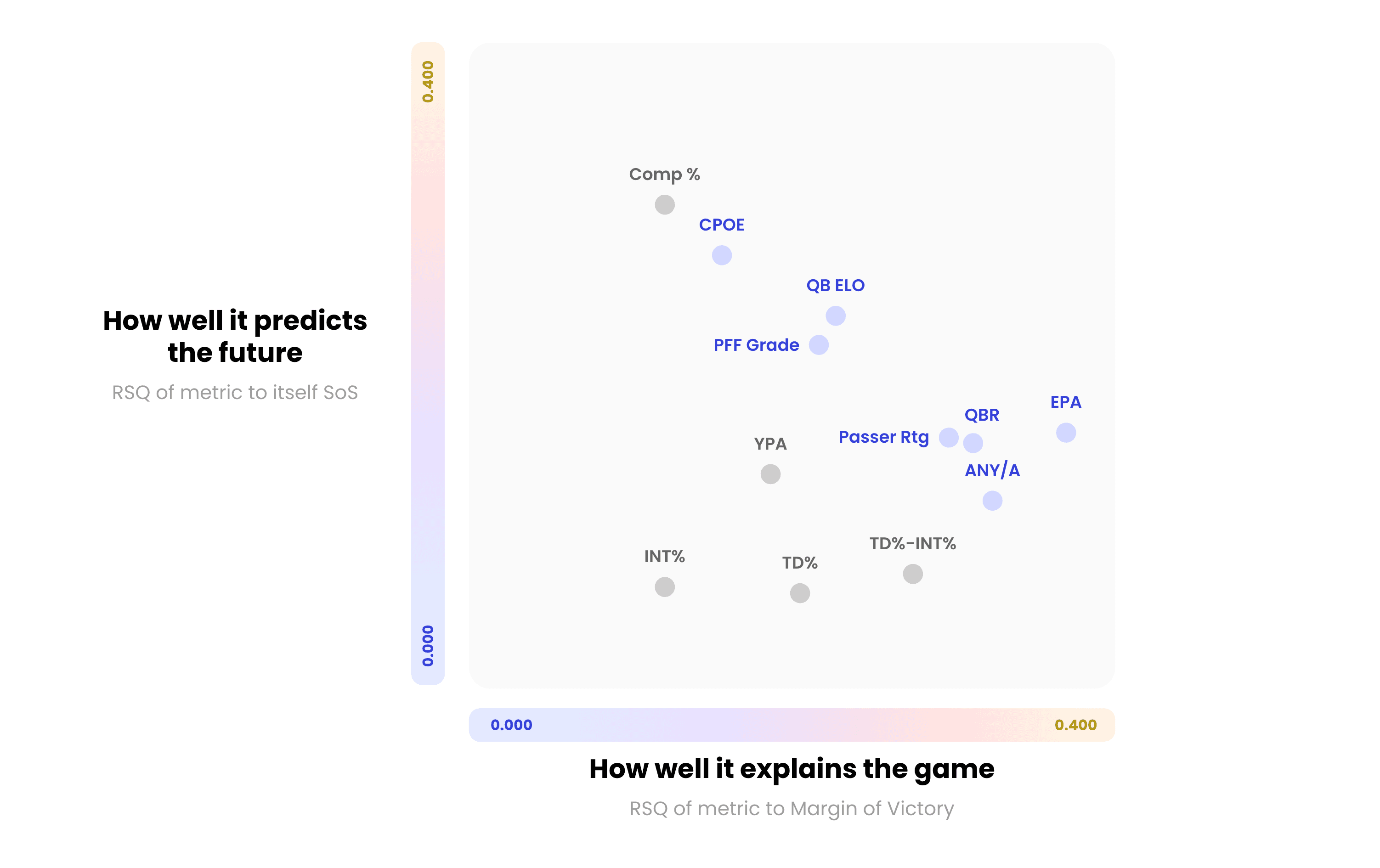
There was a great article written a few years ago that tells you something about QB grades and PFF. There are other stats that do a better job of correlating to the team actually winning the game, like passing EPA — which is a team stat, not an evaluation of the QB — but PFF grade is good for predicting year-to-year performance because it works to isolate the QB’s actual throws and rushes rather than use the yardage results. Here’s a chart that shows that:
I’ll be very interested to see where things go with single-game evaluation. SumerSports is working on a product to measure performance 1-10 with tracking data.
5 — Justin Jefferson and Josh Metellus explain Jefferson’s deep-ball tracking
Remember Justin Jefferson’s catch in the back of the end zone against the Packers? Goodness gracious.
We asked Jefferson about how he was able to track the ball down and make an adjustment on the fly to the football on a play like that.
“If the ball was a little bit further outside, I probably would have stayed outside but just seeing him on top of me and having that leverage on top of me, I felt like going inside was the best decision to get in a better position,” Jefferson said. “Carson threw a perfect ball to where I should be at on the field. Obviously, y’all can see the red lines on our practice field, but in the game, it’s not there. So every single day, just having [lines] on the field and being aware of where to be at and the location to be at.”
Josh Metellus said that the thing that separates Jefferson’s ability to track the football is that he has better concentration than most receivers.
“I think it’s just like the ability to act like there’s nobody there,” Metellus said. “You can see it when the ball’s in the air, especially on a deep ball. Like, it just feels like it’s just him and the quarterback, you know? Like, even when you’re covering him, it’s like nobody’s there. He’s not phased by what you’re doing with your hands. He’s not phased with your hands in his face, trying to knock his arms down. He’s literally just focused on the ball. And I think that’s what makes the best of best.”