
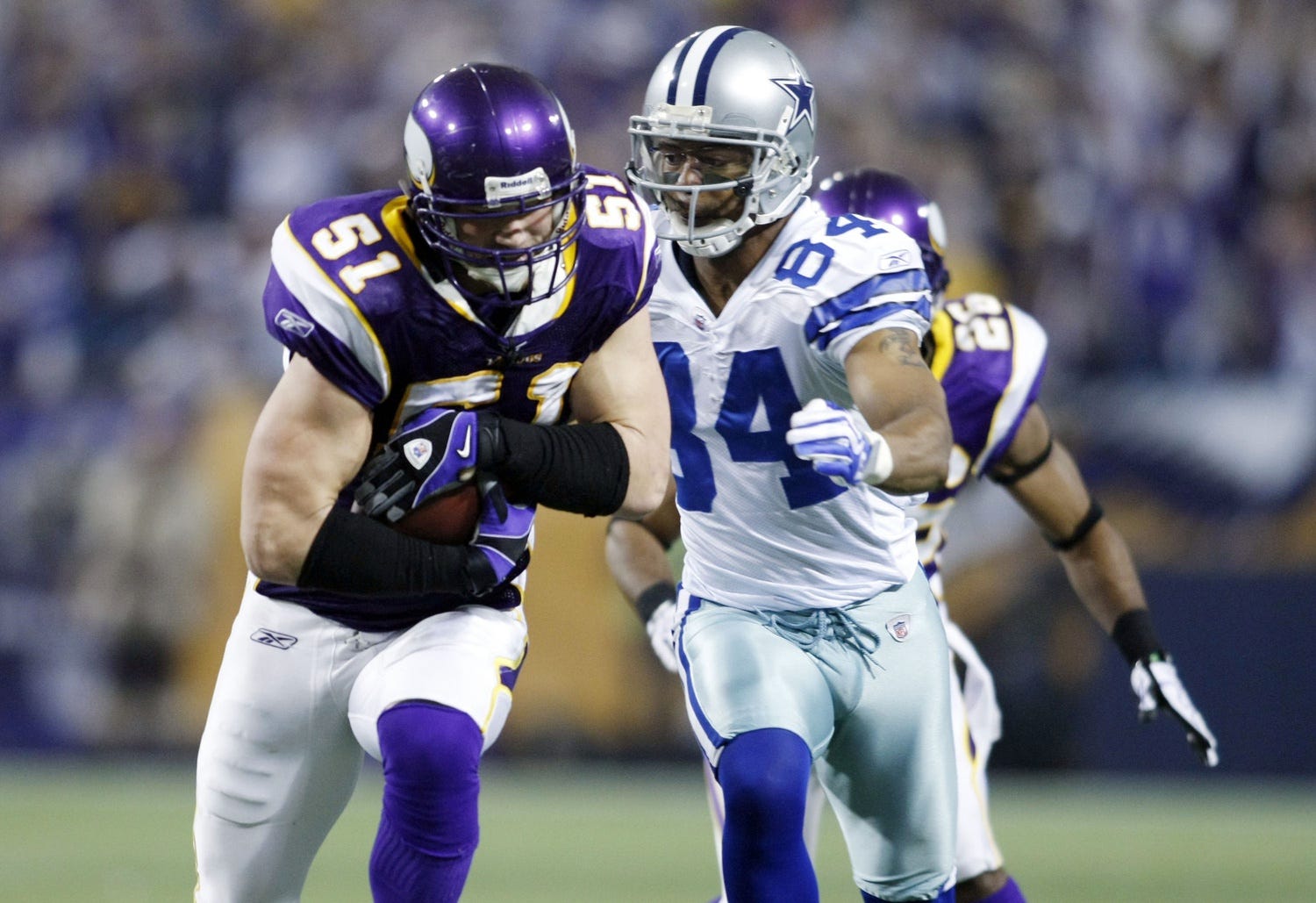
By Matthew Coller and Josh Smith
Warning! If you grew up a Minnesota Vikings fan during the Fran Tarkenton era, this factoid is going to hit you pretty hard: The 2026 season will mark 50 years since the Vikings have reached the Super Bowl.
So we are counting down the most underrated players of the last 50 years of Vikings football.
Let’s continue our countdown….
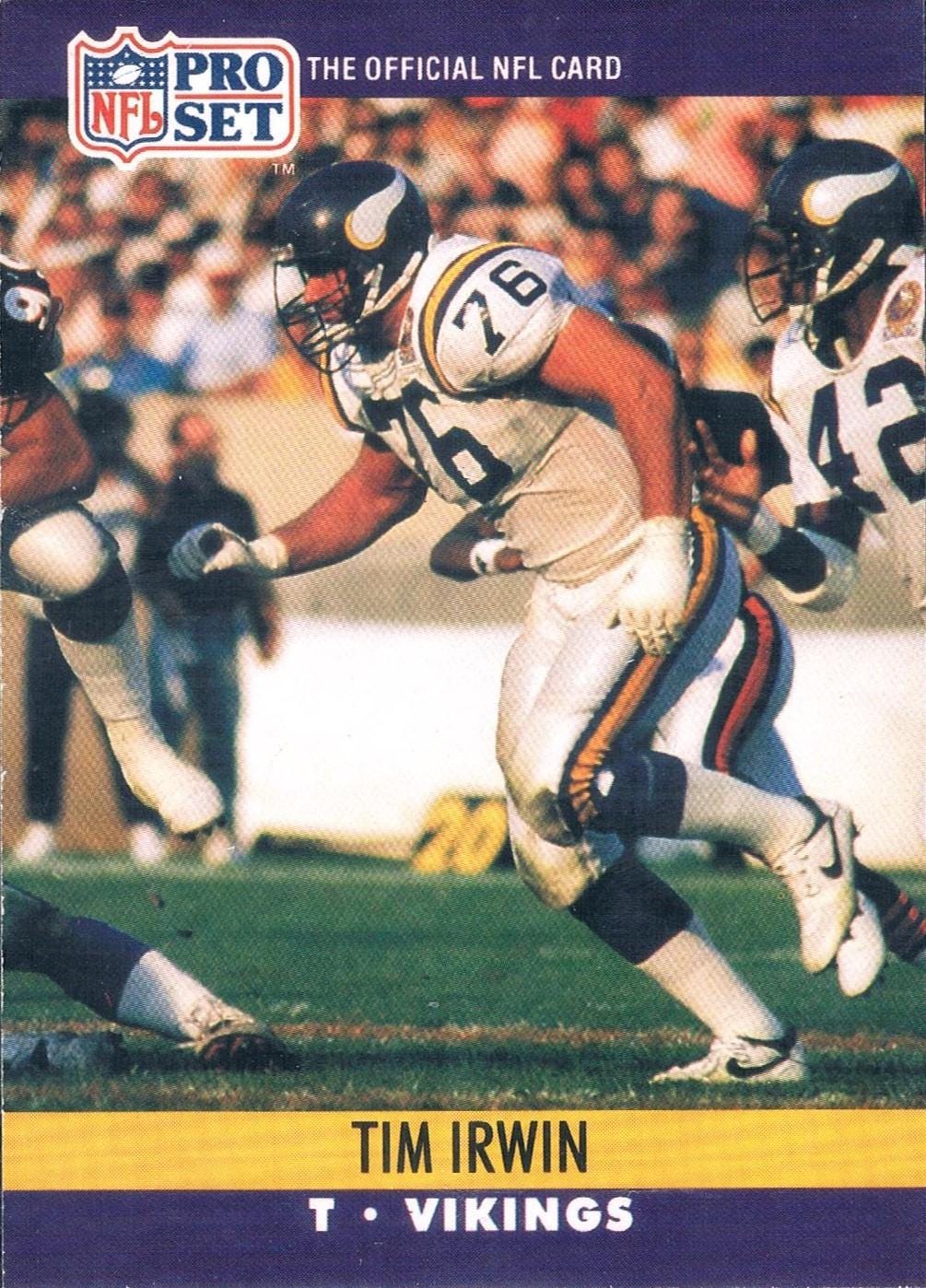
10 -- Tim Irwin
— By Matthew Coller
I debated with myself for way longer than is rational about whether Tim Irwin is underrated. In one sense, the Vikings organization fully understood his contributions. He was named to the 40th anniversary team and put on the 50 Greatest Vikings list. It’s difficult to say that someone is underrated when they are beloved by the club that employed them to that degree.
But there are a few things about Irwin that I decided make him less appreciated than he should be. The first is that he never made a Pro Bowl. Unfortunately we don’t have metrics like we do now to describe how many QB hits, pressures and sacks that an offensive lineman gave up or exactly what his impact was on the run game but Irwin was playing a key position as a starting tackle from 1983 to 1993 for the Vikings during an era where they had a lot of great offenses.
In 1986, the Vikings ranked 4th in scoring. They went to the NFC Championship game in ‘87 and then had a top-five offense again in ‘88, top-10 in 1990 and top-five again in ‘92. In Pro-Football Reference’s “Approximate Value” stat, he’s 20th in Vikings history.
Irwin’s durability was unfathomable. In those 11 seasons from ‘83 to ‘93, he missed zero games outside of the strike in ‘87. How is that even possible for an offensive lineman? Zero? Can you imagine how many times that guy must have been banged up and found a way to fight through it?
Right tackles also never got their due in Irwin’s day. It was all about left tackles until the 2010s when we started to study stuff closely and realized that the difference between LT and RT is nowhere near what we think it is.
I was also thinking about how many moments that Irwin was there for. Every play, every game, Mr. Reliable was there through the Les Steckel nightmare of 1984 and Bud Grant’s return in ‘85 when they beat the 49ers. He was there in ‘87 when they shocked the 49ers and came within one drive of the Super Bowl. He was steady at RT when they got Hershel Walker in the worst move ever and when they got Cris Carter in the best move ever.
We don’t give enough credit in sports to reliability. Irwin was the definition of that and even if the franchise has recognized him, he didn’t get enough attention for his contribution during his era and his greatest talent goes overlooked in sports in general.
9 -- Wade Wilson
— By Matthew Coller
As an eighth-round draft pick, Wade Wilson had to wait his turn. Wait and wait and wait and wait. He was taken in 1981 and only started 10 games by the end of 1986. In those contests, his performance was pretty mediocre. He was only 5-5 with more interceptions than touchdowns and a 63.6 QB rating. In today’s game, there is no world where this guy would ever turn out to be a good starting QB. He’d be in the UFL by that point.
I always thought that something must have happened to Wilson during his time on the sidelines. Imagine how anxious you must get standing there with a clipboard hoping. My theory is that he waited so long to play that when he finally got his chance in 1987, he was going to let loose. No regrets, aye Wade?
Wade’s ‘87 is a crazy journey. He started the season and played well in the first two weeks, getting wins over the Lions and Rams and then the NFL went on strike. When the players returned, Wilson struggled and then the QB situation turned into a back-and-forth with him and Tommy Kramer. There was a game against the Raiders where Kramer started and Wilson came in during the second half and threw two passes for 69 yards and two touchdowns. Basically every week they were both getting playing time — and they were winning.
At the end of ‘87, Wilson had a terrible game against Washington with 3 INTs in an overtime loss and it looked like it was over. Then he fought back with two legendary performances in the playoffs vs. New Orleans and San Francisco and gave them a shot at the Super Bowl in a 17-10 loss to Washington. Wilson ended up leading the league in yards per pass attempt (8.0) and he averaged 15.0 yards per completion in ‘87. Just throwing bombs.
The following season he made the Pro Bowl and operated an elite offense with the highest completion percentage in the NFL.
After that, his performance drifted and his time ended with the hiring of Dennis Green but Wilson eventually won a Super Bowl with the 1995 Cowboys as their backup quarterback.
He also went on to coach for a long time with Chicago and Dallas.
Quarterbacks like Wilson will never be fully appreciated but his resilience and willingness to air it out makes him a Vikings legend at QB.
8 -- Ben Leber
— By Matthew Coller
If I time traveled 20 years back and analyzed the performance of Ben Leber, he would have been one of the first “analytics darling” type players. After four seasons with San Diego in the pre-PFF era, Leber signed with the Vikings as a free agent. In the first year of PFF’s grading system, he ranked as the 14th best linebacker in the NFL with at least 500 snaps. He played a lot of outside linebacker that year and picked up 14 QB pressures and ranked fourth in run defense grade behind the Williams wall. He finished with 48 tackles on one of the best run defenses of all time.
His role changed to exclusively playing inside LB after that but Leber continued to create pressures, racking up 27 in 2007 along with 5.0 sacks. Where he developed in those first few years was in coverage, where he ended up ranking No. 2 in the NFL in 2009. He gave up just 8.0 yards per reception into his coverage and led the league in PBUs.
In the Vikings’ playoff win over the Cowboys in ‘09, he had an interception and he totaled 18 tackles in two games. Yes, it was a bogus flag against him in overtime vs. New Orleans.
In total for his Vikings career, opponents only had an 89.1 quarterback rating when throwing into his coverage.
Leber wasn’t just one of the earliest players that advanced data highlighted, he was incredibly durable, playing 15 games in 2006 and all 16 games every other season in purple. He brought quickness to the second level, which played off the beef up front excellently and there was some violence to his game.
Leber never made a Pro Bowl and he won’t get discussed as often with those great defenses of the mid-to-late 2000s because of the Williams Wall and Antoine Winfield Sr. but anybody who watched during that time could match the eye test with the data and agree that he was underrated.
7 -- Rickey Young
— By Matthew Coller
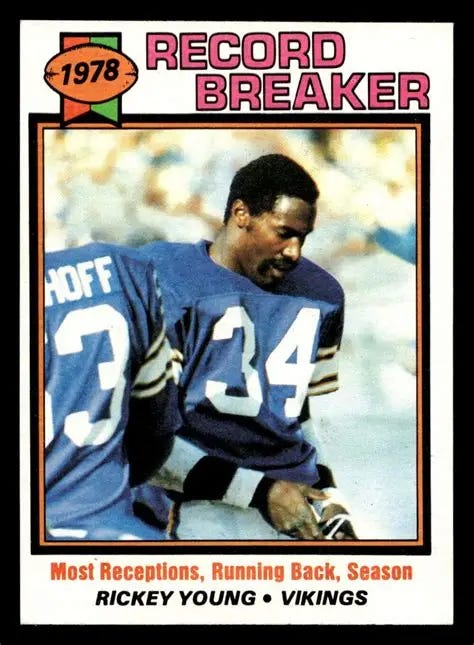
Had Rickey Young played in a different era of Minnesota Vikings football, maybe his career in purple would have been amplified more. Between 1978 and 1983, the Vikings finished with eight, seven, nine, seven, 5-4 strike-shortened season and eight wins. It was a run of mediocrity that would make Jeff Fisher blush. Good players during that time got overlooked because the overall product was so bleh. Young was one of those guys.
It’s funny, in the NFL’s early days, Chuck Foreman was one of the only backs who became a legitimate weapon in the receiving game and then in the 1990s there were a ton of guys in the backfield like Thurman Thomas, Amp Lee, Larry Centers etc. who caught a ton of passes but Young was ahead of his time in the late-70s and early 80s as a pass-catching back.
In 1978, Young led the NFL in receptions with 88 on 112 targets. He never quite reached that peak again over the couple following years but from ‘78 to ‘81, his 267 receptions were No. 1 in the NFL and only two other running backs had over 200. For example, Cleveland’s Mike Pruitt was known as a pass-catching back and he only had 187 receptions in the same span.
How impactful were all these receptions? Luckily we do have some stats that tell us that. His Success Rate of 52.5% between ‘78 and ‘81 on receptions is the sixth best of any running back that had at least 100 receptions during that span. He was 15th in all-purpose yards during those four peak seasons.
When he retired, Young ranked No. 1 in NFL history for receptions by a running back and he added 3,666 yards rushing. Another crazy stat: He never missed a game, playing in all 131 possible games during his career.
Young was a bit overshadowed by first-round pick Ted Brown, who had eight touchdowns in 1980 and then over 1,000 yards in 1981, but together they ended up making up a quality duo.
6 -- Anthony Carter
— by Josh Smith
We understand what you might be thinking, perhaps as long-ago visions float through your head of this man scorching defenses:
How is Anthony Carter on a list of most underrated Vikings?
And that’s fair to wonder, considering a few impactful facts from this dandy’s career in purple. Specifically, those three Pro Bowls, that two-game playoff stretch for the ages in 1987 and, if you’re like me, that one poster of him — outstretched horizontally for a catch — on your bedroom wall in 1990.
But this might be where we should really begin to parse the term “underrated.” Because, in the unmatched annals of Vikings wide receivers, we dare say that AC is almost precisely what this discussion is about.
Ask dyed-in-the-wool Vikings fans for an ordered list of the franchise’s best wideouts and AC might land as far back as sixth or seventh. But recall the timeframe when he was the face of the Vikings offense and imagine how blah it might’ve been without him.
Then, think about the masterstroke of acquiring him. In 1985, Minnesota sent linebacker Robin Sendlein and a 1986 second-round pick to Miami for the rights to Carter, who had burned USFL defenses for 3,000 yards and 27 TDs over three seasons.
Finally, imagine how in the world the Dolphins could’ve seen that and decided: Nah, we need two LBs (the draft pick became one named Kevin Murphy) instead of giving Dan Marino one of the era’s filthiest deep threats.
Alas, Carter spent nine years in Minnesota, where he didn’t have Marino but he had a run of electric playmaking despite a five-headed monster of QB mediocrity.
In 40 games from 1985-87, Carter averaged an NFL-best 20.4 yards on 119 catches. The tour de force, of course, came when he compiled a then-NFL playoff record 227 yards on 10 grabs in an ’87 divisional shocker over the 49ers.
It put him on the cover of Sports Illustrated. Next to the words “MAIN MAN,” the uniquely built AC is mid-gallop — a majority of his 168 pounds seemingly in the thighs and rear that powered an explosive 5-foot-11 frame. (He ran a 4.35 40 at Michigan, where he convinced Bo Schembechler to throw the ball.)
When scrawny boys like me saw him — and saw his jersey in the JC Penney Catalog — he made us believe we, too, could play in the NFL. That is, if we developed Olympic-caliber speed and elite ball-tracking skills that led to absurd deep completions or punt-return dynamism that could result in another single-game playoff record (also in 1987 vs. New Orleans).
AC produced 1,000-yard seasons from 1988-1990 before the Velcro-handed Cris Carter (no relation), acquired in ’90, got his act together and became the primary target.
Still, in team history, AC is fourth in receiving yards and TD grabs, sixth in catches and first in yards per reception (16.0) for anyone with more than 400 receptions. In Pro Football Reference’s Approximate Value, he’s ninth all-time among Vikings, two ahead of Justin Jefferson.
Yet in his day he garnered less respect than more complete peers like Rice, Monk, Ellard and Sterling Sharpe.
And in Vikings lore, even with the profile of a top-tier playmaker, Anthony Carter remains overshadowed by his rich receiving brethren.
Tim Irwin, now an attorney. I remember watching the Vikings play the Raiders and crazy, steroid madman Lyle Alzado went against Irwin. The battle was epic and Irwin never backed down. Total respect…
I thought Carter was clearly a superstar in his years with the Vikings. Also I think Chuck Foreman was perhaps not underrated but I was constantly amazed how he could always get open for a catch over the middle. Like Carter he was unstoppable but he won't make the HOF.