
By Matthew Coller and Josh Smith
Warning! If you grew up a Minnesota Vikings fan during the Fran Tarkenton era, this factoid is going to hit you pretty hard: The 2026 season will mark 50 years since the Vikings have reached the Super Bowl.
Over all those years, there have been a lot of Vikings players who have come and gone and not all of them have gotten the recognition that they deserved.
So we are counting down the most underrated players of the last 50 years of Vikings football.
The criteria is wide ranging. In some instances we have elected to go with players who were only appreciated by Vikings fans and did not get recognized outside of the state. In others, players whose contributions that were more subtle or were overshadowed by bigger stars.
So let’s dive into our first installment…
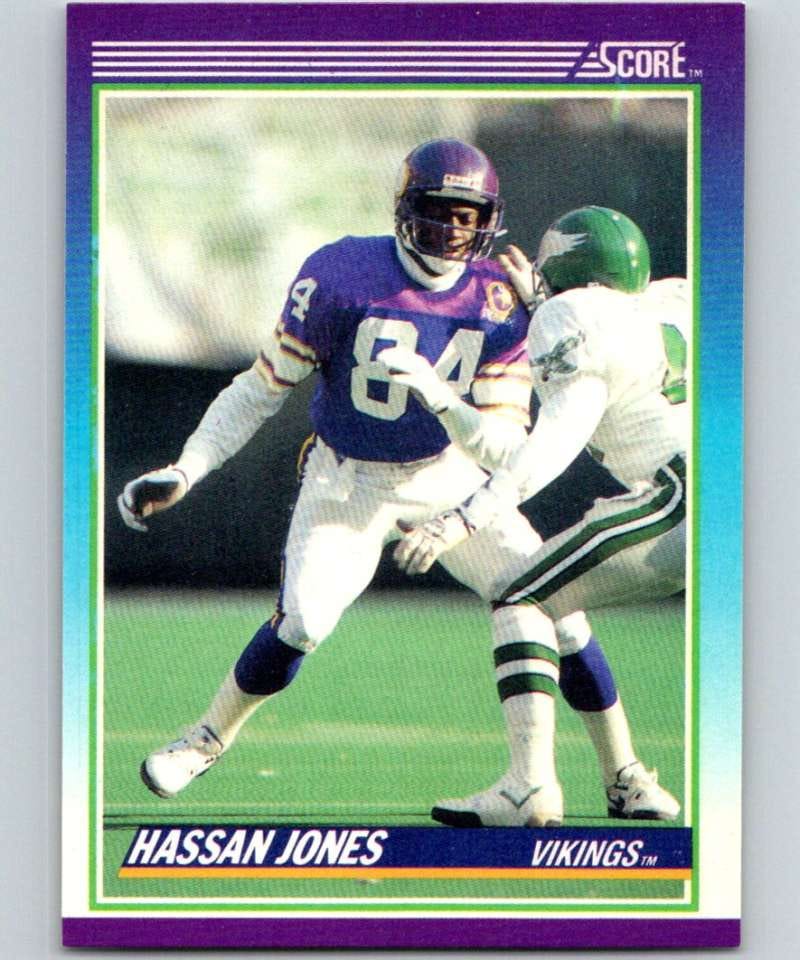
20 -- Hassan Jones
— By Matthew Coller
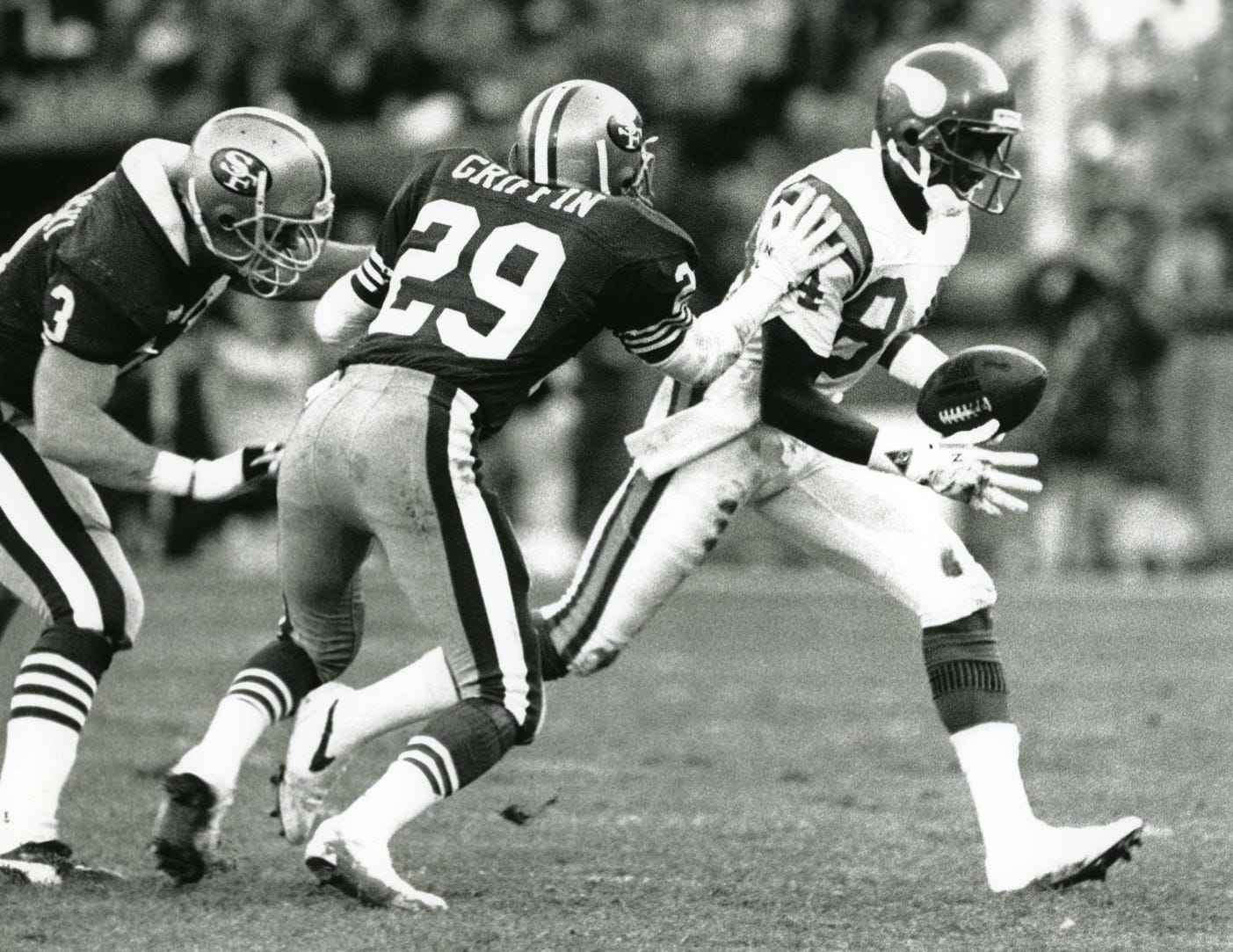
In search of trying to remember exactly how Hassan Jones played football, I typed his name and the word “highlights” into YouTube and nothing came up. You’re telling me that nobody in the entire world made a cut up of a guy who averaged 20.4 yards per reception as a rookie, caught a 44-yard Hail Mary touchdown at the end of the first half in the Vikings’ blowout win over New Orleans in the 1987 playoffs and had 778 yards in 1988 and 810 yards in 1990 doesn’t have a highlight reel?
Google unearthed some legal troubles but nothing insightful about his career. What gives?
Jones wasn’t a superstar in the NFL as he played second fiddle during his career to Anthony Carter but he was one of the best deep-threat receivers of the late-80s. In terms of total yards between 1988-1990, he ranked 27th in the NFL, in the same range as memorable receivers like Al Toon, Mark Clayton, Flipper Anderson, Brian Blades, Mark Jackson, John Taylor and Mark Duper.
In terms of yards per catch, the receivers who were in his range (17.2 YPC) from ‘88-’90 were Jerry Rice, Henry Ellard, Michael Irvin and James Lofton.
Because Tommy Kramer, Wade Wilson and Rich Gannon were always hucking deep balls to Jones, he never ended up with a ton of volume stats. Only four times in his career did he receive 10 targets in a game and he only had four games with six or more receptions, yet he had 14 games of at least 75 yards.
A quintessential example of Jones’ role on the team was a 43-3 blowout over the Cowboys in which he had 132 yards on three catches.
In a league that is all about high completion rates nowadays, the explosive play was king back then and Jones had 23 games where he averaged at least 20 yards per catch.
Being that he was a fifth-round pick in the 1986 draft whose career high in receptions in college was 34, Jones made the most of his Vikings career on some good teams.
His career would have been more robust statistically if not for two things: Denny Green’s West Coast offense and Cris Carter.
In 1991, the Vikings landed Carter, who instantly became WR1, pushing Anthony Carter down on the depth chart and making Jones into a rotational player. In 1992, Green was hired and brought a quicker passing game that didn’t have as much need for a deep receiver as Jerry Burns’ offense did with two big-armed QBs pushing the ball downfield.
Jones’ nice career gets lost in the history books in part because the Vikings’ history at receiver is probably the best of any franchise ever. For a lot of teams, his career 3,733 yards would be pretty high on an all-time ranking. For the Vikings, it’s just 12th.
He may go forgotten because of the stars that came after him but Vikings fans of the last 80s remember him well.
19 -- David Dixon
— by Josh Smith
At age 16 in September 1995, I went to a Pittsburgh Steelers bar to watch them face the Vikings. All eyes turn toward my party while I walked in wearing nearly all purple.
As I slinked to my seat beneath the protection of my friend’s rotund father, it felt like I was in a foreign land, like I didn’t quite belong.
Meanwhile, an even more enormous man who did some guarding that afternoon at Three Rivers Stadium was an expert at handling such feelings.
David Dixon, of course, is known here today as a giant fixture on Minnesota’s OL for nearly a decade. Prior to that, though, he was a stranger in a strange land.
Dixon had been a rugby player in New Zealand when a football scout spotted him on an Auckland sidewalk. In 1986, he journeyed 8,500 miles from his home country to play defensive line in a sport that was brand new to him at a school, obscure Rick’s College (Connecticut), that honestly sounds fake.
After transferring from the junior college to Arizona State, he showed enough promise — at 6-foot-5 and anywhere from 343 to 366 pounds — for New England to use a 1992 ninth-round pick on him.
How raw was he? A Boston Globe post-draft scouting report said Dixon “doesn’t know much about how to play football.”
And that was before the Pats moved him to offensive line, where among seasoned pros he had to learn such things as how to properly stand.
No surprise, he got cut. On to Dallas, and another release. Then, Minnesota took a flyer.
Back to that September 1995 day against Pittsburgh. While I tried to hide behind my buddy’s father — during a Vikings rout made famous by Robert Smith running for a TD in one shoe and Bill Cowher stuffing a ref’s shirt pocket with a printed copy of a penalty he’d missed — Dixon earned his first NFL start.
As an injury replacement, Dixon acquitted himself well at right guard. He continued getting snaps that season. The action included a predictably disastrous fill-in at tackle against Green Bay that ended with Dixon saying Reggie White had “kicked my [butt].”
Still, he was learning, gaining experience and impressing coach Dennis Green.
By late 1996, 10 years after first learning of this American sport, Dixon had become an NFL starter, helping rejuvenate the running game for a playoff team.
While his pass blocking remained a relative weakness, Dixon and right tackle Korey Stringer formed a side of beef the size of which was seldom seen.
With Dixon entrenched at RG for eight years, Minnesota’s average annual offensive ranking by yardage was 4.6.
Think about part of that previous sentence for a moment. Entrenched at RG for eight years Today’s Vikings fans might cut off an arm for an established guard like Dixon, who fortified the middle for their QBs and RBs.
As for me on that day in 1995, I managed to escape the Steelers bar with all my appendages. Meanwhile, Dixon went on to become one of the most underrated Vikings ever.
No, he wasn’t an all-star. Few NFL fan circles would recognize his name. But with the benefit of hindsight, it isn’t a stretch to say this: In a given NFL career, no one in history came farther as a player than David Dixon.
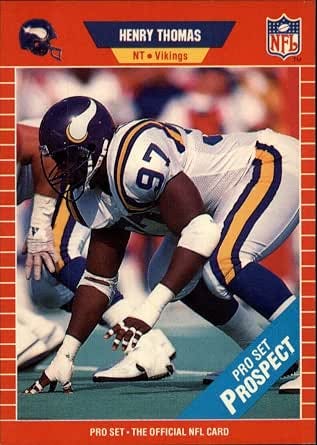
18 -- Henry Thomas
— By Matthew Coller
From 1988 to 1994, the number of defensive tackles that had more sacks than Henry Thomas is: Zero.
His 53.5 sacks during that stint eclipsed Hall of Famer Steve McMichael and memorable All-Pro DT Michael Dean Perry.
The number of defensive tackles with more tackles than Thomas from ‘88-’94 is just one.
Thomas’ game was more consistency than it was flash. He produced between 6.0 and 9.0 sacks every year as a Viking outside of his rookie season. He was involved in at least 80 tackles in five of his seasons in purple. If availability is the best ability, Thomas was an all-star. He played in all but 10 games during his Vikings career from ‘87 to ‘94.
Consistency is always going to go underrated but Thomas’ style also didn’t get enough appreciation. His nickname was “Hardware Hank” and he had a cockeyed stance that you could spot from the highest seats in the Metrodome.
With a player like Thomas, the statistics that we have available now just don’t tell the entire story. He was undersized as a nose tackle, playing 30 or 40 pounds lighter than a lot of guys who lined up over the center and he never came out of the game. Rotations were less used then than now but the ability to have such a talented player vs. run and pass on the field for every snap of the game is incredibly valuable.
The impact of having a top-notch DT who plays every snap can be seen in some of the broader team total stats, like in 1988 when the Vikings finished No. 2 in points allowed and No. 1 in yards allowed and gave up a 41.3 QB rating to opposing quarterbacks.
But Thomas largely flew under the radar because those clubs were so talented on the defensive line. Whether it was Chris Doleman or John Randle or Keith Millard’s legendary 1989 season with 18.0 sacks, Thomas’ steady hand never had the gaudy numbers that his cohorts put up. Still, he was every bit as valuable and is deserving of recognition.
17 -- Brian Robison
— By Josh Smith
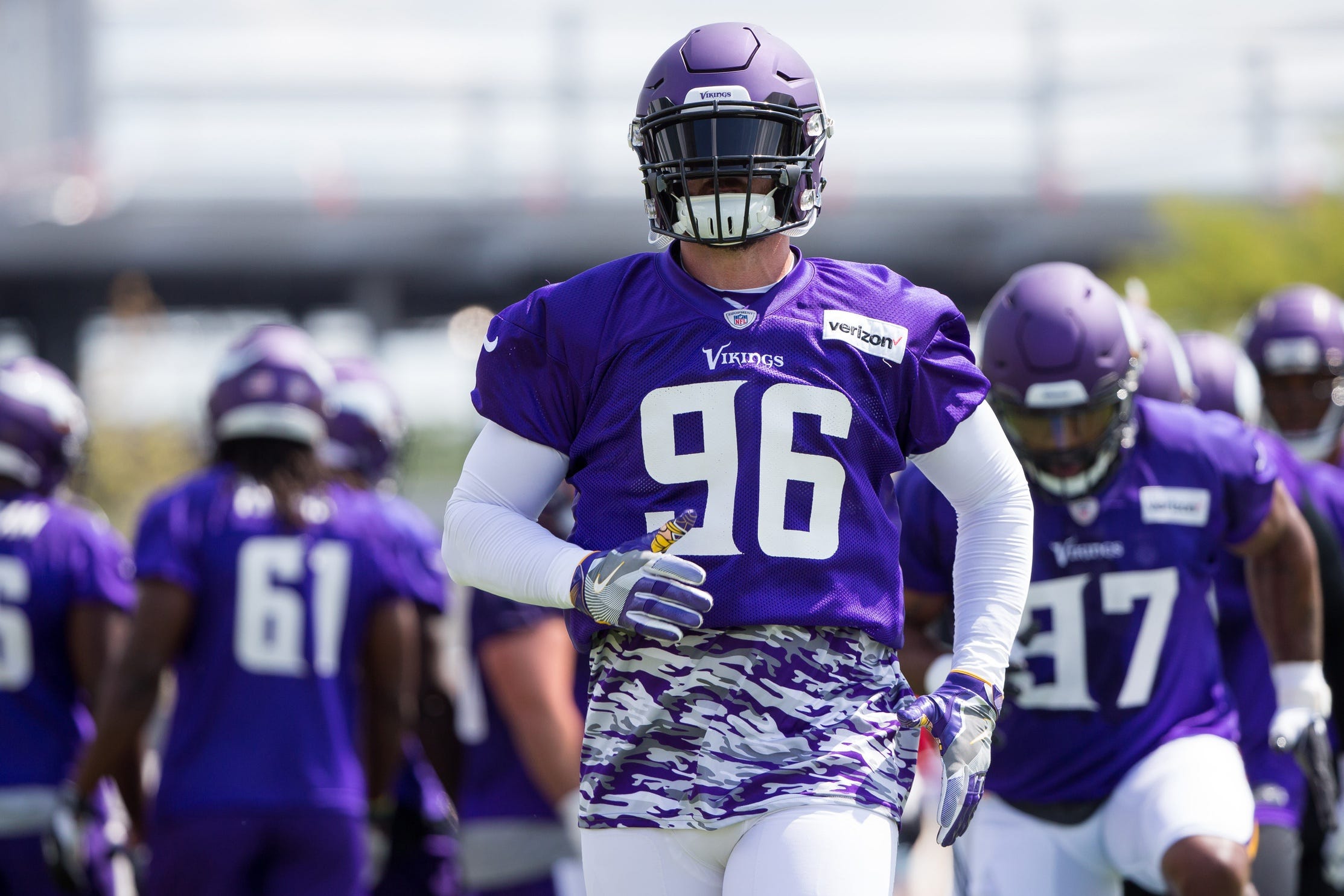
This career Viking (2007-2017) endeared himself to fans thanks to his ferocious yet heady defense and his personable yet probing inside-the-locker-room Q&A series, which was featured on the team’s official website.
While he intimidated in his dark game-day visor, Robison’s charming “96 Questions” made him one of the most recognizable faces on the roster during a time when the team grew to greatness and digital marketing boomed.
It helped that, by then, he had become a productive, disruptive starting defensive end.
In his NFL debut, as draft classmate Adrian Peterson burst onto the scene with a memorable touchdown, Robison quietly had his own breakout with two sacks of Atlanta’s Joey Harrington, portending the long success to come (for Robison; not Harrington).
Robison experienced a bit of everything in his 11 seasons, as part a rising squad that reached a title game, a swooning one that sank to three wins and one that rebuilt to formidability.
At first, he was a developmental fourth-round pick out of Texas, where he was a two-sport star. He would’ve been a great answer on his own show if he had asked which Viking, from any timeframe, could’ve been an Olympian — because he was an All-American thrower as a Longhorns track and field star.
Once in the NFL, he used that athleticism to quickly become a situational pass-rusher on a top-notch defense that reached the Final Four in 2009.
By 2011, as the team fell off briefly, B-Rob took over as a rock-solid starter. Eventually, he helped fortify Mike Zimmer’s confounding unit while prowling the line of scrimmage, mostly on the left edge.
Late in his career, Robison assumed a backup/tutoring role to the gifted Danielle Hunter. He continued adding value to the team on the field and, off it, laughs for all of us with the microphone.
Robison isn’t a name that leaps to mind when considering all-time Vikings sack masters. However, from 2011-13, he recorded 25.5 as a bookend to superstar Jared Allen — and each QB takedown was followed by his hook-em and reel-em-in celebration.
Overall, he is 10th on the list of Vikings career sack leaders (60) and eighth in forced fumbles (13) and, goodness gracious, look at the gentlemen who are in front of him in those categories. It’s a who’s who of Hall of Famers and franchise greats.
Robison’s run ended in 2018, when the Vikings decided to get younger by keeping forgettable free-agent rookie Tashawn Bower over the experienced leader who had been a staple of their defensive success.
Regardless, there’s not a single question about it, never mind 96 of them: All in all, Robison was one of Minnesota’s best mid-round picks of the past 40 years.
16 -- EJ Henderson
— By Josh Smith
There might not be a Viking in recent memory who drew more adjectives referring to his reserved nature than E.J. Henderson.
No-nonsense. Private. Understated. Such words accompanied nearly every mention of the middle linebacker, and it certainly contributed to him being considered underrated. There was no inspirational dancing like Ray Lewis, no I-like-this-kind-of-party mic’d up moments like Mike Singletary, no Energizer flashiness like Junior Seau.
However, if you find this clip of a single, microcosmic Henderson play, any descriptor that comes to mind for his on-field performance is more emphatic than sedate.
The play came in 2007, his fifth season, a year he won Vikings defensive MVP. With the host Bears running out the second-quarter clock on a day when rookie Adrian Peterson was amid his first 200-yard rushing explosion, an innocuous handoff to fullback Jason McKie ends with a burst of nasty violence, brought to you by our taciturn defender. Henderson blurs into the frame from the right and obliterates McKie with a shoulder shot that pops the ball into the air.
Kyle Brandt tweeted it in 2022. Jerome Felton, a nine-year NFL fullback, replied, “[Henderson] was legit the only linebacker that I ever dreaded playing against.”
It was an extreme yet emblematic moment for Henderson, who was a wood-bringing, sure-tackling career Viking (2003-11). With his calming influence and reliable play, the team constructed a fierce front-seven that culminated in a sixth-ranked defense (by yardage) in 2009.
Henderson’s arrival and development solidified an important position (he moved to the middle full-time in 2007) after a string of undersized, uninspiring LBs had manned the spot in preceding years.
The Vikings drafted Henderson with their ’03 second-round pick (after the Kevin Williams debacle) and felt they’d landed a steal. An All-American at Maryland, Henderson had won the Butkus Award and Bednarik Trophy, but concerns about his speed kept him out of the first round.
He was rookie backup, then became a starter in 2004. Henderson made steady improvement, thrice leading Minnesota in tackles as the team built under Brad Childress. He was playing at an elite level early in 2008 when he suffered two toe injuries that ended his season.
He entered 2009 “more hungry” than ever, he said, assuming a captain role among a veteran group primed for excellence. His splashy stops were infectious. His intensity permeated. His sparse words carried weight.
“When E.J. is in there, it’s a different deal,” defensive coordinator Les Frazier said that summer. “He commands so much respect.”
Defensive end Jared Allen called Henderson “a monster,” and he played like one as the Vikings started 10-1 before disaster struck in Week 13 — a horrific compound fracture to his femur during a loss in Arizona. The break appeared career-threatening. Teammates were near tears afterward when asked about their leader.
His gruesome injury forced into action the inexperienced, limited Jasper Brinkley and weakened their nickel defense through a playoff run that ended with the crushing championship loss in New Orleans.
While there was never a doubt about Henderson’s impact, a giant question hangs over his career: How much of a difference could he have made against those high-octane Saints?
Regardless, Henderson returned to full strength in 2010. And while the team faltered greatly, he notched his first and only Pro Bowl nod in his penultimate season.
It was a well-earned decoration for one of the most important Vikings defenders of the past 40 years.
Even if he did it quietly.
David Dixon!
When Dixon was still playing my son and I saw him at the MOA. Just walking past him we made eye contact. I probably smiled goofy and nodded and he nodded back. No big deal.
He was the largest human I had ever seen. Sorta like a refrigerator with a head on it. His wife is tiny.