
By Matthew Coller
Warning! If you grew up a Minnesota Vikings fan during the Fran Tarkenton era, this factoid is going to hit you pretty hard: The 2026 season will mark 50 years since the Vikings have reached the Super Bowl.
So we are counting down the most underrated players of the last 50 years of Vikings football.
Let’s continue our countdown….
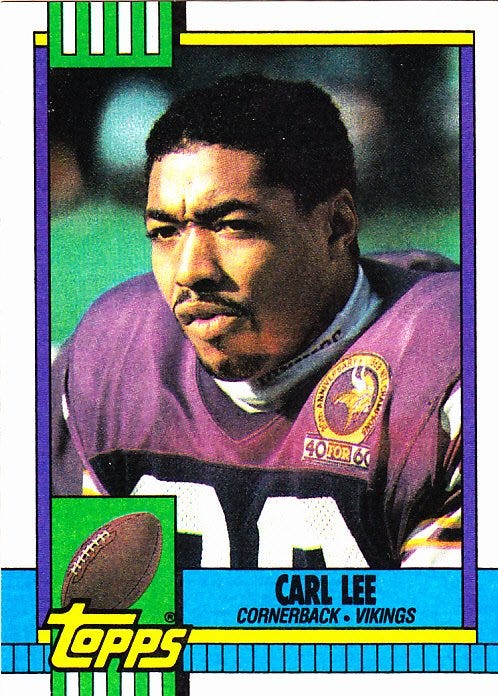
5 -- Carl Lee
Carl Lee is not underrated by his own team. He was on the 50 Greatest Vikings list and 40th anniversary team. He played 11 seasons in purple and during that time it was not lost on Vikings fans that he was a steady presence at cornerback.
Where he doesn’t get the credit is that the era had some superstar cornerbacks that got a ton of shine i.e. Ronnie Lott, Rod Woodson, Darrell Green, Deion Sanders and a player like Lee went under the radar. The 80s defenses also had Joey Browner in the secondary and Chris Doleman on the defensive line, so it was easy to get overshadowed.
When we talk about things lost to history, Lee’s 1988 season is one of the best ever by a cornerback. Pro-Football Reference’s “Approximate Value” statistic ranks Lee’s ‘88 as tied for the 40th best performance by any player at any position. The players who scored a similar mark as Lee’s 1988 include Jim Brown, Peyton Manning, Alan Page, Warren Sapp, Bruce Smith, Brian Urlacher and Tom Brady. In terms of cornerbacks, Darrelle Revis’s 2009 season, Patrick Peterson’s 2011, Stephon Gilmore’s 2019 and Deion Sanders’ 1996 are the only corners who have had a better single season.
In ‘88, Lee picked off eight passes, returned two of them for touchdowns and the defense overall was No. 1 in opposing passer rating allowed (41.2) and QBs completed just 45.6% of passes. He earned All-Pro but only finished eighth in DPOY voting.
Lee never repeated that season, as most cornerbacks do not when it comes to crazy high numbers of interceptions, but his longevity deserves to be celebrated. During Lee’s 11-year tenure in Minnesota, he only missed three games.
Lee ended up with 169 games played for the Vikings, 22nd most in team history and he picked off 29 passes, which is seventh on a team that had many great defensive backs.
The long-time defensive back also had an underdog story. He was a seventh-round draft pick in 1983 and barely saw the field in his first season. He was forced to earn his spot every step of the way and it took six years before he made his first Pro Bowl.
Lee had to fight his way to the top, posted one of the best seasons ever and wasn’t considered a top player for much longer after that because he didn’t get the interception numbers. I suspect if we had better data back then, we would have realized his impact year after year.
4 -- Doug Martin
— By Matthew Coller
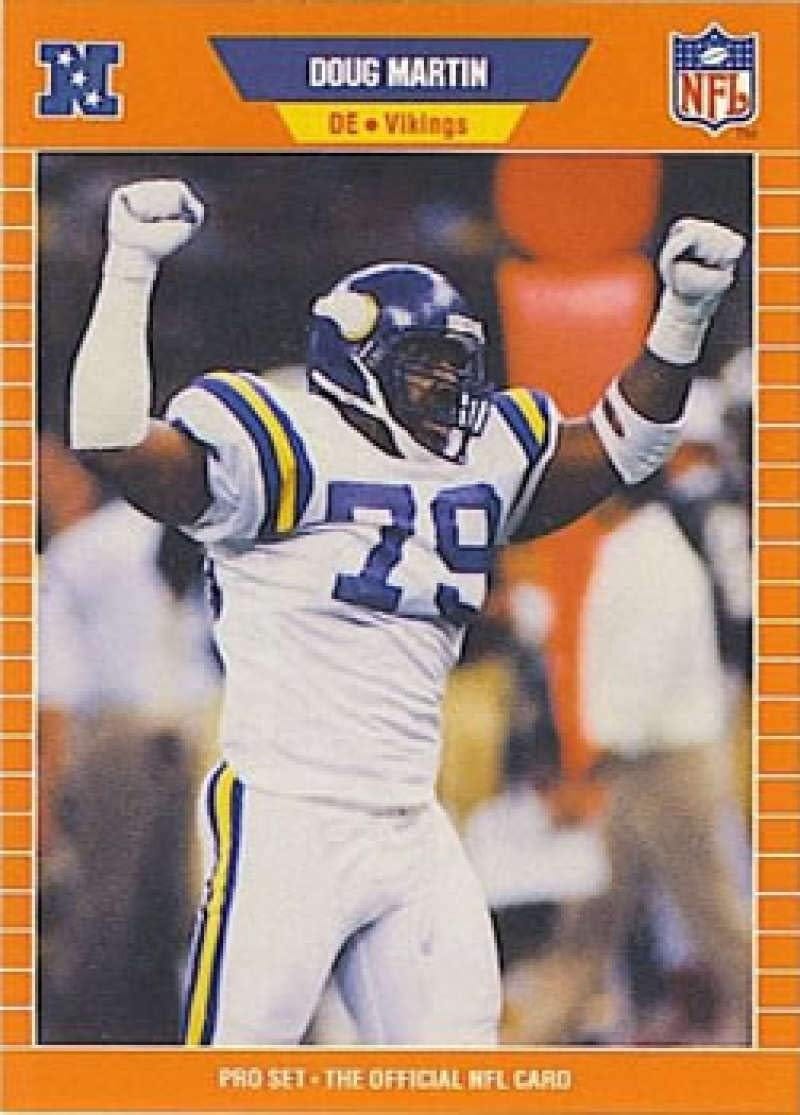
Doug Martin’s 1982 season should be talked about more under the all-time great pass-rushing seasons. It was the first season that the league officially tracked sacks and Martin led the NFL with 11.5. Keep in mind, that season was shortened to only nine games so he was the first ever NFL sack champion.
The following year, Martin didn’t lead the NFL but he picked up where he left off with 13.0 sacks.
He never quite reached that peak again but he did manage 9.0 sacks in 12 games in 1987 (the replacement player season) and he was a key part of the defense that helped them to the NFC Championship and then a top ranking in the NFL in 1988.
Martin played the entire decade of the 80s for the purple and never played for another team. After Pro-Football Reference did its research on sacks prior to 1982, they credited Martin with 11.0 more between 1980 and 1981. With those extra sacks, he is ninth all-time in sacks, just ahead of Brian Robison and Kevin Williams and behind Everson Griffen.
When Martin passed away, I went looking for more information on him. For such a key player on the Vikings defense in the 80s, it was hard to find much. Martin was a humble player, credited for doing the dirty work that went beyond just getting to the quarterback.
“He was a huge part of any success we had, and you could count on him,” Scott Studwell told Vikings.com. “He was a great player and a better man. We will miss him.”
Players like Martin, who were on the field for all of the greatest moments of a decade yet Google searches don’t even turn up many stories, are pretty much the reason why we wanted to make this list.
3 -- Linval Joseph
— By Matthew Coller
From 2015 to 2017, Linval Joseph was the best nose tackle in football. His performance peaked in 2017 when the Vikings ranked No. 1 against the run and pass and gave up the fewest points in the NFL.
Joseph was the starting point for that success, grading as the sixth best overall defensive tackle by PFF and the fifth best against the run while racking up 30 QB pressures and 35 run stops, which was sixth most total.
At a position that is known for coming off the field when it’s time to rush the passer, Joseph played 644 snaps in 2017 and ranked as the 11th best pass rushing nose tackle in football.
At 6-foot-4, 330 pounds, Joseph was probably in the top five strongest players in the NFL. At the Combine, he benched 39 reps (96th percentile) and he was definitely stronger by the time he reached the Vikings. I have no earthy idea how anyone in the NFL could block someone that large with the quickness that he developed.
There were two things about Joseph’s play that became almost comical over those seasons. One was that teams kept running up the middle on third or fourth-and-short. Week after week, opponents would hand off and get stuffed into oblivion by the big man in the middle. Not that there were many easy answers against those defenses but the worst possible answer was to run at the most dominant player on the field vs. the run.
The other thing that happened pretty often was Joseph would track down screens and short passes. Imagine being a slot wide receiver and catching a low crossing pattern and Joseph is there to take the soul out of your body. Or imagine getting tracked down as a running back on a screen while you’re trying to dodge traffic and a 330-pound man lands on you.
Of course, we haven’t even mentioned Joseph’s most memorable moment: His interception for a touchdown against the Philadelphia Eagles in 2018. Not that anyone questioned his quickness but he was flying. The pick-six turned into an iconic image of Joseph getting oxygen on the sideline, looking like nose tackle Darth Vader. After the game, he wore a hot pink suit.
Joseph didn’t just go underrated because of his position, he was overshadowed by a ton of superstar talent on that defense. Mike Zimmer was clearly the face of the D and all-stars like Xavier Rhodes, Everson Griffen, Danielle Hunter, Anthony Barr and Harrison Smith got the majority of the love.
What I enjoyed about covering Joseph is that he was a kind soul. He had been bullied as a kid and made efforts off the field to quell bullying. When he talked to media, he was soft-spoken and friendly. The locker room didn’t just like him, they seemed to care about him. They wanted everyone to understand how important he was and they wanted him to get it too. That was cool.
Funny though, the guy who brought so much violence to the field was the person you would most want to water your plants while you are on vacation.
When the Vikings drafted Caleb Banks and Domonique Orange, it was a reminder that Joseph was basically both of those guys’ talents combined. We don’t appreciate enough how difficult that position is and the incalculable value that it brings to have the best of the best.
2 -- Chris Liweienski
— By Matthew Coller
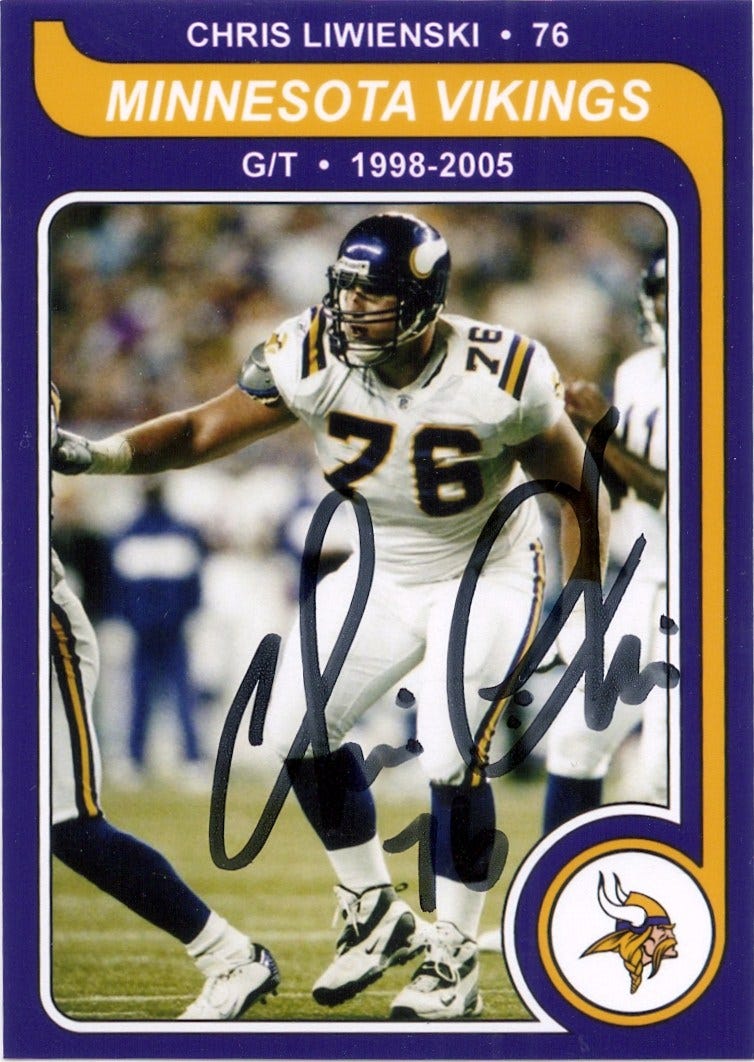
I’m sure that some of you are having a “huh?” reaction to Chris Liweinski being tabbed as one of the most underrated players of the last 50 years but hear me out: This one is for all of the offensive linemen of yesteryear who didn’t have QB pressure numbers or PFF grades to make their case for greatness. None of them were celebrity podcasters and there weren’t All-22 analysts to point out when they had thrived.
So this one is for Jeff Christy, Kirk Lowdermilk, Jim Hough, Wes Hamilton and the other grinders who never got any limelight.
The reason why I picked Liweinski to represent the underappreciated Vikings linemen of the last 50 years was because he had a very difficult situation to start his career. He was a seventh-round pick of the Lions who got released out of his first training camp. The Vikings signed him and put him on the practice squad in ‘98 and ‘99 and then he was a backup in 2000.
Liweinski went into the 2001 season expecting to play guard but when Korey Stringer died he was the unfortunate soul tasked with trying to replace the great Stringer. That was a very rough season on everyone but Liweinski carried on as the starter in 2002, when the Vikings offense ranked 8th best in the NFL behind Daunte Culpepper throwing to Randy Moss for 1,347 yards and Michael Bennett rushing for 1,296 yards at 5.1 YPC.
For his efforts, Liweinski was named to USA Today’s “All-Joe” team, that was meant to highlight unheralded players.
In 2003, Liweinski moved over to left guard, a more natural position for him. While the season ended in stunning fashion and the Vikings missed the playoffs, the offense as a whole led the NFL in yards and Moss led the NFL with 17 touchdowns.
The 2004 season featured one of the most prolific passing years in NFL history with Culpepper going for 4,717 yards and 39 touchdowns with a 110.9 QB rating. As a team they averaged 4.7 yards per rush (2nd) despite not having a clear No. 1 running back.
Liweinski was a member of the offensive line through 2005 and then the Vikings got Steve Hutchinson and he went to Arizona with Denny Green. The only statistics we have for linemen from that era is Pro-Football Reference’s “Approximate Value,” which ranks the tackle/guard 86th in team history, right around Stefon Diggs and Xavier Rhodes.
The current Minnetonka resident was never a Pro Bowler. Won’t ever be mentioned on a list of the best Vikings offensive linemen in team history but he battled his way into the lineup, played multiple positions and was there during a stretch of great offenses. That’s what being underrated is about.
1 -- Jake Reed
Here’s an unforgettable setting for you:
Lambeau Field, Oct. 5, 1998, 8:20 p.m.
Who in this audience doesn’t have recurring dreams about that utterly glorious Vikings evening?
I revisited it recently — but not for the obvious reason. Meaning, not to re-watch Randy Moss’ astounding star launch.
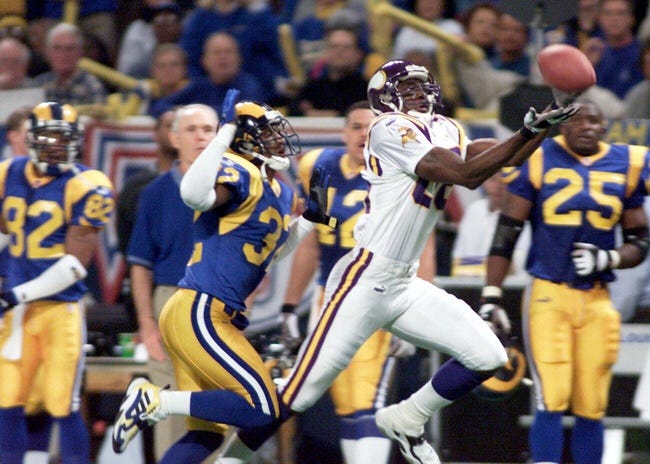
No, I wanted a reminder of a different pass-catcher’s usage in that deliciously historic offense. I wanted to see how good Jake Reed still was as he accepted a backseat role after serving — largely under the radar — for four years as arguably the NFL’s best No. 2 wide receiver.
And, yowza, here’s what you see a quarter into a 3-3 tie:
The 6-foot-3 Reed trots to the bottom of the screen, streaks downfield, snags a back-shoulder pass from Randall Cunningham at the Packers’ 25, shirks a Craig Newsome tackle attempt and saunters into the end zone for a 56-yard touchdown on ABC’s Monday Night Football.
As Reed celebrates, arms outstretched, Al Michaels calls him “the forgotten man.” Boomer Esiason wonders aloud how Reed had been feeling up to that juncture.
“A lot of his passes have gone to No. 84, Randy Moss, and [Reed is] a Pro Bowl receiver himself,” Esiason said.
Boomer was right on the first part, wrong on the second. Reed had never been selected to a Pro Bowl (and never would). But the error was understandable because Reed had been such a convincing talent.
Big, strong, complete and quietly productive.
We probably don’t think about Jake Reed enough. And we certainly don’t think about him when we reminisce on that game. Yet, there he was, lighting the fuse for an offensive explosion — and then just stepping back.
After a frustrating journey to gain a role, Reed was, in most circles, just the lesser known sidekick to record-breaking Cris Carter. Then, after Moss landed in Minnesota’s lap, he selflessly accepted even more of a complementary job as the offense set the league ablaze.
It’s easy to forget that, at various points, without much individual fanfare, Reed was the other guy in perhaps the finest WR tandem and trio in NFL history.
For these reasons and several others we’ll exhibit, Reed wears the crown as our list’s most underrated Viking.
In many ways, Reed was an anomaly. He’s the rare NFL wideout who only played the position for one year in college, then endured, as he said in 1994, “one injury after another” that disrupted his development before he earned enough trust from a coach (Dennis Green) who didn’t draft him to replace a departed legend (Anthony Carter) despite logging just 11 catches in 27 games over his first three seasons.
At Grambling State, Reed spent three years as a running back/wingback. A switch to WR as a senior resulted in a 1,500-yard season and — per Vikings scouting reports in 1991 — comparisons to both Eric Dickerson and Art Monk.
But after Minnesota took him in the third round (with a pick it got back from Dallas in the Herschel Walker trade) and a spate of health issues, the idea of Reed completing the vision of a prototypical pro receiver was difficult to see.
Partly because of his right eye.
In 1993, Reed was diagnosed with binocular vision disorder. He had trouble coordinating the focus of his eyes. His peripheral vision was weak. He did vision agility drills for an hour a day, five days a week in the offseason. He wore an eye patch. He endured some laughs.
He caught 200 passes a day. He beat the problem. He benefitted from Green’s patience and belief. He slayed the internal and external doubts and became a starter in ’94, fending off a training camp pelvic injury.
Then, with little warning, he came into his own. By Week 4, he was snatching 100 yards worth of spirals from Warren Moon. The QB praised Reed’s speed (4.4 seconds in the 40), body control and rise to reliability. For instance, Reed would’ve been rated a contested-catch beast if the modern analytic had existed then.
Soon, Cris Carter and Reed were being referred to as Moon’s “go-to duo.” By the end of that season, they had become the NFL’s all-time leading receiving tandem in total catches. Reed notched the first of his four straight 1,000-yard campaigns and Carter — partly thanks to the additional threat of his cohort — broke the single-season record with 122 catches.
From 1994 through 1997, Reed had the NFL’s fifth most receiving yards (4,800, just behind CC’s 4,859). Yet he’s the only one of the group who was his team’s obvious No. 2 WR.
In 1996, he was third in the league in yards per reception (18.3) — but he had at least 20 more catches than the two players ahead of him, finishing with 72.
In 1997, he caught the biggest TD of his career on a late 30-yard toss from Cunningham to aid Minnesota’s improbable Wild Card playoff comeback win over the Giants in the Meadowlands.
Then, in 1998 — after Carter and Reed had each put up 1,000 yards for the fourth time to complete a never-before-accomplished feat by a pair of WR teammates — along came the supremely gifted Moss.
Carter and Reed accepted mentoring duties for the rookie. And while Reed, then 31, remained a starter, it was his target share that decreased, an inevitable outcome on a loaded unit.
But Reed never complained. Instead, he spoke of Moss as a family member and compared him to Michael Jordan.
Recently, the “3 Deep” brothers filmed a fishing trip together for a Moss series called “Chasing 10.” Reed recounted watching film of Moss at Marshall ahead of the draft and CC saying they might get him.
“I said, ‘We’re about to get him?!’” Reed recalled. “I said, ‘OK. We about to be trouble.’”
Just think back to that beautiful blowout in Green Bay — when Reed set it off with a terrific play, only to become an afterthought as Moss Mania took hold that very night.
Alas, Reed injured his back in November ‘98, necessitating surgery. He watched the next week as Moss carved up Dallas on Thanksgiving.
Reed never returned to the thousand-yard ranks. But his part in “3 Deep” burnished his legacy. He’s sixth all-time in Vikings receiving yards, and he was crucial in three of the franchise’s top seven passing seasons.
Compared to his brethren, Reed’s list of accolades is minimal. Not a single Pro Bowl, Boomer. Zero bold, league-leading numbers.
But he fought hard to build an esteemed receiving career during a timeframe when passing took off.
No vision problem could cloud the picture of his worth. Over his time with the Vikings, Jake Reed was a dangerous No. 3 and a peerless No. 2.
And now, here at Purple Insider, he’s finally a clear-cut No. 1.
— Josh Smith
Honorable mention
Jesse Solomon
Linval and Reed are good picks for the top 5. Hard for anybody to come in with the Williams Wall still pretty fresh in people’s minds and get the credit they deserve.
I was hoping Carl Lee would be high on this list. He was such a consistent quality performer at CB.