
By Matthew Coller
EAGAN — When the Minnesota Vikings were putting a wrap on minicamp, head coach Kevin O’Connell was asked what he thought of quarterback Max Brosmer. At the time, that question fell under the category of “local angle” because Brosmer spent 2024 as the Minnesota Gophers quarterback. But KOC’s answer hinted that there might be more than meets the eye with the undrafted free agent.
“I think Max [Brosmer] is as smart as any young player that I’ve been around,” O’Connell said.
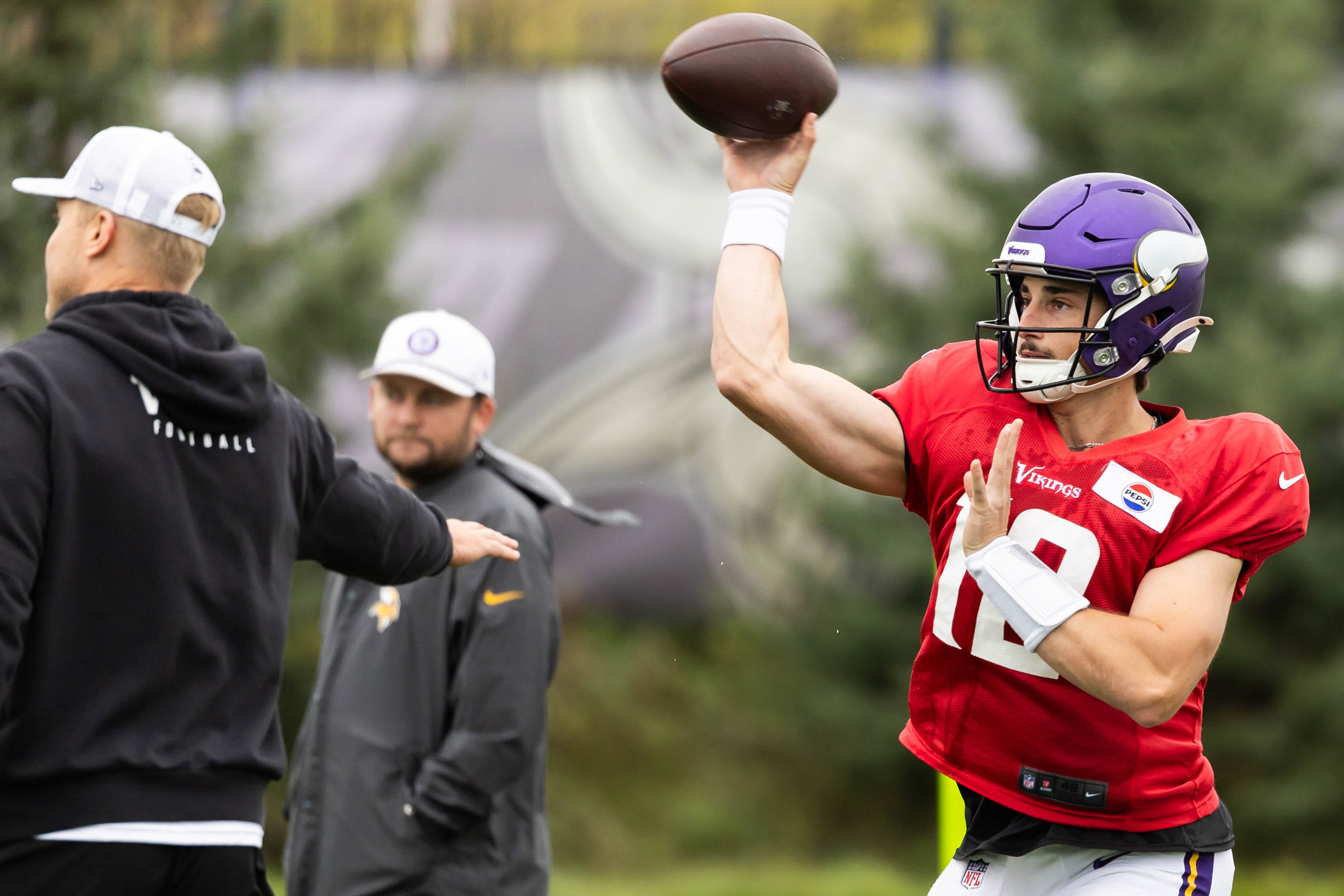
Throughout training camp, it became more and more clear that Brosmer was able to handle an NFL playbook. When he got reps in training camp, he appeared to see the field well and regularly found his target with the football. When he got into preseason games, the same thing happened. It was especially noticeable during the Vikings’ final preseason game against the Tennessee Titans when he went 15-for-23 for 161 yards and one touchdown. PFF tracking registered zero turnover-worthy plays and he was not sacked.
O’Connell, who has a good relationship with Gophers head coach PJ Fleck, had been intrigued with Brosmer for a long time because of what the Gopher staff had said about him and from seeing him in two Gopher pro days. That intrigue grew during minicamp and training camp, but his performance against the Titans is what locked him into the 53-man roster.
“He’s starting out a game against Tennessee’s starting defense and some pretty impactful players making it hard on him, and he’s functioning and able to move the team and do some things that really solidified a lot of the things we were feeling on Max,” O’Connell said.
Following the preseason, the Vikings brought in veteran Carson Wentz to play the QB2 role, giving Brosmer time as QB3 to get the hang of the NFL. When Wentz got hurt and had season-ending surgery, the Vikings added veteran John Wolford, who played in a similar system with the Los Angeles Rams from 2019 until 2022. Still, they decided to stick with Brosmer as the backup.
When JJ McCarthy went into concussion protocol this week, KOC named Brosmer the starter against the Seattle Seahawks.
Over and over, the Vikings have touted the ex-Gopher’s work ethic and preparedness when it comes to operating the scout team and getting ready to play if called upon. But there is one particular area of his on-field game that has been highlighted most: Processing.
Anyone who watches football regularly has heard broadcasters or mention “processing” but it rarely gets much further explanation. Intuitively we can connect its meaning with the players who are talked about with having strong “processing” abilities, like Dak Prescott or Matthew Stafford. It’s rarely ever fully explained though.
So how does “processing” apply to Brosmer?
For Brosmer, that starts in the huddle and identifying things about the defense that will dictate whether the offense is going to run their original play or switch to a different play.
“I feel like it’s getting in and out of the huddle with some tempo, getting the right ‘cans’ and checks as much as you can throughout the game,” Brosmer said. “I felt like the guys did a really good job with that this week where things might not be perfect but we’re getting the play off and executing the play well.”
Those “cans” and checks aren’t as easy as calling for an audible on Madden. Aaron Jones detailed just a few things that the quarterback has to see with the play clock ticking down.
“Identify the [defensive] front to get us in the right protection calls, then to identify if there’s going to be a pressure or edge pressure or the safety’s buzzing down,” Jones explained.
Post-snap is when all hell breaks loose. Defenses these days are using deceptive coverages, blitzes, simulated pressures (where they send four rushers but they aren’t the four you expect), and all kinds of other tomfoolery to mess with the quarterback.
“After the snap it’s determining what coverages they’re in, if they’re trying to bait you and make it look like one coverage and drop to another,” Jones said. “It’s all little chess pieces games within the game.”
With one side of the quarterback’s brain he has to identify the coverages and with the other side he has to apply that to the play call. Oftentimes plays are designed to have Option A if the opponent is in man coverage and option B if they are in zone. There are a bunch of details to that. Some coverages are zones that look like man. Some are cover-2 that have a “Tampa” linebacker or safety. Some have “inversions” where the corners play safety and the safeties play corner.
The plays are designed to deal with these issues but the plays only work if the quarterback can decide which option is the best within the timeframe of the play. It would be ideal for the QB to sit in the pocket for five seconds, casually look around at his receivers until someone breaks open. Unfortunately for QBs, they pay people like Seattle’s star defensive tackle Leonard Williams a lot of money to make sure that’s not the case.
When it’s done perfectly, the quarterback looks unspectacular. Receivers look open. The QB looks unbothered.
“That’s what a lot of great quarterbacks are able to do,” tight end TJ Hockenson said. “They’re able to move from read to read based on what the defense has given us…you can be on the backside of the route and you end up becoming the primary just based on what the defense is giving you…So that’s obviously a big thing at that position.”
The word that kept coming up as it pertained to Brosmer’s processing and its impact was: “Quick.”
Offensive coordinator Wes Phillips said that typically young quarterbacks get through their options too slowly, to the joy of pass rushers like Mr. Williams. In Brosmer’s case, however, he was seeing things lightning quickly.
“[Brosmer was] almost at times was processing things too quickly through camp and preseason,” Phillips said. “Whereas there might be something there, but he’s able to get through it so fast that he might be a little bit ahead of the play, which is generally kind of the opposite with a young player.”
Aaron Jones said: “I feel like if somebody can pick up on [processing] quick it’ll make allow them to play faster.”
Justin Jefferson said: “Being able to process information quickly would be just getting the in and out of his hands as fast as possible.”
Quick is what the Vikings desperately need on offense. They have the third worst sack percentage in the NFL this season and starter JJ McCarthy has the sixth slowest snap-to-release in the league, per PFF, and all the other QBs are runners. Vikings pass-catchers have been struggling to get the ball on time and typically-productive players have seen their numbers crater. Simply getting the ball out of his hands into the right place would do wonders for players like Hockenson and Jefferson.
“He’s definitely a good quarterback, so to be able to be fit in with this offense and create a spark for us, something that we really need right now,” Jefferson said.
Brosmer will have to try to create that spark against a team that ranks fourth in sacks and seventh in opposing QB rating.
“I made the comment that everyone is an All-Pro when you’re not taking the reps, you’re the guy in the back taking mental reps… it was a wake-up moment again of the reality of getting back into the swing of things as The Guy,” Brosmer said.
One thing that can be said for the former Gopher QB is that having to process quickly in order to win isn’t new. He’s not particularly large by industry standards and he isn’t going to scramble around like Patrick Mahomes. He spent most of his time in college at New Hampshire because he didn’t have freakish traits. This is the way he’s always had to play.
“I pride myself on being the most prepared guy on the field,” Brosmer said. “That’s something that caters to my strengths. I was never the most athletic guy, never the strongest guy but I felt like I could do it better with my mind on the field. That’s playing NFL quarterback, in my opinion.”
I’m ready for it. Let’s go, man.
Good stuff as always, Matt. By the way, I appreciate the quick definitions. Simulated pressure is one thing I've always meant to look up but never have.