
By Matthew Coller
If you just tilt your head to the left a little, you can kinda see it.
Maybe just zoom in with the microscope.
Actually, try using this calculator. Run it with the abacus as well, just to double check.
Now, have you ever done a trust fall? Because you’ll need to do that too in order to understand Day 2 of the Minnesota Vikings’ draft.
Going into the day, there were expectations that the Vikings would land some skill players, a center, possibly a starting caliber safety and maybe a cornerback if things fell correctly.
Instead they ended up with another defensive tackle, a linebacker, an offensive tackle and a safety that nobody in the mock draft universe had going in the third round.
To go along with that eyebrow-raising approach, the Vikings traded one of their best players for two third-round picks.
Uh… what?
Well, let’s see if we can pick it apart.
Friday evening began with the clubs picking in the early part of the second round scooping up the first-round talents who fell through the cracks. Players who would have made sense for the Vikings like speedy wide receivers De’Zhaun Stribling and Denzel Boston or physical cornerback Colton Hood or dynamic DB Treydan Stukes or pass rushers R Mason Thomas, Cashius Howell, Derrick Moore and Zion Young all went off the board immediately.
When they arrived at the 49th pick, there were enough talented players on the board that they could drop back two spots and still get their guy. So they traded back with the Carolina Panthers to No. 51. One of the best corners in the draft (though undersized), Indiana’s D’Angelo Ponds went to the New York Jets at No. 50, leaving the Vikings with Cincinnati linebacker Jake Golday.
Linebacker?
Not exactly. Last year Golday lined up everywhere on Cincinnati’s defense. Per PFF, he was in the box as a linebacker for 314 snaps, the slot on 248 snaps and on the D-line for 117 snaps.
If that sounds like Andrew Van Ginkel, you’re exactly right. It’s almost spooky how similar the two players are in size and athleticism too. Van Ginkel is 6-foot-4, 240 pounds and had a 38-inch vertical and 6.89 3-Cone drill at the NFL Combine, showing off his footwork and quickness. Golday is 6-foot-4, 240 pounds and had a 39-inch vertical and 7.02 3-Cone drill.
Golday was an elite run defender in college football with a 90.6 PFF run defense grade and he had a quality 77.5 PFF coverage grade. He was targeted 35 times and only allowed 217 yards into his coverage. As a pass rusher, the Bearcat added 18 QB pressures and produced 3.5 sacks.
He’s a very experienced player as well with over 2,000 snaps of college football.
While Van Ginkel has been a phenomenal player in Minnesota, his future is up in the air. He’s a free agent after 2026 and he missed time with injuries last year. Golday gives the Vikings depth at a position that’s pretty much unique to Brian Flores’ defense and a player to build around for the future that isn’t locked into one role.
He can play a traditional LB spot or edge rusher and learn the ropes from AVG. Had he just been an inside linebacker with no dynamic element, it wouldn’t have made as much sense. But he’s much more than that.
Shortly after the Vikings picked Golday, they announced that Jonathan Greenard was being traded to the Philadelphia Eagles.
Huh?
Greenard has been a tremendous addition to the Vikings. He had 12.0 sacks in 2024, playing a major role in the team’s 14-win season, and then despite struggles to convert sacks in 2025 he still ranked in the top 20 in pass-rush win rate by PFF, producing 47 QB pressures, one more than TJ Watt.
He also became a heart-and-soul player for the Vikings. His motor was undeniable. His voice mattered. He brought intensity and IQ to the defense and an energy and relentlessness that was infectious.
So when the Vikings traded him for two third-round picks, it might have seemed a bit bizarre.
Wasn’t Dexter Lawrence just moved for a top-10 pick? Didn’t a team agree to trading two first-round picks for Maxx Crosby not that long ago?
The Vikings were put into a very difficult spot with their spending in recent years. Even with some very calm handling of the offseason, they were still only hovering above cap compliancy. Trading Greenard created around $12 million this year and $22 million next year.
It could allow them to make a summer addition to the roster or make a trade before the season begins.
The fact that Greenard wanted a new contract made things even more challenging. The Eagles immediately signed him to a four-year, $100 million deal with $50 million guaranteed. The Vikings were not in a good position to increase his salary and hand out that much guaranteed money. Could they have made him play out the rest of his contract over the next two years? Yes, but they would have had to live with big cap hits and figure out how to deal with his unhappiness.
They couldn’t get more in the deal in part because the trade had to come along with an extension. That brings the price tag down. So does an injury last year. So does the lack of sack production.
It is never good for a player of Greenard’s talent to leave the premises but there is a depth chart-related reason to do it.
At the end of last season, Dallas Turner thrived while filling in for Greenard’s pass-rushing position. He looked worlds more comfortable than when he was asked to cover for Andrew Van Ginkel’s versatile role. Turner showed all the signs of the star talent that they spent so much to draft in 2024.
Finding out about Turner matters because of how much draft capital they used to move up and get him but it was also going to be extremely difficult to get him into a favorable spot in the lineup with Greenard there. If both of them needed the third-down pass rush reps to be the best version of themselves, how would they both get them? Yes, rotations are good, but someone needed to be The Dude. As long as Greenard was there, it was going to be him. Now Turner can have a chance to be that guy.
So the Vikings got the No. 98 pick and a 2027 third-rounder, which could prove valuable down the road.
With the No. 82 pick, there was a thought that they could look for a wide receiver to replace Jalen Nailor. Two speedy deep-threat types, Chris Brazzell and Ted Hurst, were both available.
Instead they went with…. another defensive tackle? Really? Didn’t they just pick one Day 1 in Caleb Banks?
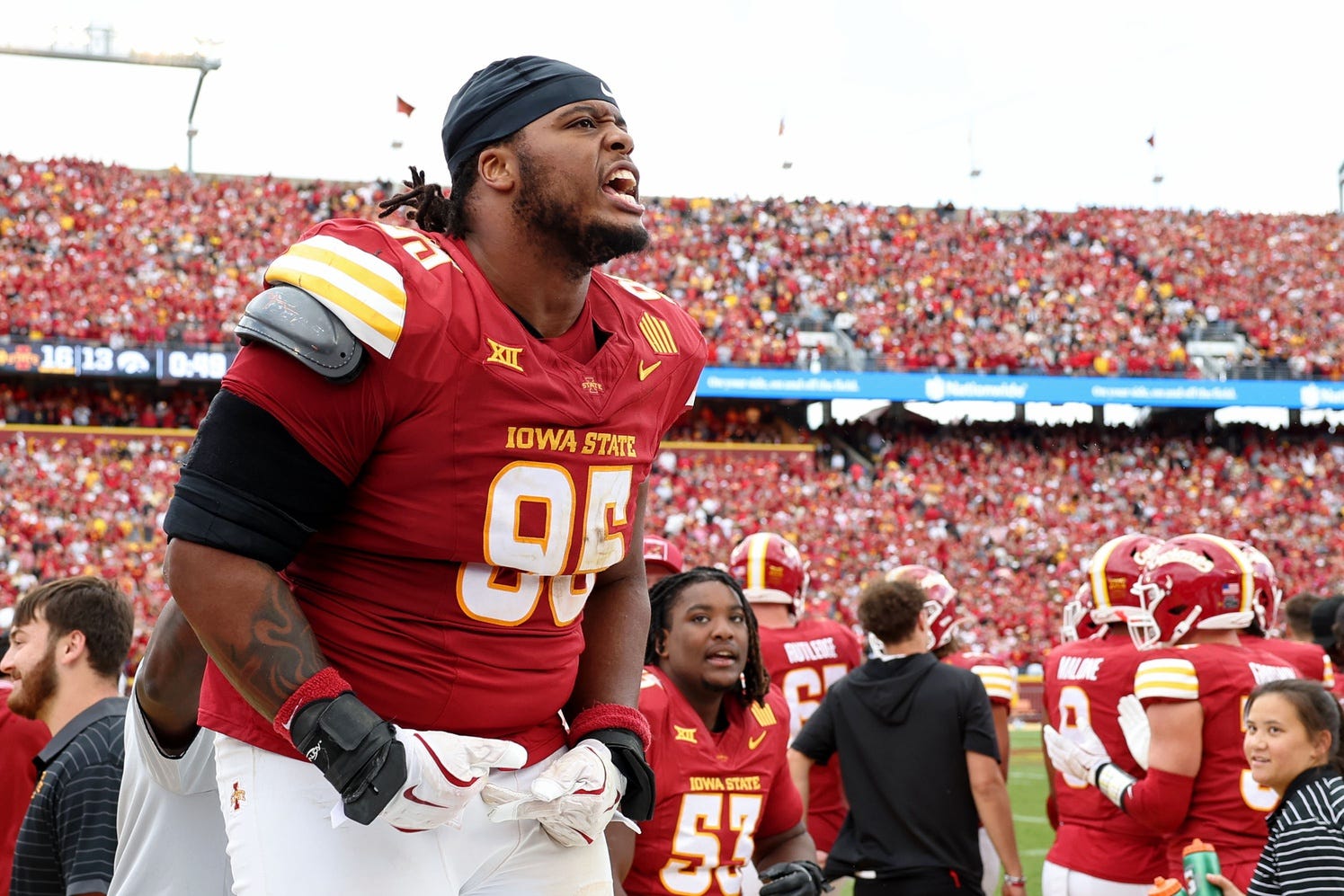
This one, Domonique Orange from Iowa State, is a completely different player than Banks. He is 6-foot-2, 322 pounds and he stuffs the darn middle.
Orange is the type of player that the Vikings have not had during Flores’ time in Minnesota, yet he is typical of Flores’ roots in New England. The Patriots had Vince Wilfork as a centerpiece for a long time. Also Pittsburgh, Flores’ other influence, had the center manned by Casey Hampton in their heyday.
The run stopping operation was focused on holding up guards and moving them with Harrison Phillips in 2023, 2024 or last year by winning 1-on-1s with Jalen Redmond, Jonathan Allen and Javon Hargrave.
Opponents try hard to keep the Vikings out of blitz mode by running on early downs and there were games last season where it worked effectively against them. They faced the fewest pass attempts in the NFL in 2026 overall. Orange is a response to that.
He also makes sense within the context of the NFC North, where all three teams have coaches that like to build everything off their run game. So while there were other possible options, the Vikings put their resources toward the trenches.
As the board approached the Vikings in the third, a run on wide receivers started. At one point, five of 11 picks were wide receivers.
By the time they got to No. 97, 10 receivers had come off the board in Day 2.
The other position that seemed pretty obvious was center. But top players Logan Jones and Jake Slaughter were picked 57th and 63rd.
Safety and corner were other possibilities. Emmanuel McNeil-Warren from Toledo was taken after the Vikings rolled with Golday and LSU standout AJ Haulcy went 78th.
They decided with the 97th pick to take tackle Caleb Tiernan from Northwestern. He’s nearly 6-foot-8 and has quickness but lacks the ideal length to be a top tackle draft pick. He has nearly 3,000 snaps of playing experience and has graded by PFF as an elite pass blocker two years in a row.
Tiernan was Dane Brugler’s 8th best tackle in the draft.
“Tiernan relies on refinement to compensate for his average length and redirect skills, using disciplined hands and poise to execute assignments,” Brugler wrote. “He’ll have swing tackle ability, although his best position long-term might be guard.”
OK but why are the Vikings taking the 8th best tackle?
This one requires you to get out a telescope. Look into the deep future of 2027 and you might see something interesting: Uncertainty along the offensive line.
While Brian O’Neill still could get a contract extension, the Vikings’ hesitancy to pay Greenard might point to more contract disputes to come. If they can’t lock O’Neill into a multi-year extension, Tiernan may instantly become relevant at tackle.
The suggestion that he could play guard is interesting as well. Guard Will Fries technically signed a five-year contract last offseason but the NFL’s contracts are fake. In 2027, Fries is scheduled to carry a cap hit of $21.5 million and the Vikings can save $9.5 million on the cap if they cut him. He is owed $10 million cash if he’s on the roster on the third league year day in March 2027.
Considering Fries wasn’t a dominant player for them last year, they will have to consider cutting the right guard.
Tiernan also gives the Vikings instant depth. They have been crushed by injuries on the offensive line in recent years. Last season they struggled mightily to patchwork multiple positions and his addition gives them a talented, mature player to handle fill-in work right away.
Is it the deep-threat receiver or star RB that everyone wanted? Not exactly but it’s a sensible decision.
The last pick is a reach according to the draft prognosticators but once you read the scouting report for Jakobe Thomas of Miami, you will see Brian Flores’ fingerprints all over it.
Here are some of Brugler’s list of Thomas’s strengths:
● Fast and physical attacking gaps in the run game
● Runs the alley with conviction and fearless throwing his body around
● Sticks his hat into the midsection of his target and drives through
● Understands spacing in zone looks where he can track the quarterback’s eyes
● Finished interceptions he got his hands on
● Miami liked to blitz the safeties, and Thomas flourished in this area
Flores, Flores, Flores, Flores, Flores.
Thomas was a playmaker with five interceptions and 11 pass breakups this season. He was also the Fiesta Bowl MVP.
Production, fearlessness, IQ.
Regardless of whether Harrison Smith returns, the safety room should be pretty deep and competitive.
When you look at the totality of the Vikings’ Day 2, it fits. They got a lot better in the trenches, opened up cap space for a potential incoming move or extension(s) and they grabbed a playmaker in the secondary.
So why doesn’t it feel like it makes sense?
Probably because, similarly to Day 1, it diverges from expectation by quite a bit. Many players are either still on the board or were taken along the way that seemed to jive perfectly with the Vikings. Not getting anything in terms of instant-impact offensive prospects feels like something was left on the table as well.
If they eventually trade for a running back and sign a veteran wide receiver, it might feel different in the light of day.
This simply wasn’t a draft for the immediate, outside of a player like Domonique Orange. Acting GM Rob Brzezinski indicated that might not be the case but it’s a little tough to reason with when it actually happens.
This was cap management and “board integrity” after the team went buck wild in the first round with a massive swing.
They likely won’t get tremendous grades for anything they did, including the Greenard trade. How it works out long term, we’ll have to wait a while to see.
Thomas’s highlight reel is very fun, but it is a bit tough to swallow them reaching on the consensus board by like 70 spots at a non premium position with the Greenard trade pick. People sometimes act like extra picks you get from a trade or the compensatory system are “free picks” that you don’t have to spend rationally, but that just isn’t true. Overall, the OT pick is obviously a bit of a head scratcher, and they left some good CBs and WRs on the board that I think could’ve had an immediate impact. But it won’t surprise me if Darrisaw and O’Neill both miss games, so hard to be too upset on getting tackle depth with a guy who was a bit of a consensus steal. Fun night, hopefully they hit on some of these guys. They all seem like really good dudes from the interviews.
Good points about following the Patriots model of building the defense from the inside out and the division opponents. Rob is setting this up to be an attractive GM job.