
By Matthew Coller
If you have been tracking reported visits to the Minnesota Vikings, you have probably noticed that there is a trend when it comes to the wide receiver position: Almost everyone that they have met with ranks by most analysts in the ballpark of a Day 2 draft pick.
With the Vikings holding the No. 82 and 97 picks in the third round, the shoe certainly fits when it comes to the team’s need to seek a contributing wide receiver who might have upside in the future. Players like Georgia State’s Ted Hurst or NDSU’s Bryce Lance, for example, rank on Mock Draft Database’s consensus board as No. 79 and 92, respectively — right in the range of where the Vikings are picking.
The third round feels right for the Vikings in this draft. They have very serious needs on the defensive side that are more likely to be addressed in the first round and there is expected to be a distinct drop off in prospect quality after the first six receivers go off the board. Plus there are defensive starters expected to be there in the second round.
Not to mention that they have Justin Jefferson and Jordan Addison under contract for the next two years so they might not view WR3 as having enough bang for buck to take in the second round.
So unless the Vikings believe that an exceptional receiver has fallen through the cracks, the third round will likely have a number of quality prospects who either have impressive athletic profiles are very strong production.
Via Mock Draft Database, here are the prospects between picks 60-100 on their consensus big board:
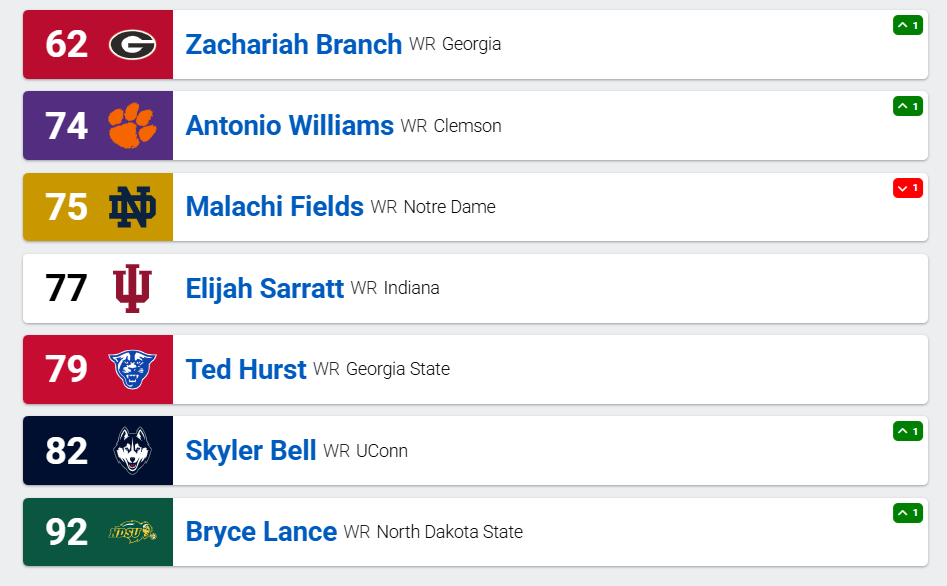
You could easily envision how any one of these prospects would fit into the Vikings right away. Here’s a quick rundown:
Branch — Dynamic after the catch, lightning quickness and agility.
Williams — Smooth route runner, best used in the slot
Fields — Big body receiver with good hands and impressive route running for his size
Sarratt — Great hands and contested catch ability
Hurst — Blazing fast deep speed and strong ball tracking
Bell — Undersized but knows how to get open, caught a million passes last year
Lance — Freaky athlete who takes the top off the defense.
On paper, if you plug any of those fellows into the Vikings offense alongside Jefferson and Addison, they should have an instant impact.
But we know that the draft is anything but a sure thing.
Can you really get a quality receiver in the third round or is that too far down the board to expect a success story?
Let’s have a look at recent history…
Here is a list of all the wide receivers picked in the third round since 2017, sorted by yardage gained. The players who became anywhere from solid contributors to stars are listed with an asterisk.
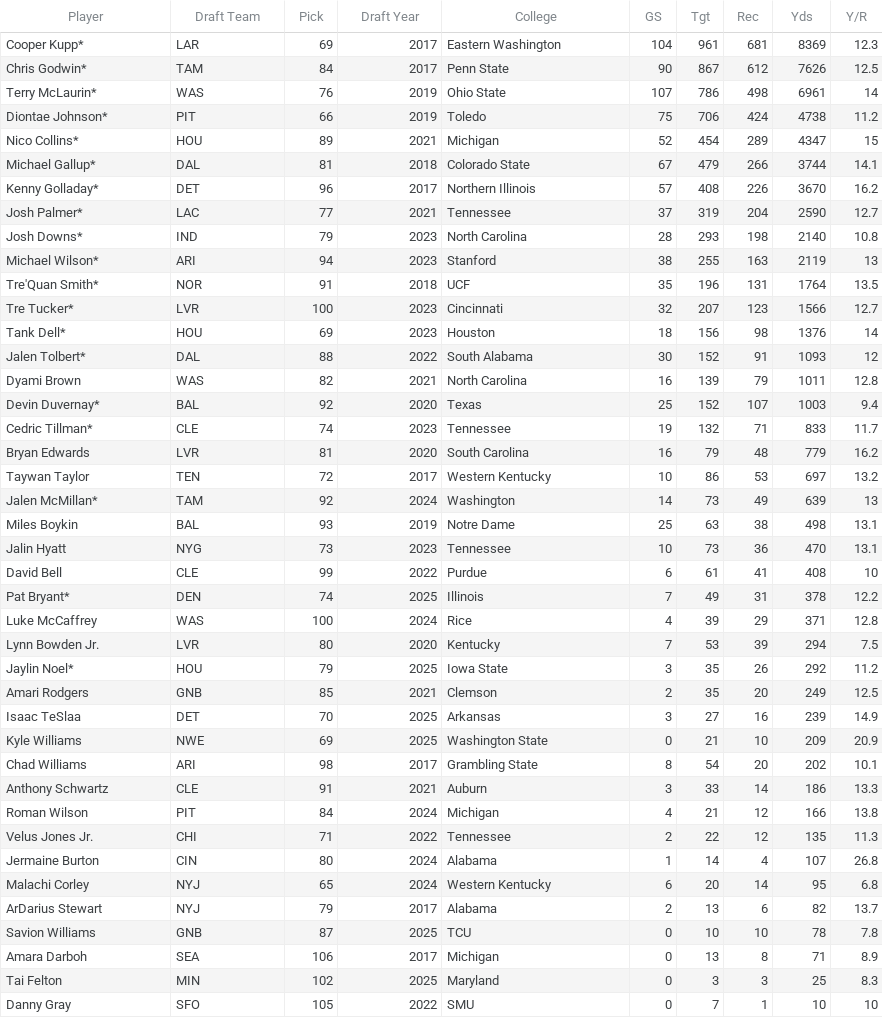
Here’s how it breaks down:
— Out of 40 third-round receivers taken since 2017, 19 of them became at least solid contributors. That bar is relatively low when we are including players like Jalen McMillan, who had 37 catches in his first year but fell off in Year 2 or Cedric Tillman, who has between 21 and 29 receptions each season. But they weren’t exactly busts either. So it would be inaccurate to call it a near 50% “hit rate.”
— If we block the group into tiers, there are..
Four stars: Kupp, McLaurin, Godwin and Collins.
Seven semi stars: Johnson, Gallup, Golladay, Downs, Wilson, Dell, Tucker.
Eight players who have been decent contributors.
There are a handful of others that you might not call a success but have had their moments like Dyami Brown, Isaac TeSlaa, Kyle Williams, Myles Boykin etc. who you wouldn’t say were a success but not a massive failure either. (The jury is still out on TeSlaa and Williams).
Based off the relative hit rate alone, taking a third-round receiver looks like it’s pretty well worth the investment. More than a quarter of the players becoming excellent starter-level players or stars is an outstanding rate for the third round.
It stands to reason that WR would be one of the most successful positions down the draft board because there are ways that teams can adjust their roles to make the shoe fit. Offensive linemen, edge rushers and cornerbacks don’t have very moldable positions, for example.
Plus college football’s quarterbacks are often so bad that good receivers can fly under the radar. And the NFL Combine traditionally has not done very well at separating receivers because it’s such a technical position.
What does does the data tell us?
If we compare where our set of third-round receivers were expected to land based on the Mock Draft Database big board, is there any connection between reaches or steals and success rate?
Here are the biggest reaches:
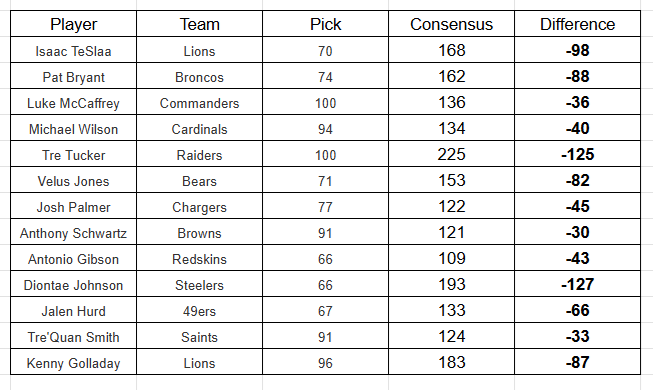
There are a couple pretty big hits. Michael Wilson, Tre Tucker, Diontae Johnson, Kenny Golladay.
Maybe teams that are reaching for these guys have more of a plan for them or more patience for development. Or maybe it’s a coin flip since there’s a lot of busts too.
Something interesting is that there are barely any steals. Receivers who are projected to be gone by the second round rarely are there in the third. The only players who fell more than 30 spots beyond their projections were Jalin Hyatt and Josh Downs. That’s it.
So if we look back at this year’s list, there might be some receivers who are way down the board that surprise us but the Vikings won’t be able to expect second-round projected receivers to be there. In fact, it’s much more likely that the guys projected in the third round will be taken before they are on the clock.
Is there any type of stylistic comparison between the success stories?
Size doesn’t seem to be a factor since big receivers like Collins and Golladay worked out as did tiny Tank Dell.
Production, however, is there across all of the hits.
Here’s how the best third-rounders faired:
— Kupp: 117 catches for 1,705 yards
— McLaurin: 20.0 yards per catch, 11 TDs on 35 receptions
— Godwin: Over 2,000 yards between his final two college seasons
— Collins: 19.7 yards per reception, seven TDs on 37 catches
It wasn’t always volume for the best guys. In McLaurin and Collins’ cases, it was big-play ability.
For the others…
— Johnson had 1,278 yards in his second-to-last season
— Gallup grabbed 100 passes for 1,413 yards
— Golladay had 87 catches for 1,156 yards
— Downs caught 101 passes and 94 passes in back-to-back seasons
— Dell had 91 and 108 receptions in his last two years
— Tre Tucker is the only one on the list without an exceptional stat sheet in some way. He had 53 catches for 680 yards.
The bottom line:
It would appear that drafting a third-round wide receiver is largely a strong play, even if half of the receivers didn’t work out. If the Vikings are going to pick a receiver in that range, it doesn’t have to be someone from a huge program but it does have to be a player who was productive. Of this year’s group that’s projected in the third, most of the players did have quality production, especially Skyler Bell of UConn, who caught 102 passes. Having a specific plan for the player’s role might also play a role in their success.
There is enough in terms of quality players to also believe that the upside could be someone who ultimately takes over for Jordan Addison under the right circumstances.
But even if they don’t become a major hit, players like Dyami Brown and Josh Palmer, who weren’t exactly big hits, still ended up landing $10 million contracts as free agents. If the Vikings pick a player who only gives them 25 to 30 receptions on a rookie deal, there is still a significant surplus value.
Conclusion: Worth it.
This seems right to me, and I’m a huge big Skyler Bell fan if you can get him in the third round. He had a pretty elite RAS score despite the size and that showed up on the tape to me. He also ran a lot of different routes and seemed to have a really good feel for where to sit against zone coverage. Not sure what his drop rate was, but he has some of those freakish catches on his highlights and seems pretty sure handed. I’m sure KOC would ideally like a bigger WR3 (think he asked Nailor to put on weight), so you have some run blocking ability to keep the defense guessing in 3 receiver sets, but that’s the only concern I would have. And he could be a good run blocker for all I know.
You have convinced me Matthew.
WOULD! draft a 3rd round WR
I wonder if we do trade down with our first to get another 3rd..
On the topic of drafts, Michael MacKelvie just dropped this (mainly focusing on 1st round drafting)
https://www.youtube.com/watch?v=H8rolEibsPg