
By Matthew Coller
By the numbers, the Minnesota Vikings’ running game improved this year.
They finished 13th in rushing Expected Points Added — up from 28th last season — and improved their yards per carry from 23rd to 12th.
The biggest jump was in Success Rate. The Vikings went from 24th to 6th.
By PFF’s metrics, they were an OK run blocking team, finishing 13th by their grades. But the RBs did their job to have success, scoring the 12th best Rush Yards Over Expected, which is yardage adjusted for blocking.
All in all, running was good for the Vikings for the first time in the Kevin O’Connell era.
As they head into the 2026 offseason, however, there are questions about how to take the next step toward becoming a great running team and which RBs will be patrolling the backfield.
Let’s dive in…
Aaron Jones contract situation
First, there’s no person you’d rather have in your locker room than Aaron Jones. He has been every bit as valuable as a leader for the Vikings as he was in Green Bay, where he was unequivocally respected. It’s tough to put a price on that. But unfortunately, that’s how the NFL works sometimes.
Jones finished with 548 yards on 132 carries (4.2 YPC) and ranked 55th of 60 in PFF grade among all RBs with at least 75 carries. He caught 28 passes for 199 yards and scored three touchdowns.
Dollars to donuts, extending him last offseason did not work out. Jones signed a two-year, $20 million deal with the Vikings last offseason and was the ninth highest paid RB in the NFL in terms of cap hit in 2025.
Now the Vikings have a choice: Do they work out something different with his contract or let him go? The veteran RB is set to make $14 million on the cap in 2026. That’s simply not going to work. Per OverTheCap.com, they cannot create any more space with a restructure so any adjustments would have to come in the form of a new deal or an extension. The latter seems unlikely.
If they release Jones, that will create $7.75 million in space and carry a $6.8 million dead cap figure.
Considering the 31-year-old ex-Packer was only able to play 12 games and a low percentage of those were at full health, the best course of action is very likely to move on. Jones has already beaten the age curve and provided the Vikings with overall quality performance but the likelihood of bouncing back and playing 15+ games in 2026 is not high.
Is Jordan Mason an RB1?
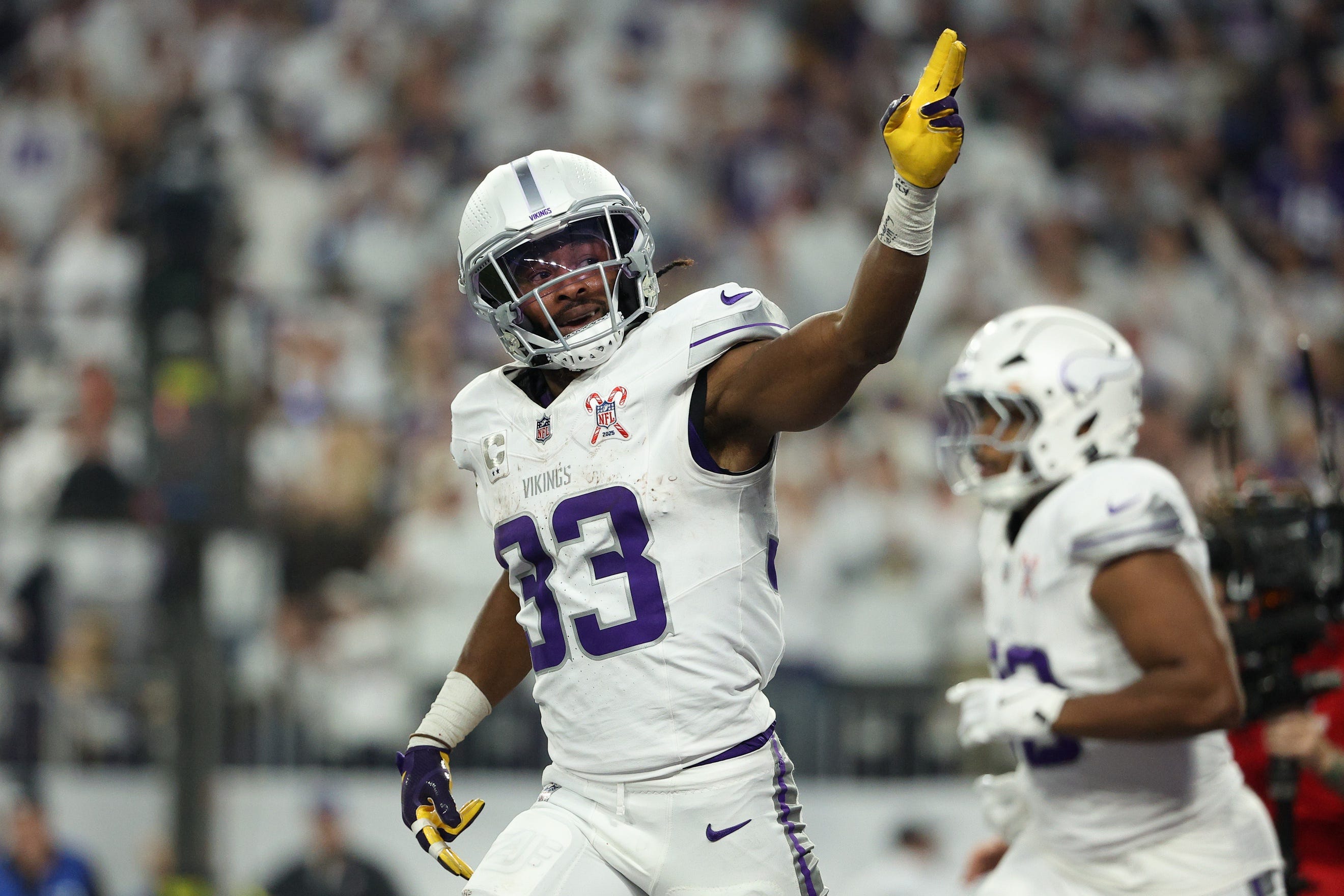
If the Vikings move on from Jones, that raises the question: Do they have their guy in Jordan Mason? He ran 159 times for 758 yards (4.8 YPC) and six touchdowns and ranked 28th of 60 by PFF. He was also seventh best in Success Rate (min. 100 carries).
Mason finished 12th in yards after contact and had 22 10+ yard rushes.
In terms of his per-rush stats, he was a very effective runner who was worth acquiring from the 49ers in a trade.
Does that mean he can take on more workload than 159 carries?
From a rushing perspective you would expect the answer to be yes because he’s 26 years old and doesn’t have a lot of tread on the tires. The question is whether he can handle everything that O’Connell’s offense requires of the running back.
Mason only caught 14 passes for 51 yards this year and had just 11 catches for the 49ers last year.
His pass protection was beyond bad. It was some of the worst pass pro in the entire NFL. PFF credited him with 11 pressures allowed in just 65 blocking snaps. That was the second worst Pass Blocking Efficiency in the league and he had the second lowest PFF grade among all RBs with at least 50 pass blocking snaps.
It’s highly questionable whether he could take enough of a step forward in pass pro and receiving in order to be a full-time back.
In terms of bang for buck, Mason’s $5.7 million cap hit for next year is solid if he’s in the same role as 2025.
The depth
Let us never forget that Cam Akers threw a touchdown for the 2025 Vikings.
Of course, this time things didn’t really work out with Akers as he only took eight snaps.
The Vikings lost Ty Chandler for the majority of the season due to an injury suffered in Week 1. He is an unrestricted free agent and it would be a surprise if he returned.
They did find something in Zavier Scott. He only rushed 32 times for 114 yards but the former college receiver caught 14 passes for 98 yards, including a toe-tap touchdown in the back of the end zone against Pittsburgh. It’s a small sample size but he was asked to pass protect 12 times and did not allow a QB pressure.
Scott isn’t as young as you’d think (26) so he isn’t a “developing” type player. He might have enough special teams value and receiving and blocking skill to be a third down back.
Otherwise with Chandler exiting, the Vikings should be on the hunt for depth at RB.
CJ Ham likely retirement
Speaking of pass protection, Ham was an elite pass protector this season. Among all RB/FB with at least 25 pass pro reps, the veteran fullback ranked third by PFF grade, giving up just three pressures on 35 opportunities.
Down the final stretch of the season, O’Connell used Ham more than ever. Between 2022 and 2024, there were only five instances where he played 20+ snaps. This season he did so four times in the final five games.
It raises the question: If Ham indeed retires, will the Vikings look for a new fullback? Considering the run game found some things this year and his usage was up, it seems plausible that they would want to find another bruiser to load up with bigger personnel packages.
One thing that should be noted about Ham’s career is his impact on special teams. This year, as the kickoff was completely changing the game, he was on the field for 182 special teams snaps in 11 games. Over his time as a Viking he played 2,385 total ‘teams snaps. Those can’t be overlooked. He won’t be easy to replace. If you know, you know.