By Matthew Coller
I feel for anyone who wasn’t around for the 1998 NFL season. In Minnesota, Randy Moss was putting on a show unlike anything the league had ever seen. Terrell Davis ran for 2,008 yards. Reggie White had 16.0 sacks at age 37 and won Defensive Player of the Year. Charles Woodson was Defensive Rookie of the Year. Dan Marino was taking one more shot at a Super Bowl with Jimmy Johnson as his head coach. Steve Young had Jerry Rice AND Terrell Owens. Bill Parcells had the New York Jets at 12-4. The Dirty Bird was a thing. Brett Favre led the NFL in passing.
The storylines were endless.
For a 12-year-old resident of Western New York, however, one storyline towered above the rest: The unlikely rise of Doug Flutie.
To explain Flutie’s ‘98 season, you have to go back to Boston College. Flutie was a college football legend, most remembered for his Hail Mary in 1984, but he was also the most prolific passer in college at the time, leading the nation in passing yards per game three times.
He decided to play in the USFL to start his pro career. The questions began there: Can a 5-foot-9 quarterback really win in the pros?
When the league folded, Mike Ditka decided to find out. In 1986, Chicago Bears starter Jim McMahon was injured so the Bears traded for Flutie’s rights from the Los Angeles Rams (who drafted him in the 11th round). He ended up starting a Divisional Round playoff game against Washington after only starting one regular season game and Chicago lost 27-13.
Flutie got another shot in 1988 with the New England Patriots and won six of his nine starts but didn’t put up impressive numbers with just a 63.3 passer rating.
After that, Flutie went to the CFL, which had a larger field and a more wide-open style that would allow him to play his type of game. And by 1991, he set CFL passing records for yards and rushing touchdowns by a QB.
By the end of the 1997 season, he had three Grey Cup championships and six Most Outstanding Player awards.
But he still wanted to prove that he could play in the NFL.
When the Buffalo Bills signed him in 1998, I was just old enough to listen to sports talk radio in the evening and read the sports section in the newspaper and start forming opinions on the things that I heard/read.
When Flutie signed, I was listening to my eventual co-worker (circa 2010) Chris “Bulldog” Parker on WBEN-930. The callers were mostly negative about the signing. They declared it to be a gimmick — a PR stunt to get more fans from Canada to come to games. Why bring in another quarterback when they had just traded a first-round pick for Jacksonville backup Rob Johnson, they wondered?
Bulldog pushed back. There was no risk involved. He was going to be the backup. What difference did it make? Why not take a shot at a guy who had been wildly successful in the CFL? If he ever appears in a game, it will be a surprise, so nobody should be too worried.
In the coming months, Flutie vs. Johnson would become a war between fans, talk hosts and eventually the locker room and owner vs. head coach.
But I decided that night that I was all in on Flutie. My parents bought me Madden ‘99 (the one where Randy Moss is wearing No. 18) and the first thing I did was dial up a season with the Bills with Flutie as the starting quarterback, despite his poor ratings (even Madden was skeptical).
In the first week of the season, Johnson got hurt against the Ryan Leaf-led Chargers and Flutie entered the game and played well (12-for-20, 2 TD, 1 INT) but his game-winning drive went awry with a missed 39-yard field goal and the Bills lost 16-14.
Johnson went back to starting and played well but in the team’s fifth game, Johnson got hurt on the first drive and Flutie came in the game. He played at a high level, going 23-for-28 with 213 yards and two touchdowns.
There wasn’t any controversy yet though. The Colts were terrible and Flutie mostly just kept the train on the tracks as they ran all over Indy. Plus, the game was on the road at the RCA Dome.
The following week changed everyone’s sports lives in Buffalo forever.
At Rich Stadium in Buffalo, the Bills faced off with the Jaguars, who had gone 11-5 the previous season and were 5-0.
Both defenses largely controlled the game but Flutie kept them alive. In the fourth quarter, the Bills trailed 16-10 with 39 seconds left and the ball at the Jacksonville 39-yard line. Flutie found receiver Eric Moulds for a 38-yard gain to the 1-yard line with 28 seconds left.
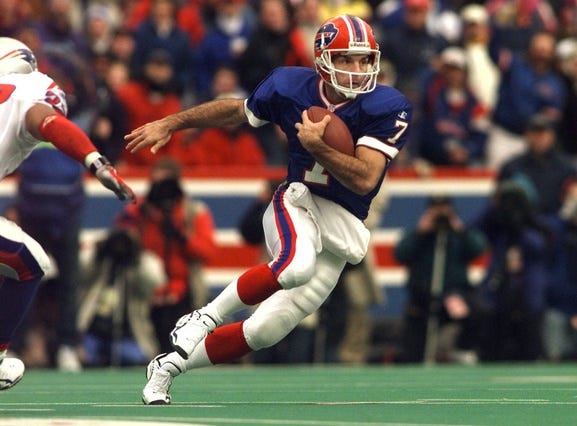
On the first two plays, Flutie threw incomplete into the end zone. That set up fourth-and-goal. The college and CFL legend took the snap, appeared to have a miscommunication with RB Thurman Thomas on a handoff and then took off toward the end zone. The Jaguars froze. Flutie scored. Nearly 80,000 people shook Orchard Park, New York in celebration.
Flutie Magic was born.
He remained as the starter, lighting up the Panthers on 18-for-22 passing the following week. He threw jump passes, he scrambled, he won. The Bills went 8-2 in their next 10 games with the small field general in charge and made the playoffs despite an 0-3 start.
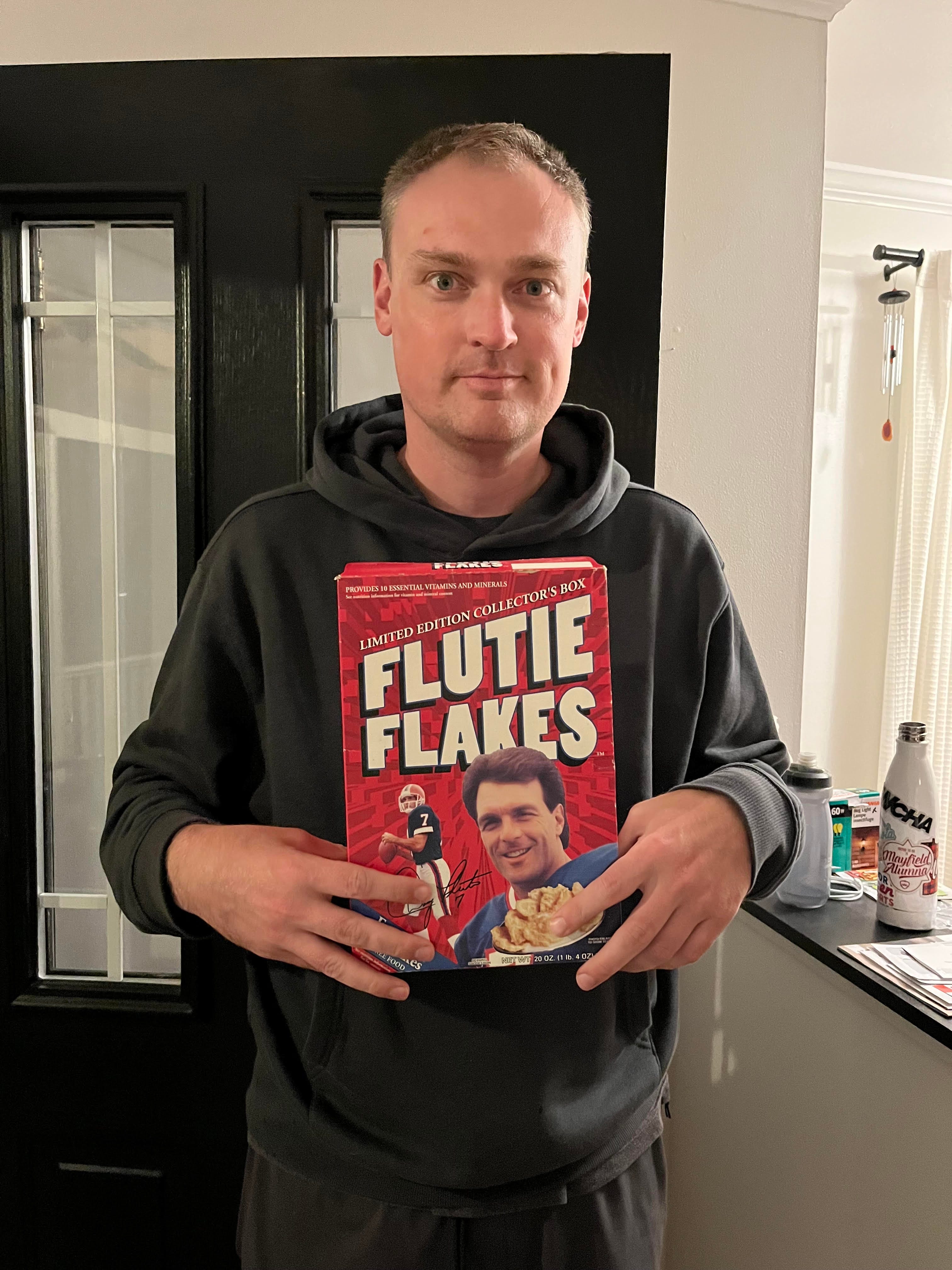
While his improbable run was taking Buffalo by storm, a cereal called “Flutie Flakes” hit the shelves in stores, with profits being donated to the Doug Flutie Jr. Foundation for Autism, created in honor of Flutie's son.
If you weren’t there to see it, you’d think it was a made-for-TV Disney movie.
The Bills ultimately lost a wild playoff game against the Dolphins and the Johnson vs. Flutie debates raged into 1999.
Long story short: Flutie played well enough to get the Bills to 10-5 but Johnson played the final (meaningless) game of the ‘99 season and the owner demanded that he play against the Titans in the playoffs. That game turned out to be the Music City Miracle.
Now here’s the reason that I’m telling you this story: The two seasons of Flutie in Buffalo were not only memorable but they were convincing to a 12-year-old fan of Flutie’s that we should never judge a book by its cover. That great quarterbacks come in all sizes. That there’s a real thing as being a winner and you’d rather have somebody with the “it” factor than a guy who has all the measurables. And there’s nothing like a quarterback who can make plays out of structure.
I don’t care how cliche that stuff sounds. That was the takeaway.
I also learned that no matter what a short quarterback does, people will always want the guy who “looks the part.” They will always doubt anyone who doesn’t play “traditional” quarterback.
Into my adult life as a sports talk host in Buffalo and then Vikings reporter, Flutie’s run stayed in my mind. I argued that the Bills should tank for Cam Newton. I made the case for the Vikings drafting Lamar Jackson and Jalen Hurts.
There was only one quarterback who truly looked like Flutie when he played: Kyler Murray.
Their stories included a Heisman trophy but Murray’s path was quite different. He was a 5-star recruit and the No. 1 overall draft pick. Because enough quarterbacks had succeeded as runners, and undersized QBs Russell Wilson and Drew Brees had thrived, the stigma wasn’t anywhere near as strong as when Flutie was playing.
But that doesn’t mean it went away.
Murray’s career has been filled with questions about whether he can see the field and whether a short quarterback who scrambles around can ever lead a team anywhere. If you look at any comment section this offseason during the Murray vs. McCarthy quarterback battle, you’ll see endless insults about Murray’s height. You’ll see tons of concern trolling about how “KOC will adjust his offense” for Murray.
There was a very, very large contingent who wanted the traditional Michigan QB who looked the part, even if his passes flew inaccurately and his processing time had to be measured on a sundial. Even as Murray formed a clear chemistry with Justin Jefferson in camp.
After Carson Wentz won back-to-back games, plenty of folks demanded he remain the starter despite Wentz going 5-9 with a 83.1 passer rating from 2022-2025. He looks the part, remember. Everyone’s always gonna love the guy who looks the part, remember.
Now as the Vikings are getting ready to play the Indianapolis Colts and Murray has shown a little magic, the bar has been raised for him with a 5-0 team to finally win and show that he can lead a quality franchise after spending all those years with the bumbling Cardinals.
With Murray’s career at a crossroads, I wanted to better understand what it’s really like to deal with the physical and mental aspects of being a quarterback at under 5-foot-10.
So I called Doug Flutie, who is doing a football podcast these days on YouTube called Flutie vs Stegall with (Vikings fan) host Arash Madani.
The phrase “never meet your heroes” really shouldn’t exist because we talked for nearly 40 minutes about the X’s and O’s, leadership and the drive to prove people wrong that comes along with life as an undersized QB.
A kinship with Kyler
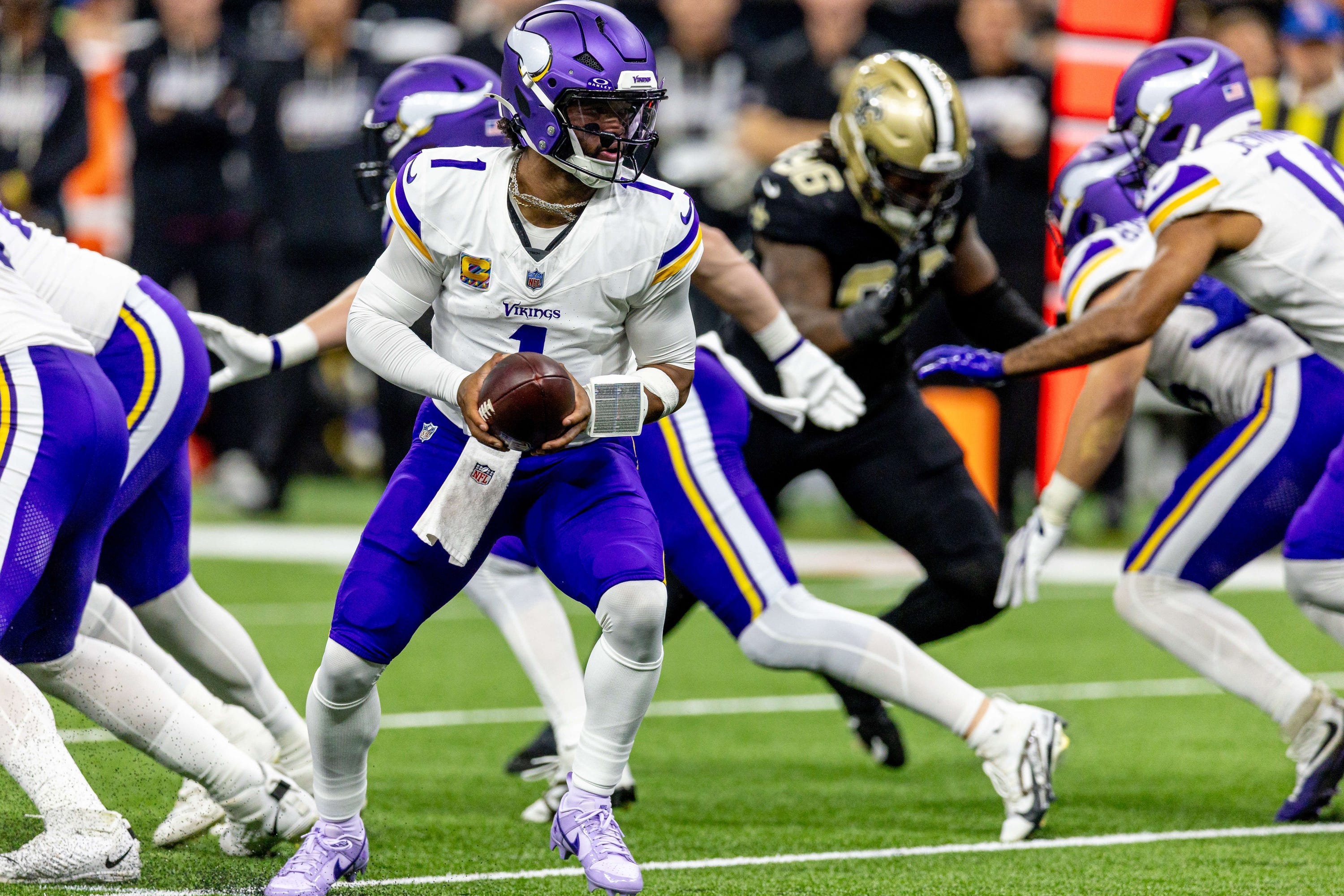
Doug Flutie doesn’t know Kyler Murray well, but he did meet Murray’s family during the 2019 Heisman ceremony.
“We were talking and his mom was talking about whether he should play baseball or football,” Flutie told Purple Insider over the phone. “I knew how difficult the road was. And I’m like, ‘if he can play baseball, go play baseball.’”
Flutie knew how hard the road was going to be, even with Murray’s resume as an all-time great Texas High School player and elite college QB.
Of course, Flutie has always rooted for Murray.
“From afar, root for him because of the size factor and I want him to do well,” Flutie said. “I know that everybody’s, ‘oh, they’re 5-0, but he’s struggling da-da-da. So then this week I paid attention… and he actually looked real solid, so I was happy for him.”
Where he relates the most is Murray not getting the benefit of the doubt.
“There’s an automatic go-to for why you’re not getting it done when your team [isn’t winning] but it’s such a team game that you’re dependent on everyone,” Flutie said. “It’s hard on a daily basis to walk in that locker room and act like you’re Josh Allen, Peyton Manning, Patrick Mahomes, or Tom Brady, and just take total control of everything because there’s always a doubt from other people about your size.”
The doubt about his height would show up in the coaching rooms. He remembers changing a play in a preseason game when he was with the Patriots and throwing a touchdown but getting reamed out in the meeting room because they hadn’t practiced it. He recalls getting questioned about moving outside the pocket to create throwing lanes because it made the offensive tackle more likely to hold. If he quickly chopped his feet to get to a throwing lane, it was called “getting happy feet.”
“I think it’s taxing,” Flutie said. “My years in Canada weren’t that way. That’s a perfect example of it. That was not taxing. I was having fun. If I felt like doing something, I just added it in the middle of the game. I would change plays and check out of things because I just felt good about something. And I didn’t need a reason. And it usually worked out, right? It’s like, you can’t do that in the NFL because in the NFL... Tom Brady could do that but if I did that, I better have a damn good reason why I went to something. We better have talked about this on Wednesday and Thursday.”
It’s hard to know how much of this applies to Murray. Since he was expected to be the franchise player in Arizona, he may have gotten more leeway but there were NFL folks who described Murray’s offense as “college-like” early in his career. When he arrived in Minnesota, there were questions about whether he could run a complex offense from the pocket, even if he’d been doing so under Drew Petzing in recent years.
What Flutie did with the non-stop questions is turn them into a drive that would keep him in the NFL for years after Buffalo.
He remembers being in his 40s with the Chargers and running hills with fellow undersized NFL’er Tim Dwight, a receiver and punt returner, and thinking about how nobody believed they should be there.
“We always looked at each other saying, we’ve got to prove we belong every day,” Flutie said. “Where the 6-foot-4 guy has to prove he doesn’t belong.”
Flutie recalled Patriots quarterback Steve Grogan being asked why Flutie was still playing with the Patriots in 2005.
“I remember reading a quote from Grog saying, ‘you know why he’s still playing? Because he’s trying to prove you assholes wrong,’” Flutie said. “You know, it was true.”
He noted that he wondered in the back of his head after he retired about people saying he couldn’t still do it. At 43.
Murray has never been outward chip-on-the-shoulder guy but those close to him said this summer that he was highly motivated to prove that he can still be a top NFL QB.
Flutie’s advice: Lean into that.
“Constant motivation, chip on your shoulder,” Flutie said. “I do some speaking [these days]. You need a reason every day. A motivation on a daily basis to get up and be better that day and to continually improve.”
‘I knew what I did well’
Flutie’s first NFL action came when he was 24.
I asked him why he felt that things worked out so much better for him the second time around when he came back to the NFL at age 36.
“I don’t know if it was different from an X’s and O’s standpoint, just from a confidence standpoint when I came back from Canada, I knew what I did well and what I didn’t do well and I wanted to focus on that stuff,” Flutie said.
You have to wonder if that can be a difference for Murray, who has completed 40 of his last 48 passes after finding a groove against the Miami Dolphins and New Orleans Saints. Does he understand much better now when he should scramble? When he should check down?
Murray has to be able to communicate what he does well to the coaching staff. Over the last two weeks, Kevin O’Connell and Wes Phillips have commented on them getting a better understanding of what’s working for Murray in the offense.
After watching the New Orleans game, Flutie saw something clicking for Murray that always worked for him.
“What I did realize that I just saw Kyler do it this week, play-action passes where you gave me something to do with the ball,” Flutie said. “I want play action. You do like a half boot pull up while it’s developing downfield. The further away from the line of scrimmage I was, the easier vision was. And the best way to get the ball downfield was this hard play-action stuff… it gave me something to do while the, double moves [were developing].”
Murray is 14-for-21 in the last two games using play-action and averaged 9.0 yards per attempt.
When Flutie was in Buffalo, he loved to throw to star receiver Eric Moulds, who went for 1,368 yards in 1998. He felt that if his top receiver was able to get one-on-one coverage, that he was accurate enough and could see the field well enough on the outsides that he could deliver.
“In man-to-man coverage, I found my matchup and I’m throwing the ball,” Flutie said. “You’d love a crossing route, a corner route or some kind of movement route. So you pick your guy, I’m gonna throw the ball. And the best example of this is one-on-one on the outside and he’s running the fade and whether the coverage is good or not, there’s somewhere to put the ball.”
If this sounds familiar, it’s what we have seen from Murray with Justin Jefferson. Last week vs. the Saints, Jefferson was initially covered one-on-one and Murray put the ball in a spot in the back of the end zone for him to go get it. By the time the ball arrived, so did two other Saints defenders, yet Jefferson caught it for a touchdown.
What about the “happy feet” thing? Sometimes when Murray is in the pocket, he bounces and ducks around like he’s panicking. Flutie pointed to that element of his game that was simply always going to have to look different than tall QBs.
“I would drift into the lane and coaches used to give me a hard time about, ‘Doug, this is a five-step drop, you’re not sitting firm, you’re drifting, you’re taking seven little shuffle steps,’” he said. “It’s just an instinctive thing I started to do. And the key to that for Kyler, for myself, for Patrick Mahomes even, is that you’re an athlete. You played baseball. You’ve thrown the ball off balance from short to sidearm. You’ve done a jump throw. You flip your hips and throw. Run into your left. You just open your hips a little and throw it sidearm. Because you could make these athletic throws, I didn’t care where my feet were.”
It speaks to the fact that it requires a different mentality as a coach. The thing about the Vikings’ current situation is that the bottom line is the only thing that matters this year. While O’Connell is badly going to want Murray to run the offense as designed, he isn’t a robo-QB and he’s going to have to do things that are unorthodox to win.
At the same time, Flutie heard KOC’s quote earlier this year talking about how Drew Brees had said that it was “his job to see the field.”
Just being undersized isn’t an excuse for not playing within the structure of the offense, as Brees himself proved at only two or three inches taller than Flutie or Murray.
“The underlying factor of all this, yes, you can be a playmaker, move your feet, do these special things and do all that, but you still have to be the best quarterback in the room at dealing with pass protections, understanding your reads and getting the ball out on time, all that stuff,” Flutie said. “Then the other stuff is a bonus. But you first have to be able to do all the other stuff from the pocket.”
If you’re getting the sense that Flutie was enjoying the conversation, indeed it felt like he could talk about this subject for days. I wondered as we were chatting whether people outside of football have ever asked him about the details of playing as a shorter quarterback or if they preferred to focus on his story.
Or maybe his passion for football just goes beyond what any sane person would conceivably possess and detractors of Murray might say that’s the difference between them.
Or maybe football has so many layers and so many anomalies that it’s never-endingly interesting to peel them back. It’s still inconceivable that either Flutie or Murray have achieved what they have. Think about the thousands of other high school quarterbacks who were 5-foot-10 and couldn’t make it work. These two did.
At the end of our conversation, I told Flutie that my Bills-fan dad would be thrilled that I spoke with him and that he’d shaped my view of football for life.
And such comes along with buying the idea that Murray’s differences do not make it impossible for him to take the Vikings where they need to go.
I guess we’ll find out in the coming weeks if Murray becomes a Flutie-like sensation in Minnesota.