
By Matthew Coller
EAGAN — After two days of watching the film, looking at all the data, reading other analysts’ breakdowns, listening to Brian Flores’ comments and meditating for several hours with NFL Films music playing in the background, I think I’ve got a pretty good idea what happened to the Minnesota Vikings’ defense against the San Francisco 49ers.
First, the 49ers are very, very good at football. Their MVP-caliber quarterback executed throws to their future Hall of Fame players with a gameplan from their elite playcalling head coach.
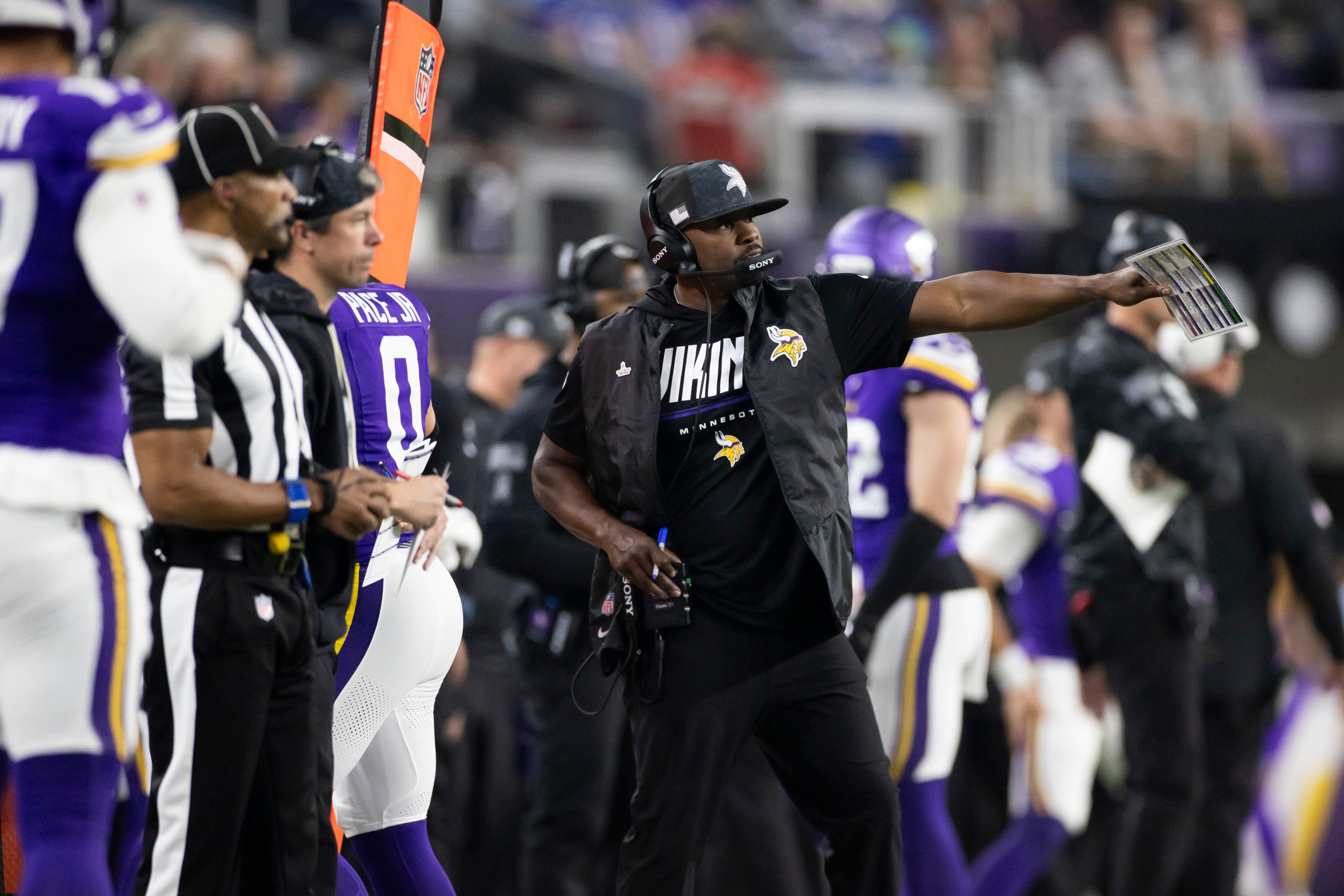
“I think you’ve got to give San Francisco a lot of credit,” Flores said on Tuesday. “They played really well. Look, they’ve had a lot of success for a long period of time for a reason. They’re well coached. They’ve got a lot of great players. They played well. They made a lot more plays than we did.”
Next, San Francisco had brilliant answers in the middle of the field. The way they spaced their route combinations against Flores’ pressures gave QB Brock Purdy a chance to quickly identify in-breaking routes in front of the safeties and get the ball out of his hands lightning quick.
“I think that’s something that our opponents have tried in previous games, this isn’t the first time we’ve seen some of those things,” Flores said. “We just didn’t play them as well. I think they got to those spaces. I would say there’s been other games where teams have gotten to those spaces, but we either batted the ball or got in there…and got to the quarterback. And there was enough disruption to limit the opportunities for them to create plays on those.”
Also, the 49ers used something technically that we have not often seen against the Vikings: Five out. San Francisco routinely sent five weapons out on pass patterns and elected to block their five rushers with the five offensive lineman and not add much in terms of assistance, making it more difficult for the Vikings to cover all the weapons with only six defensive backs. When they did keep in an extra blocker, they didn’t always use the same player over and over. George Kittle blocked eight times, Christian McCaffrey five, Kyle Juszczyk twice etc.
Per SumerSports, the 49ers used extra blockers on 57% of snaps, which was well below Detroit’s 75.9% three weeks ago but similar to Green Bay’s 59% and Buffalo’s 50% in recent weeks. That was actually more than usual for the 49ers, who had used extra blockers under 25% of the time in their previous three games.
Still, several of the 49ers’ biggest plays came with five options for Purdy. SumerSports lists 124 of his yards coming on those plays on 9-for-11 passing (Mac Jones threw the one other pass) and only 33% pressure rate from the Vikings.
Is that a blueprint for opponents to attack the Vikings’ blitz-heavy defense?
“There’s a lot of teams that do that and we’ll likely see more,” Flores said.
Per SumerSports’ data, there aren’t any other teams that do it quite like San Francisco. The 49ers are No. 1 in the NFL in terms of drop-back percentage with no extra blockers. So they were uniquely prepared to play that way against the Vikings. That might not be the case for everyone.
In terms of upcoming opponents, Atlanta is 16th, Carolina 13th and New England 29th. The Falcons have used extra blockers on 60% of plays or more for five straight weeks.
If Atlanta suddenly does become a five-out team, Flores knows what the answer is:
“Pressure, mixed coverages, and win the spaces on the field that we want to win,” Flores said. “I think that’s really what it boils down to in the pass game…win the one-on-ones. If they’re getting five out, then there’s some one-on-ones inside that we have opportunities to win there too.”
The Vikings weren’t given much opportunity to win those one-on-ones because Purdy got rid of the ball so quickly. Michael Penix Jr. has a tendency to do the same. He’s fourth in the NFL in terms of the lowest pressured QBs in the NFL, per PFF. Purdy is third. Penix Jr. is also fourth in the quickest snap-to-release time and 48% of his drop-backs include the ball coming out in less than 2.5 seconds.
Flores knows that they may have to make changes with the ball likely to come out quickly.
“You can call coverages that are tighter, you can drop more people into coverage, bat a couple balls down,” Flores said. “There’s a you know several different ways you can go about it or try to go about it, so we’ll look at all of them and see where what fits because we’re certainly going to see more of that as we as we go.”
The Falcons’ offense may not be anywhere near San Francisco’s in terms of production — they are 24th, San Fran is second — but they do have several gamebreakers in running back Bijan Robinson (5.1 YPC) and receiver Drake London (50 catches at 16.0 yards per reception).
Atlanta has been in a rut lately, only producing 30 points in the last three games. They are, however, coming off a bye week against a Vikings team that has put a lot of mileage on their bodies in their recent stretch of road games against the Lions, Packers and 49ers and a Monday Night Football game against the Bills.
Flores is hoping to use the loss to the 49ers as inspiration for the team to lock in as they go into a stretch of winnable games.
“We’ll be talking to the players about and talking about as a staff about things that we know have actually come up in other games without consequence, so it’s a great learning opportunity for us as a staff and our players,” Flores said. “I think we’ll grow from it and be better for it.”
ADDITIONAL NOTES
— Per SumerSports, the Vikings rank 20th in success rate on screen passes this season at just 38.1%. Over the last two weeks, they have thrown 11 screens and gained just 32 yards. On Tuesday, offensive coordinator Wes Phillips diagnosed what he thinks are the issues relating to screen game success.