
By Matthew Coller
By now you have probably seen a chart that shows the Minnesota Vikings having the least cap space in the NFL heading into free agency. Well, sometimes charts lie.
Per OverTheCap.com, the Vikings have the third most space that can be created by restructuring contracts, which gives them a possible cap space number of $56 million.
Add that with the option of cutting players like Aaron Jones, Ryan Kelly and Javon Hargrave and… poof, cap space.
That doesn’t mean that the salary cap is fake and they can sign all five of the biggest free agents in football and trade for Maxx Crosby or something insane but it does give them some flexibility to take different paths with their spending this offseason.
Let’s take a look at the ways they could go…
The big-fish approach
Maybe you have also heard that the Vikings have spent a lot of cash over the last couple years in free agency. Per OTC, they are No. 1 in “active cash spending.” So what’s a few million more?
If the Vikings wanted to push all chips into the middle of the table to chase a Super Bowl by building through free agency this offseason, they could try to do so by bringing in one or two major names and filling out the rest of the club’s areas of weakness with bottom-barrel moves and draft picks.
What would that look like?
Example 1: Big-time spending on the backfield
The Vikings, who have struggled to dominate in the run game since Kevin O’Connell arrived, could make an enormous commitment to the ground attack by signing either Breece Hall or Kenneth Walker. The Athletic estimates that both players will land deals for four years in the ballpark of $50-$55 million.
That type of commitment to a running back would be antithetical to the modern way of team building but the Seahawks bucked that trend by spending multiple second-round picks on RBs to create a tough-to-slow duo. The Vikings could do the same with Jordan Mason already in the backfield.
Considering they have an offensive line capable of being effective in run blocking (when healthy) and they hired Frank Smith from Miami presumably to help update their rushing scheme, it could be the type of approach that bumps the Vikings up into the top 5-7 teams in rushing.
With the quarterback position in question, what can help even out the offense more than being able to lean on the run? Walker ranked as PFF’s No. 2 best running back in 2025 and he’s only 25 years old and Hall is even younger.
The downside would be that running backs tend to get hurt often and have a tendency to regress. If the big investment turns into average performance, the Vikings will have wasted a huge amount of money on a position that comes along with red flags.
Example 2: A franchise center
The value of the center position has always been lagging behind other offensive line positions but the recent trend of defenses becoming more and more nasty with stunts and blitzes has increased the need for a brilliant brawler in the middle. That guy for the Vikings could be Baltimore’s Tyler Linderbaum if they are willing to throw the bag at him. The Athletic estimates four years, $71 million for him in free agency but their calculator might be missing a few zeros. It would not be surprising to see him top $20 million per year.
That might sound insane considering the spending on Christian Darrisaw’s new contract, a potential Brian O’Neill extension and the $18M/year they gave Will Fries last year. But is it really insane to invest in an offensive line with the potential to provide top-notch play if they are healthy?
Linderbaum has been an elite run blocker during his career, which could help the Vikings greatly enhance their performance on the ground without a big investment in the backfield and he’s ranked as high as fourth best by PFF in pass protection (though last year his numbers dipped).
It’s worth noting that the Vikings could get out of Fries’ contract after next year and an extension for O’Neill could lower his cap hit in the immediate.
The center position connects again to the Vikings QB spot. In only a brief time, we saw how Ryan Kelly was able to impact the blocking up front and help guide the QB. If the Vikings have uncertainty at that position, there isn’t much better a cheat code than a top-five center.
The drawback is that the Vikings wouldn’t have much other cap space to work with in order to shore up spots like running back, receiver, cornerback, linebacker, defensive tackle etc., even if there was a favorable structure to the deal. They would have to believe that Linderbaum was vastly ahead of any other option at center.
Example 3: A beastly secondary
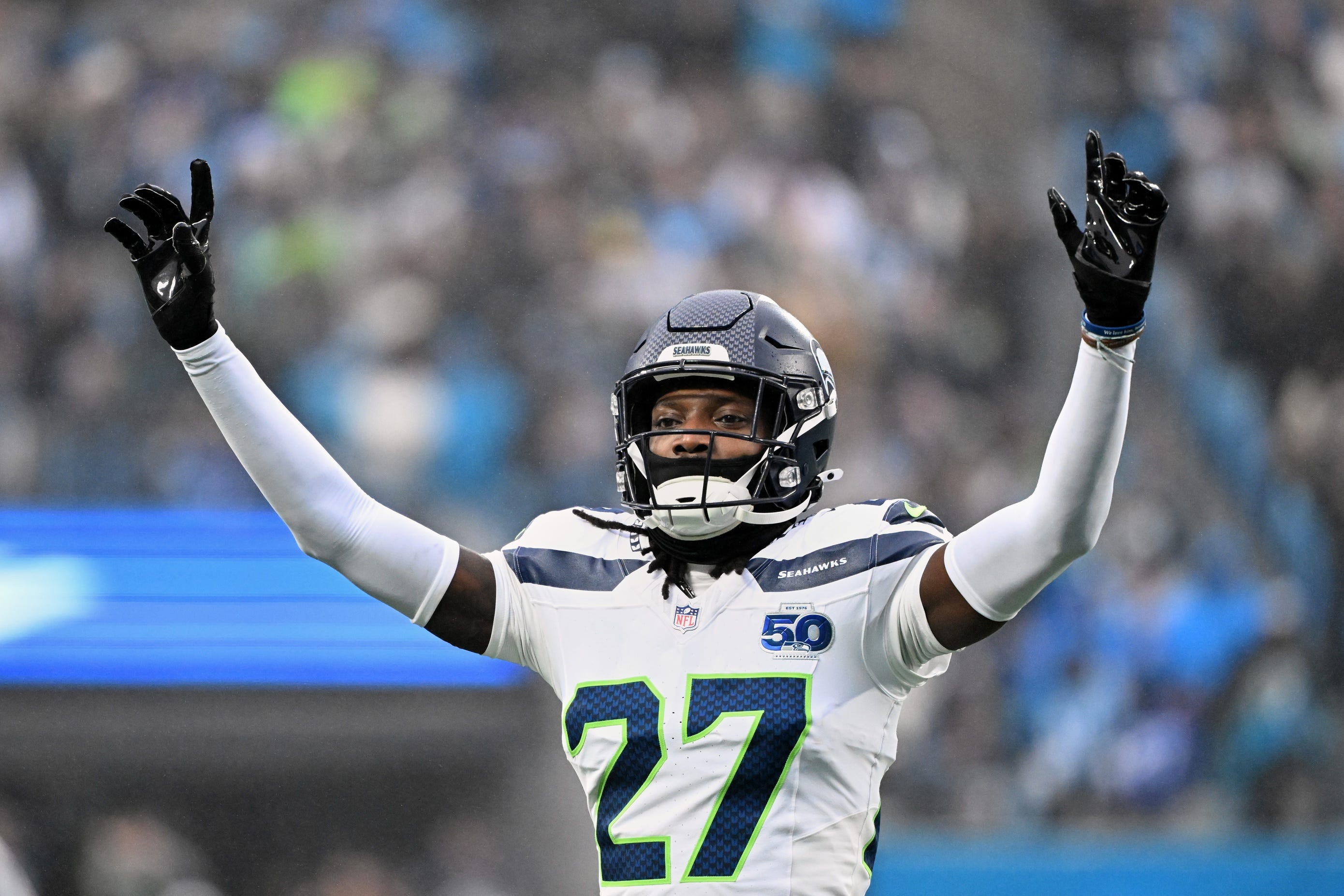
Instead of beefing up the backfield or offensive line, the Vikings could go a big-spender route on one of the top names in the secondary. That could mean a top cornerback like Seattle’s Riq Woolen, who is estimated to make more than $70 million on a four-year deal in free agency, Kansas City’s Jaylen Watson (four years, $73 million) or Tampa Bay’s solid veteran Jamel Dean (estimated three years, $54 million).
With Byron Murphy Jr. and Isaiah Rodgers in place as starters, why spend more at cornerback?
Well, if Harrison Smith elects to retire, the Vikings could end up playing much more in the nickel personnel grouping. They could move Josh Metellus to a traditional(ish) safety role along with either a draft pick or a more cost-effective free agent alongside him and have Murphy Jr. play the nickel corner spot. Murphy Jr. has played as a slot corner often in his career and it might fit him just as well or better than on the outside. Plus Rodgers is only under contract for one more year and they have zero depth behind him and Murphy Jr.
Considering the front seven that the Vikings already have in place, locking in a smothering secondary would be the final step from Brian Flores’ defense going from being very good in 2024 and 2025 to tremendous in 2026. If you are wondering, Seattle allowed opposing QBs a rating of just 77.9 (4th best) on throws into their coverage this season. The Vikings at 86.0 weren’t that far off. Adding Woolen, Watson or Dean could be a game changer.
The question is whether the Vikings would be able to do enough to improve the offensive side of the ball if they went all-in on the secondary. While it might get them over the top in terms of being a nightmare for opposing offenses, we saw last year that even the best defenses can have off days or teams that have their number (like Seattle vs. the Rams). If the Vikings can’t crack the top-10 in scoring in 2026, it isn’t going to be easy to sustain success, as we saw in 2025.