
By Matthew Coller
All the evidence says that it should get better
There are so many football data charts out there these days that rarely does one stop you in your tracks but Ian Hartitz of Rotoworld tweeted a graph that drew an audible gasp. As you can see below, his mapping of Kyler Murray’s EPA per play shows how wildly different his performance has been this year than any other year of his career.
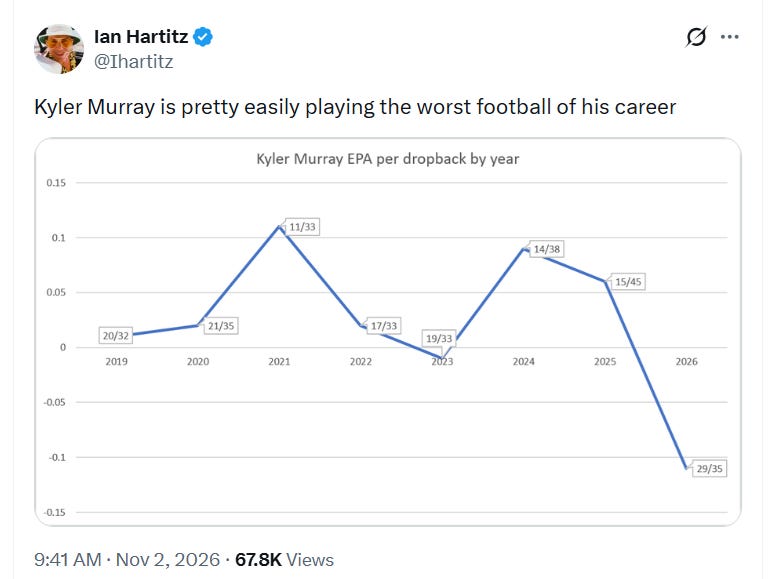
Even in his down seasons, Murray was still a top-20 QB and over the last 22 games prior to this year he was hovering in the 14th range.
However, that doesn’t mean that Murray always plays like a top-15 QB. In 2024, the Cardinals went 1-5 between November 24 and December 28th and he had a 79.5 passer rating and threw five touchdowns and eight interceptions.
In the six games before that, he was 5-1 with a 98.3 passer rating.
If you put it all together, you end up with average quarterback play but that’s not representative of consistency.
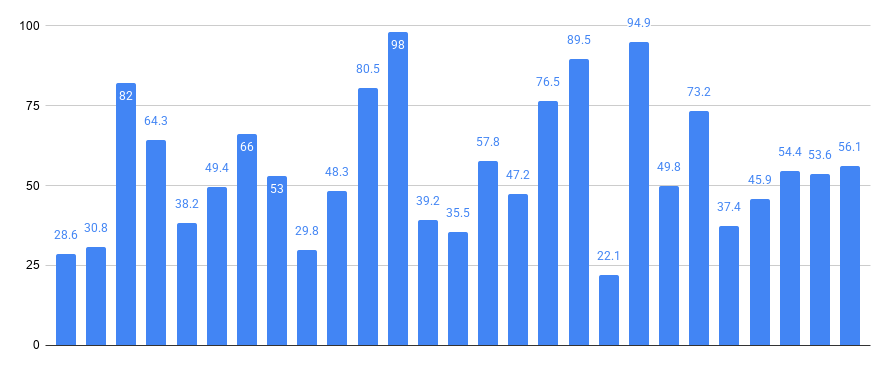
The idea was that O’Connell’s offense and the supporting cast were supposed to even out the ups and downs. That has clearly not been the case since Murray’s performances this year by QBR have ranged from average to very good (Saints game) to terrible (the last two games).
I keep coming back to short passing and improved running as the solution.
In 2024, Murray threw 46% of his passes between 0-9 yards and had the ninth best completion percentage and 12th best PFF grade with a 96.0 passer rating.
This year, 0-9 yard passes only make up 37% of his throws (32nd) and he has the No. 1 completion percentage, seventh best PFF grade and a 101.8 passer rating.
The other thing that keeps popping up is Murray on third-and-long. Since the start of 2024, Murray has a 60.7 passer rating on third down with more than seven yards to go and a 96.1 passer rating on third down with six or fewer yards to go (not to mention 14 first downs rushing on 17 attempts).
That stems back to the run game. Setting up manageable third downs is the key to the offense along with getting Murray play-action opportunities, where he is averaging 8.8 yards per attempt this year (7th best).
The presence of answers doesn’t fundamentally change Murray’s issues or the questions about his fit with what O’Connell needs from him. There are throws and opportunities that are not being taken by the QB but the numbers suggest it’s possible to mold more to his strengths if they can create the right situations.
Respectfully, it’s hard to believe that Carson Wentz is 10-game solution
Over his time in Minnesota, Wentz has been a great backup QB. He’s 3-3 as a starter with 9 TD to 5 INT and a 89.7 passer rating. He’s also thrown the ball effectively to Justin Jefferson, unlike JJ McCarthy or Kyler Murray.
The downside is that he’s been sacked 25 times. His adjusted net yards per attempt as a Viking is 5.5. Murray’s is 5.2 and Murray adds a great deal more with his legs than Wentz. And while Wentz is the last fella in purple to be able to clear 300 yards, his two 300+ yard performances came in losses where the Vikings were playing from behind against Pittsburgh and Philadelphia and he had key INTs in both games.
It would be understandable if the Vikings made a change due to the recent struggles but the problem comes with trying to get Wentz through 10 games healthy and with any degree of consistency. He hasn’t been a starting QB since the beginning of 2022 and he ended up requiring shoulder surgery last year after getting hurt in a win vs. Cleveland.
While Wentz is a great No. 2 option in comparison to most NFL backups, he hasn’t had a recent full season where he was an above average QB like Murray. It makes more sense to keep pushing and hoping that Murray finds a hot stretch rather than going to Wentz and hoping that he can survive the rest of the season and avoid key picks and sacks.
It’s also hard to believe there’s a QB trade out there
The ideas that have been pitched for the Vikings to acquire another quarterback are: Kirk Cousins and Daniel Jones.
The Raiders should have zero interest in trading Cousins considering that they have been such a struggling franchise for years. At 4-4, they have a chance to hang around in the playoff race and they shouldn’t be in any rush to play rookie Fernando Mendoza.
It’s also worth saying that the Vikings went down that road a time or five.
In terms of Jones, he’s been arguably the worst quarterback in the entire NFL this season. PFF ranks him 35th out of 36 in overall grade and he has the second worst Turnover-Worthy Play rate in the NFL. Jones has also been sacked 22 times and has rushed for just 75 yards in his return from an Achilles injury.
Murray has been vastly better than Jones. At very least he has the fourth best Turnover-Worthy Play rate.
It’s possible that Joe Flacco could give the Vikings an immediate boost because he had a couple crazy performances last year but he finished the 2025 season averaging 6.0 yards per attempt and has the 31st ranked QB by PFF.
There are no other options.
Is the run game revamp a fit for the players? Or is it a player away?
All offseason we heard about how the Vikings’ new run scheme and changes to the coaching staff were going to change everything on the ground. That has been far from the case to this point.
The Vikings are 17th in rushing yards and 22nd in yards per attempt — and that’s with Murray’s scrambling baked in.
Jordan Mason, who averaged 4.8 YPA last year with a banged-up O-line, is only picking up 3.9 YPA thus far and has a 39.5% Success Rate (56.0% last year).
Aaron Jones’ stats are virtually the same with 4.2 YPA and 49.1% Success Rate (50.0% last year).
In 2025, PFF graded the Vikings’ run blocking as the 13th best in the NFL. This year they are 26th.
That makes you wonder whether Jonathan Taylor is a one-man fix.
As great as Taylor has been during his career, the Colts were the fourth best graded run blocking team last year and they are currently ninth.
Maybe it’s the overall vibe of the Colts that has been problematic but it should be at least a tad concerning that Taylor is the 39th graded RB by PFF out of 57. He’s only 27th in yards after contact. However, his success rate is significantly better than the Vikings’ RBs at 54.1%.
Trading for Taylor overall could have a huge trickle-down impact on the Vikings offense but the scheme and blocking are concerning toward how much he could overhaul the run game by himself.
Strength of schedule